
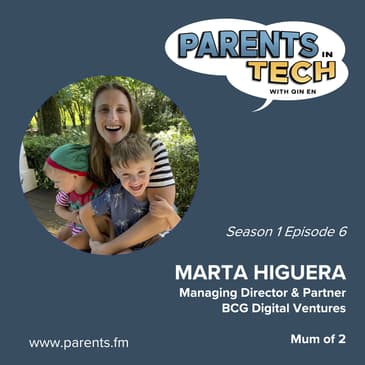
Adapting to situations, staying energized throughout the day, and building trust to deal with challenges. Marta shares with us her adventure of being a full-time working mum with two young children.
Marta Higuera is Managing Director and Partner at BCG Digital Ventures, the corporate innovation and venture building arm of BCG, dedicated to launching and investing in game-changing businesses. Prior to Digital Ventures, she co-founded real estate tech startup OpenAgent, one of Australia’s successful tech companies and recognized as Deloitte’s Tech Fast 50 ANZ and APAC.
An innate pathfinder, Marta reveals how staying flexible and having the right support system helps navigate life’s challenges - such as starting a company while on a sailing expedition in the Mediterranean sea, fundraising while pregnant and during delivery, and relocating to Singapore on 24-hour notice.
Don’t forget to head over to www.parents.fm to stay up to date with new and previous episodes, join our community of parents in tech or drop me a line. I’d love to hear from you!
Thanks for listening to the Parents in Tech podcast with me, your host, Qin En. We hope you were inspired on how to raise kids and build companies. To catch up on earlier episodes or stay updated with upcoming ones, head over to www.Parents.FM to join our community of parents in tech. There, you can also drop me a question, idea, feedback or suggestion. See you next time!
Transcript
00:06
Qin En
Hi, I am Qin En. And this is the Parents in Tech podcast. Welcome to Season One, where we interview mums who are technology company leaders here in Southeast Asia. We want to hear stories, hopes, challenges, and tips from mums who are raising kids while pursuing their career aspirations. In this episode, we speak to Marta, Managing Director and Partner at BCG Digital Ventures. In my short stint as a venture builder, I had the privilege of working under Marta's leadership. Her energy is highly infectious as she always brings positivity and inspiration to the teams. Prior to BCG DV, Marta co-founded and led OpenAgent, a real estate tech company that became one of the most successful start-ups in Australia. She started a company while on a sailing expedition in the Mediterranean Sea. She now is a mother to two sons. One is four years old and the other is 15 months. Hi, Marta. Welcome to the Parents in Tech show. To begin with, can you tell us a bit more about your family?
01:17
Marta
I'm a full-time working mom and my husband - not planned, but I guess, one of those serendipities of life, he's a stay-at-home dad and we have a four-and-a-half-year-old, Sebastian. And we have a 15-month-old Kai who was born here in Singapore.
01:38
Qin En
That's beautiful. To Sebastian, four and a half, this is where he's starting to learn and expand his vocabulary. How do you explain your job to Sebastian?
01:48
Marta
I actually don't. It’s like he knows that I go to work. Because now we work from home, and he very frequently, most frequently that everybody can manage, pops into my office. And he wants to talk to my friends, which is the people on Zoom, to say hi and so on. But I don't think I have actually made any efforts to explain my work to him. I guess we talk about work, his school being his work, and we sometimes ask him to do the work. But we have a very broad definition of work at home, I guess. I just realized. It's a blind spot. Thank you for pointing out to it. I’ll do that over the weekend.
02:34
Qin En
Okay. Yes, to explain what your job is. Let's treat this as rehearsal. If you had to explain your job to him, how would you describe your job?
Marta
Oh my God.
Qin En
We can practice now.
02:48
Marta
Yes. I got to tell you an analogy. It's a story. Hopefully this gives an idea. But in the past, I was a management consultant and I was trying to explain to my grandma what management consultants do. This is the kind of the analogy. And I came with a brilliant story. I told my mom and my grandma that I was a doctor. I was a doctor for companies that were sick and I was helping them. I’m hoping I can come with an analogy like that. Nowadays, I guess I could tell my four-year-old, what I do is I like to set up… This is so hard.
Qin En
No pressure.
Marta
Yeah, I'm feeling all the pressure. I help create new things from scratch and getting groups of really cool people that bring different things, working together to create something new. I think that will relate with the type of things that he does at school. He goes to a very creative school where kids like to build things on their own. I think that's where I would go. Around bringing diverse, talented teams of people to build something new from scratch.
04:11
Qin En
That’s awesome. It's amazing. I was very fortunate to be part of some of the teams that you built in my short time at Digital Ventures. So, really good to be connected and hear you say that. You mentioned, Marta, about bringing him to a school that focuses on building things. Tell me more about that. What was the journey like towards finding the school? Was that intentional? We'd love to hear more.
04:34
Marta
Interesting. We moved to Singapore two weeks before circuit breaker. By then, my son had attended a couple of local Montessori schools in Australia. But it very loosely defined Montessori. I don't think it's like the Montessori at Singapore. It was largely an instructor, open play with a lot of outdoor spaces. And it was very child led. The children decided what to do. We were very much focusing on play base, open curriculum. Also, I guess, reacting to my son's personality, we knew he's very self-led. He doesn’t like to be told what to do. He is incredibly creative. And we were kind of trying to go with it. To me, the priority was for him to enjoy a school in the early years, to foster creativity and curiosity and to develop a sense of self-advocacy. I guess he's now four and a half, so we are getting close to school age. But I'm still very relaxed about learning numbers and letters and so on. Then we arrived to Singapore and he was home for a really long time. We were waiting for him to go back and he was very keen to see other children. We would go on the street after circuit breaker and he would see other children. He would say, “Friends!” He was very desperate for social interaction that any other kid he would see, he thought it was actually a friend, not another child. We put him in a school that we thought had a great outdoor play area and was very kind of open-ended and so on. And I guess, we were confronted by cultural differences. And prior to this, he had been in three different schools because we moved around in Australia and he always loved it. He started to come back from the school sad. I was getting the updates from school. Lovely people at the school. The school was very well intentioned, but there was a lot of focus on teaching the children letters and numbers.
06:39
Marta
Like, it was teacher led. Maybe only for an hour or two a day, they were maybe only made to sit in a chair for that time, but it obviously was influencing him a lot. So, we decided to move into school and went to another one that is Reggio Emilia. I guess all those are buzz words for me. It is truly child led. It has a beautiful outdoor environment, which I think was very important. He's quite the nature boy. It's very inquisitive and there's no curriculum. The children come up almost with the curriculum as they go. So, we are very happy. It’s a really good fit for him. I think the main thing is like, what is right for that child? There are a lot of other children I see from France who enjoy the structure, and they may fit somewhere else, right? I think we found a good one for us and for our child. My other son, Kai, at the moment, is reaching the age where we decided Sebastian should go to school, but we don't think he's quite ready. I guess we may go to a completely different school for him. We are just waiting to see who he is and what he thrives on.
07:55
Qin En
That's so beautiful. It's about seeing each child as different and almost like standing behind him or her, support where their interests go and not forcing them to be in a place. I totally agree. Childhood, especially at this age, they will learn the letters and alphabets at some point. It's just a matter of, can they start to learn and enjoy that learning? I love to hear about the outdoors bit. When I was starting to look around for preschools, that's also my number one priority. Can they bring the children out of the air con environment and actually get sweat and get dirty? I think it just teaches them so many more things outside that. So, really great to hear that. Marta, I have a very interesting question next. On a scale of 1 to 10, how tired are you now?
08:40
Qin En
Oh my God. I'm like 7 ½ to 8.
08:43
Qin En
Oh, wow. Okay. That's pretty tired.
08:47
Marta
Okay. There's a thing going on. I'm being very honest with you. I got a 15-month-old home, but over the last week or two, I think he's going through one of those separation anxiety phases. This is what you learn as a parent. It’s all a phase. After sleeping for nights, he's been starting to wake up two or three times at night, really anxious, obviously needing our company for a number of nights. So, we're in the depths of it. If you had asked me four weeks ago, I think it could have been a very different answer. But you just have to roll with it. You got me at the bottom of this. It's been like five or six nights now.
09:34
Qin En
Yeah. And it's so unpredictable. I also remember my daughter, consecutively for few nights, she started to sleep through. I was like, yes, it's finally here. And then after a while, it's like, oh nope. And the separation anxiety is so real. I'm sure as you would be walking into a different room, and they’ll start to cry. The reason why I asked you that question, Marta, is because of course, I noticed when we were working together, you were wearing the Oura Ring. So, tell us a bit more about that. Are you a biohacker?
10:08
Marta
Oh, a tiny bit. I don't think I'm very hardcore, but I got into this out of necessity. I have a chronic condition that is related to lack of sleep. In fact, it flared up for the first time and I did n number of research and I could like totally track it back to one of my rounds of financing, all this stress, lack of sleep and really hard work a few months prior. And it's very well-established. I guess at some point, and especially having kids and all the challenges that it presents to sleep, I decided to get a little bit serious about it. It's interesting how much we count calories and things like that and how little we consider sleep. Nature has decided that we spend one third of our lives doing this. So, in the hierarchical things, we put it as a much more distant priority than food and exercise. But in terms of time and location, it's pretty high up there. And I guess our society has figured out how to get food from supermarket. So, we don't have to go there. But I'm not sure how you are going to hack sleep per se. One of the things that I did two or three years ago, I think it's coming up to three, was getting a device, an Oura ring, that measures sleep amongst many other things. I'm someone who gets motivated by numbers and is very logical. And having those numbers and actually managing it by numbers has been very helpful. I've learned a lot of really boring things along the way. Sadly, I guess, one of the fundamentals of good sleep are not conducive to partying till late night, drinking a lot and things like that. It actually affects most of us or 99% of us, not just like two thirds. But I learned those things and I try to stay good with it. It's a journey. It's been going strong for a number of years. And I just got the new ring. So, now I’m hacking things. I do a number of other stuff in there, but I think sleep is my main focus.
12:27
Qin En
So true. It takes a one third of our time. Yet we hardly even give that attention. And yeah, heads up to the new ring. It sounds like there's a lot more temperature sensors and all of that. So, that would be exciting. But I'm curious what's there one behavior change that happened as a result of you looking at all those numbers, how you sleep and how you rested?
12:47
Marta
A lot of them. And it's an ongoing journey, which is what is beautiful about it. I learned that the quality and not just the amount of my sleep, gets much better the earlier I go to bed. We artificially put lights in our lives. We don't go to bed at sunset, which is what we are meant to do. Trying to change evolution of a few hundred thousand years in a couple of centuries doesn't quite work with our physiology. Going early to bed is one. Drinking right before sleep. We have this wrong perception that it knocks us to sleep. It may knock you. But it doesn't knock you to sleep. It knocks you out there in unconscious state that doesn't give your body the chance to recover. I'm not a heavy drinker, but I guess I enjoy one glass before night. And I felt, one glass, right? I swear to you, I noticed when I have a glass, the metrics are astounding. I guess the difference between zero and a little bit was so large that I think it’s a lot harder now when I crossed that threshold. Then when I cross that threshold, then it’s going to be tough. I guess the habit, which I think a lot of parents have, you get to the end of the day and you just had that glass of wine to unwind. I guess that's not such a great idea. But like many more, those two are pretty universal. I'm sorry to come up with bad news on the boring side for a lot of people.
14:28
Qin En
It's certainly like a bummer. It's really hilarious. It's almost like once you're good to drink, you just drink your share, right? Your sleep is going to get affected and might as well have a really good night. And therefore, the rest of the nights.
14:42
Marta
And that's not true. But I think what really surprises me is that even really small quantities had a really large effect. I thought I was out of that because I drank in a lot of moderation, but actually zero is the way. No way.
15:02
Qin En
Yeah. That can be tough. Well, Marta, you're also on this topic of rest and recovery. You juggle so many things. You have such a successful career from an entrepreneur to a tech company leader and of course, having two kids back at home. Tell us about the conversation you have had with your husband in terms of when do you want kids. How was the conversation like? Because I remember at that point you were still leading OpenAgent back in Australia. So, tell us the journey on the timeline.
15:32
Marta
Yeah, really interesting. I think it is an ongoing forever conversation. I think that's one truth about parenting. We are all different, but it's constantly changing and you have to figure it out and adapt as you go. Not very similar to start-up life. You cannot figure it out as you go. Somehow, we are well-trained on that aspect. I don't think in my relationship, I guess, we planned for the logistics of parenting really much in advance. My own mom was a factory worker and I was largely raised by a nanny that was not a stay-at-home, but a nanny that came and worked full time days. So, I guess I was really open to having or not having a stay-at-home parent. Like my relationship with my parents is great. And I had a full-time nanny and she was great. The more the merrier kind of thing. But when it came to us, my start-up was so consuming and demanding. I had to do a fundraising right after I had my first child. It was the largest fundraise at the time in Australia. Now they have much bigger races. It was little bit like a Mission Impossible - Let's try and make this happen. My husband, I guess over the years, had been changing careers and he was in a position where he was not in love with what he was doing. To the point that to him, it was hard to leave our child with someone else, for him to go to a job that he was not in love with. We kind of made the decision, which was not a long-term decision, just for the next little bit that he would quit this job, stay at home and be the main carer.
17:24
Marta
The reality is that it's been the case since and it's not uncomplicated. I think life is hard where you're a working parent and life is hard when you are a non-working parent, regardless of the support that you have. From then onwards, it's all a conversation. Like we moved to Singapore on 24 hours’ notice. That was an interesting conversation. We arrived here and we discussed schools. We didn't have a helper back in Australia. And we were awaiting that a lot here. We decided that we have family and friends with lockdowns. So, we actually got a helper. We changed the family dynamic massively. It’s a great blessing, but it's also, I guess, for people who are not culturally used to it, a big imposition as well. Like, I'm very thankful for my helper.
18:15
Marta
So, it’s all a conversation. Right now, we are deciding in Christmas to go back to Australia with two little kids so that my parents in law see the kids again and meet my 15-month-old for the first time. That's also a conversation. There's work demands. There's like, how do we deal with the jet lag? Like, I don't know. It's all on going. And it's not premeditated or planned as much, I think. You come build a conversation in the relationship and you come build that adaptability. I think that those are the assets to have.
18:52
Qin En
Yeah. Wow. There's so much to unpack there, but first I got to grab on this one. Moving to Singapore on 24 hours’ notice. At that point, have you had your second son already?
19:02
Marta
No. I was 20 weeks pregnant and we were in Australia. I started the job. I find it weird to call things, jobs. They’re so much more than jobs, I guess. I started my role at Digital Ventures six weeks before that. I guess the pandemic happened to all of us. We were sitting in Sydney with a job situation, a family situation, a pandemic situation. There was a need from the business for people to come up to Singapore to do work that needed resourcing. And well, the pandemic has happened to all of us and out of the four places, Singapore is as safe as any place could be. This is a true entrepreneur’s mindset. This is risk management. My risk management is like, I don't know where commercial planes are going to exist in a few months. So, we managed to keep that going to some level.
20:06
Marta
But I guess my condition was that my husband and my child at the time had to come with me and the rest we can figure it out as we go. It was kind of the important things there. And they’re not the important things somewhere else. It turns out as I did that, I broke a number of health insurances and I asked really high risk of someone's agenda at some point. But I think that was also calculated. I was 20 weeks pregnant. It was my second pregnancy. I'm like, okay, there will be disruptions. At this point in time, I think I would have reacted differently at a different point with a new war, for example, or something like that. But yeah. Then we went through three different hospitals and planning. It all changed things. Four different doctors and stuff like that. As we move around Singapore and found our place and we spend most of the circuit breaker in the hotel. They were all small things where the big picture for us, I guess, was that we're all together. And we trust Singapore as a place where you can do a good job in the conditions where you are. So, that’s it.
21:21
Qin En
Well, I'm just simply amazed. It seems like you manage that so well. I mean, moving to a country, it's already a challenge, doing that on a short timeframe, plus doing that in your second trimester. So, you got to tell us. I'm sure you felt stressed and challenged. How did you deal with that?
21:41
Marta
I think we've all been challenged and stressed. The common way to let this slide, is that there are different spectrums. I thought I was not in the worst cases out there. I was in a good position in a lot of parameters. I had that perspective. To have compassion for other people who are going from much harder life and death situations that I had. At the same time, I think you have to have compassion for whatever your own situation is. You don't want to trivialize. You want to acknowledge whatever your challenges are, they are real. I think one beautiful thing that happened as the result of the pandemic is that we reach out a lot of us for each other. I reconnected with a lot of people that I haven't reconnected with.
22:29
Marta
I like to be very honest and authentic in my interactions with people. I think everyone was being honest and authentic over the phone. Because that's the measure that we have to talk to each other on phone. You could go past the latest COVID statistics in the first five minutes of the conversation and yes, really talk your problems out and ask for help. I think that's something really good that came out of it. Talking may not help solve the problem, but it can massively help solve the anxiety, the weight and the burden. In ways that like, I know this and it still surprises me how much talking about the fact that, whatever was going on at the time, whether we had been living in a hotel for three months with a toddler through circuit breaker and talk to another human being and say it aloud. It’s like, yeah, actually. That doesn't sound great. It diffused a lot of it. And once it diffuses that, then you can think more clearly. You have to trust that you will be able to come up with solutions as you go. This is like bringing me back to start that life. It’s like there's a big problem and I don't know what the solution is, but I know we have it in us to solve this. So, let’s talk about it and start doing little things that get us along the way and closer to the bigger, scary goal.
24:01
Qin En
Yeah. I think the whole part about just being able to talk it out, share your feelings, finding that trusted circle, whether it's your family or close friends, it's so valuable, right? Like you said, sometimes it's not about solving the problem, but it's about acknowledging it, being kind to yourself, giving that space. I personally think that's golden advice. It's certainly helpful. Marta, you also mentioned that you started your journey with BCG Digital Ventures when you were six weeks pregnant. I mean, I think there's some other moms out there. And that sounds crazy. Because it's almost like you're going to join an organization, especially in a leadership role. And then you're going to say, okay, I'm going to take three four months off. There are a lot of concerns on multiple levels. Oh, what will my bosses think? How will I handle it? Will that disrupt? Tell us what was the thought process as you started it.
24:48
Marta
Great conversation. On all those things, I guess, you use the word ‘advice’. And I'm like, I'm not disposing advice to anyone. We are all different and we all have different circumstances and this is my circumstance, my context and my behavior related to that. It’s my second child and I'm going through a number of management and leadership positions. I interviewed for over a year for this role. There are normally not a lot of leadership positions. At some point it was not that I was pregnant. I was considering getting pregnant. I decided to bring that up as part of the conversation before I sign any paper. For me, it was a very deliberate two-way choice, which is, it’s not just about whether they want me in these circumstances, whether they are going to create an environment where I can be successful in this environment.
25:48
Marta
And that was important to me. I think that's something where we probably are more vulnerable and have a lot more choice than we sometimes think we do. I think exercising choice is really important. I actually didn't want to end up in a place where me being pregnant would have been a problem or me having another child would have been a problem. Like I would have to stop my career. So, I wasn't doing my due diligence at the same time. I had a very honest conversation saying, I don’t know, I was what they call geriatric mom in Singapore. But I was 41 or something like that at the time and I'm like, well, I'm going to try to have a child. It may not happen. But if it's going to happen, it's going to happen really soon after I joined. It's kind of sooner or never really by the nature of what I am.
26:42
Marta
And I need you to be okay with that. Because by the time that we finish all this process, it’s going to be there. So, I had that conversation up front and we have some parameters about it. I talked about what were my intentions. And I knew that I would take a four-month leave, but I would go back full-time to work. He was the second child. So, it’s easier to know what you are going to do or not. But it was part of the conversation for me. I'm not saying this is the right answer for everyone. Everyone has the right and this should not be part of the conversation in a mandated way, actually. Like no one's asked you about those kinds of things in the context of a job. For me, it actually made sense for it to be part of the conversation because I wanted to make sure that the place where I was going, was going to support me as a whole individual, not just as a leader. But also, as a mother of two kids.
27:39
Qin En
Yeah. It's all about the candor, the transparency. You did right from the onset. Even when you successfully conceived, it was no surprise to everyone and almost everyone is aware about it. And I really liked that. Especially the point where you mentioned that ultimately it should be a personal choice. No employer should be talking or asking or questioning, but it's more like if you want to set yourself up as a mom, as someone who also wants to balance a career ambition, something to definitely keep in mind. Yeah.
28:09
Marta
Yeah. Well, I was doing a reverse interview in a way. In the sense that if they don't answer the right questions, maybe I don't want to go on and work there. Maybe not right now but I can consider it later.
28:20
Qin En
Yeah. I'm glad it all worked out. So, let's fast forward. After you had your second kid, how what's that like returning back to work? What was the experience like? Of course, it's your second kid, you probably had some experience with the first. But I'm sure things were a little different when you are an entrepreneur, when you are the boss, versus when I guess, I wouldn't say an employee per se. You're like a partner. So of course, there's different setup. I would love to hear in terms of the challenges in terms of returning back to work and also how you dealt with it.
28:55
Marta
Great question. Again, it's a very individual answer and personal answer. But this is going to be different for each person. Like you are going to think something and it's going to be something different. It's going to be personal. It’s going to be subject to change. It’s on you. You just manage as long as you go. I thought I knew what I wanted and how I wanted, because he was my second. At least I gave myself some doubt. That was good because they were changes on the plan, of course. There were a couple of things that worked really well for me. One which came in the picture really late. I was not aware of this, which is why I thought I’ll mention here. I was talking to other women in my workplace about my situation. And one of them mentioned they had a maternity leave coach. I didn't know this existed.
29:50
Marta
I contacted this woman, I don't know, two or three weeks before I was due to go on leave. She's like, “Okay, we usually start these like three months before, but let's do the crash course.” And it was invaluable. Each of us are individually trying to figure this out from scratch. How do you leave an important leadership position for a number of months? How do you set yourself up for success? How do you have the conversations? How do you establish boundaries? The woman that was advising me has advised dozens of us. She consults to organizations on how to do this successfully and she was a life coach. She had the capacity to take that knowledge, but also help you decide around who you were, what you wanted, your position and so on.
30:41
Marta
So, look for that. I'm happy to give recommendations. I'm sure there's more out there. But I wish I had learned about it earlier. You have a few sessions before and you have a few sessions afterwards. We’re all reinventing the wheel here. Like there should be some systemic change, which is why they like to do this with organizations, not individuals so, we create a system change around it. So, that was really useful for me. The other thing on the other side is, I took two weeks with my first child. I thought four months maternity leave was going to totally look serious. Retrospective, I think the two weeks were as long as the four months. I remember at some point like two and a half months into it, I felt like, wow, this is going to be hard.
31:34
Marta
Although I know I want to do this. I was very convincing about what I wanted to do, but it felt incredibly hard. It felt incredibly hard one week. The next week I decided I'm just going to do this next week. In my case, it was like ripping the band aid approach. I just did it and it was like going back into the bike. I actually planned to come back slowly part-time and so on. So, I actually came back after three months and I saved like a month of days to be able to do this in my own time. And it didn't quite work for me. So, I discourage people to do that. Depending on which position you are, it may be an all or nothing approach, or it may be a transition approach. For me, it was very much all or nothing. But it worked itself out. And I guess I know why am I doing what I'm doing. There are no regrets about it, but it was unexpected. It was unexpected for it to feel so hard despite the fact that I had so much more time the second time.
32:42
Qin En
What part was really hard about it the second time?
32:47
Marta
Emotionally, I think you spend all that time with your child. Like the logistics sounded unsurmountable. There was just a psychological barrier in there and many other things that look as scary or sound as scary just around taking the first step. Like I told you, I was just getting back on the bike. A week later, I was the working mom that I knew I could be. And a happy one. Not the miserable one because of it.
33:19
Qin En
Yes, definitely. Well, you've mentioned something that was super fascinating. It's literally the first time in my life, I heard about it. Maternity leave coach. Like I said, the idea just sounds genius. Like, why don't we do that? Tell me a bit. What was the one or two things that were like the ‘aha’ moment that you were like, oh, this is so valuable and looking back, you might have just missed it yourself?
33:41
Marta
Yeah. There is a lot of tactical advice which adds up to everything. A lot of it is around communication, establishing boundaries and understanding who are your stakeholders and how you set yourself up for success. It is around being very clear about what's going to happen, create a clear plan for where you're going, and from where you're coming back. I guess maybe being an entrepreneur, I wanted to play it all by ear. And I don't think she discouraged me. It's like give certainty to your stakeholders, to the stand that you have. Be clear about what's your flexibility, what you're going to do or not, and be proactive in setting all those mechanisms for you leaving and for you returning. And do it on your terms. I think that was basically it. And I’d say encourage.
34:32
Qin En
Wow. Okay. Let's definitely get a contact to share with the audience for this show. It definitely sounds like an asset that they could use. Marta, you're someone who is a super play but yet an entrepreneur, adventurous. As I was preparing for this show, I actually took a peek at your LinkedIn. And in 2012, you went Mediterranean sailing. This was just before you started your company. You got to tell us about that.
34:55
Marta
Yes. Me and my husband decided to take a sabbatical. And it was not a holiday. It was an adventure. Holidays are related to relaxation. What we did was not the most relaxing thing you can do. We bought a boat in Greece. We haven't seen it before. We found this thing online, we put it on the water and sail from one end to the other of the Mediterranean. When you own thing, that means there’s a lot of boat maintenance. Everything breaks up at sea like three times over. But it was a really good experience for us. I think it happened the other way around. It was because four months into this adventure, we got to a point on the trip where we were stuck. Geographically, we had to hold on. I blame that as the birth of my start-up. I think we got bored.
36:04
Marta
I talk with a friend, which is now my co-founder about this business idea of hers. She had come up with business ideas before. I was the idea killer, and I didn't kill this one. We will never know whether it was because it was the best idea to ever come with or whether it was because of boredom. We have the joke of blaming that we were just stuck on the boat and she was training for an Ironman in the winter of Australia in her bike, in her garage for literally five hours a day while it was raining outside. So, yeah. We will never know whether if it was boredom or if it was a great idea. On the fourth month of that six-month adventure, OpenAgent started to happen. Yeah, the sabbatical turned more into sailing office than a sabbatical.
37:03
Qin En
That's beautiful. Literally you and your co-founder co-founded OpenAgent, one of the most successful companies in Australia, while you were on a boat halfway across the world. And your co-founder was on a bike in a garage for pretty much many hours a day. There can’t be a better founding story to that and I really love that. There's just so many things to sailing, to what's maintaining a boat. How did you deal with it? Did you guys have any hired help on the boat to support? Or was it like we're figuring it out as we go along?
37:36
Marta
No. We didn’t. But I think we were a good team. My husband grew up sailing, so he has a nose for it. He has the incense. He sees the wind on the waves, sunlight, the clouds, some stuff like that. I don't see any of that, but I have been on boats before and I am a nerd. So, the typical picture of us is me looking at the instruments under the boat while I say, “Oh, there's these coming.” He's like, “No s**t, look at it. I can’t see the wind.” It's like, “Oh, you see 15 miles. Are you blind? Yes. Here.” But that worked pretty well, I guess. We team up and it’s around problem solving as you go. I could be the one opening up the boat, doing the research about how to do this and we'll tinker with it.
38:24
Marta
It was a great experience in that sense. It also sets you up well for marriage. You can live in a 10-meter-long boat, it means that you're going to be most of the time one meter apart across those four months. Then you know can go through a lock down. It's like a version of a lock down together.
38:46
Qin En
I'm sure internet and all that was spotty at best.
38:50
Marta
Yes. Which was not great when you had to solve a problem that you have no idea about. So, yeah. There were a few lifesaver boat mechanic books on the boat.
39:04
Qin En
Wow. That's such a crazy story. Would you consider going on such an adventure? Well, maybe not such an extended one, but like a similar one with your family? What would that look like?
39:14
Marta
Yes, we certainly are going to sail again probably. Not before the kids are older, but just to make you laugh a little bit farther, about six years ago, my co-founder and I bought a houseboat in Sydney that we shared, that number of our start up employees had been on for a while. It was a more friendly set up, like a lazier set up that we had. but it became our little house on the water where we couldn't take big breaks or do like big holidays or something like that. It was a way for us to rest and relax. We always ended up talking about the company for the poor husbands to listen to. So, it's all about boats. And I think we'd love to come back sailing, but I don't think we are that excited about doing it with a 15-month-old at the moment.
40:09
Qin En
True. I think the logistics of that would be a little too challenging. So, maybe a little bit later on. Wow. I think it's just so incredible. That sense of energy, it's just so infectious, Marta. I'm curious where do you think you get this source of motivation and energy from? Because I think that's something that just rubs off people. I really love it.
40:32
Marta
Yeah. It's interesting people talk about work life balance. And I think it's less of balance where you are trying to allocate a fixed 100% between one and the other, and it feels like a zero. I recently heard about this other concept, which is more around, you do something that energizes you to be able to do the next thing, which is different. And literally having a good day at the office, working with our super talented teams, I love tech teams. It always inspires me - the people that I work with. I go home and I am very curious about what my four-year-old is doing. You can get into that. One propels you in the other one. In the morning you are also playing with your kids. I'm like, how lucky am I that I can get so much from different things in my day? One gives me the energy to do the next one. I think it talks a lot about purpose and working with great people. I think curiosity is something that drives me a lot. I love getting curious and love to learn. One thing propels me to another. That's my experience. I don't know. It's not very deliberate. It's like learn little by little, figuring out with a lot of mistakes and failures. I don't think we've talked about that, but it's not a smooth ride. I'm not pretending it's smooth along the way at all. It’s pretty much the opposite I’d say.
42:12
Qin En
I think, Marta, it's so clear you take it in straight. Of course, I'm sure as a founder, as a leader, there are just so many fires you've got to put out. Probably you just came from putting out a few and probably a few more years you got to go to. But yeah, I think like you said, it’s like taking everything in stride, remembering what gives you the energy at work. It's the team. And at home, it's really engaging with your husband and for children. I think that's just so wonderful. To kind of sum up the time that we have today, if there's one lesson you learned as a parent in tech, what is it?
42:44
Marta
It’s the notion that the best way between where you are and where you want to be, is just to make a little bit of progress and see what happens. They make little bit of progress and see what happens. That's kind of a very agile, growing, learning, discovery experience. You are plunging into the unknown in both cases, whether it's a start-up or a new family member. Rather than trying to figure it out in isolation or come up with a grand plan, it's good to have some kind of vision, values, principles and some guard rails in place. I guess you do avoid analysis paralysis and you do something. And you establish that feedback loop of ‘What happened when I did that?’ There was something beautiful that some good parent friends have told me. Before I had children, I was like, “How did you figure all this out?" They're like, “Oh, you don't have to. You just do something and you can get it done. You're not going to destroy your children for life. You have a number of days, iterations and so on to mess up things and correct your approach. So, that's a beautiful analogy for me.
44:04
Qin En
It truly is. There are just so many opportunities to learn to grow and to see a little progress at a time. All right. Thank you so much, Marta, for taking time off the show. This was really such a joy to talk to you, and I'm looking forward to hear many more stories and adventures that you and your family embark on.
44:20
Marta
Thank you, Qin En.
44:25
Qin En
Thanks for listening to the Parents in Tech podcast with me, your host Qin En. We hope you were inspired on how to raise kids and build companies. To catch up on earlier episodes or stay updated with upcoming ones, head over to https://www.parents.fm to join our community of parents in tech. There, you can also drop me a question, idea, feedback or suggestion. Once again, the website is https://www.parents.fm. That's all for this episode, folks. See you next time.