
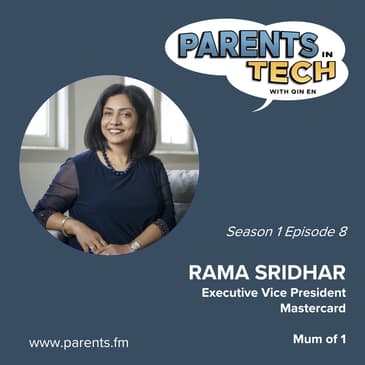
Deciding to take a break in your career, parenting during the uncertain times of adolescence, and maintaining equal parenting responsibilities. Rama tells us how she manages to keep work, family, friends, and personal interests well balanced.
Rama Sridhar is Executive Vice-President, Asia Pacific of Mastercard, where she establishes digital partnerships and develops new payment flows and products. Rama leads a team of ~50 technologists, business and finance professionals to create the future, including crypto-funded cards. Recently, she was recognized as Innovator of the Year in the Women in IT Summit & Award Series.
With over 30 years of financial and technology experience, Rama shares with us the ups and downs of her experience taking a career break. We examine how the relationships with children transform as they grow, and discuss guiding a teenager through the intense emotions of self-exploration. Rama emphasizes honest conversations, alignment in schedules and shared values as key pillars to harmony and equality in the family.
To get in touch with Rama, find her on LinkedIn https://www.linkedin.com/in/ramasridhar2018/
Don’t forget to head over to www.parents.fm to stay up to date with new and previous episodes, join our community of parents in tech or drop me a line. I’d love to hear from you!
Thanks for listening to the Parents in Tech podcast with me, your host, Qin En. We hope you were inspired on how to raise kids and build companies. To catch up on earlier episodes or stay updated with upcoming ones, head over to www.Parents.FM to join our community of parents in tech. There, you can also drop me a question, idea, feedback or suggestion. See you next time!
Transcript
00:06
Qin En
Hi, I am Qin En. And this is the Parents in Tech podcast. Welcome to Season One, where we interview mums who are technology company leaders based in Southeast Asia. We want to hear stories, hopes, challenges, and tips from moms who are raising kids while pursuing their career aspirations. In this episode, we speak to Rama, Executive Vice-President of MasterCard Asia Pacific. Rama has over three decades of payments and fintech experience and is at the forefront of creating new products for the future, including crypto funded cards. Recently, she was recognized as ‘Innovator of the Year’ at the ‘Women in IT Summit & Awards Series’. Rama has a daughter who is currently studying economics in London. Hi, Rama. Welcome to the Parents in Tech show. To begin with, can you tell us a bit more about your family?
01:04
Rama
First of all, Qin En, thanks for reaching out and thanks for inviting me. It's a pleasure, and it's a very refreshing idea that you have here to call parents in technology to talk about. So, absolutely delighted to be here.
Qin En
Thank you.
Rama
And about me and my family, we're a small family now in Singapore for the last 18 years. Both me and my husband come from the financial services background. And I branched off to technology because I discovered that was my first love. We have a bigger love than work in our life, which is my daughter. I have one. And she decided she likes finance a bit more than technology. So, she's off in the university studying right now. And that's really us, although I do come from a large family on my side.
02:00
Qin En
That’s perfect. Thanks, Rama. So maybe I'm really curious though. How do you explain what you do at work to your daughter?
02:07
Rama
Oh, for a number of years, she couldn't care less what I did. And this is true because it was much more important to her, in the first few years of growing up, she thought all your mothers go to work. Because that was what she saw. Then she realized not all mothers go to work. By the time she probably came into her double-digit age, she used to be really petulant about why I needed to go to work whereas all the other mothers stay at home and take care of the children. By the time she got into her teens and really treasured her space, she was delighted that I was going to go work. In all these years, it mattered very little what I did. Then suddenly I think, by the time she came to high school, which is when children started getting a wee bit more serious about life and what do you want to do, everybody keeps asking them, “What do you want to do?” Then she was like, “What do you do really?” So when I explained to her that I work in payments technology and all of that, she said, “What is that?” Because for her, it was about her buying her things and me paying for it. That's really what it was. I think that was really the first time. Over the last, I think three years perhaps, we've had a ton of conversations whenever the opportunity presents itself where I try and explain, how do you think about technology? Why is technology important in payments? What is the relevance? What is the future of technology and payments? And things like that. When fancy takes her or when she has a conversation with her peers and she feels like she needs to know a little more and slash a bit of the power, she comes and gets herself a wee bit more informed. So, it's become interesting. Now I can actually talk to her. We talk about crypto and whether crypto is the future, or it is not the future of finance and so on, so forth.
04:29
Qin En
Wow. Okay. There's so much to unpack there, but maybe let's may be go back to the start when your daughter was thinking, “Hey mom, why are you going to work?” How did that make you feel during that first phase?
04:44
Rama
Oh. Very guilty, extremely guilty. So I did, Qin En. I also experimented with not working. I did take a career break. What I realized in that break was that guilt is not every day, but when you give up something, the sense of what you could be doing could consume you. I actually went back to work. And I'm glad I took a break because I realized that was not me. When I went back to work, there was less guilt, but there was also always the pressure of trying to manage it, such that, you never let one part of your life overtake the other. So, that's probably how I thought about it.
05:41
Qin En
Thanks for sharing that. That's so real the challenge is, right? Because of the guilt. Sometimes it's also hard for us as parents or really as humans not to compare. I think that's the sense that, oh, are we missing out? Are we not giving our children the best? Maybe when you were on the career break, could you share what made you realize that, hey, this is not for me, I want to get back into action? I'm sure that was also not an easy decision. If you could share more on that.
06:08
Rama
When I took a break, two things happened. One is of course, I had a small child. But the other thing also was I had just come into Singapore, having signed off on a fairly robust, sharply rising career, if I may say so, as a banker. When I came into Singapore post SARS, much like you can imagine post COVID how many jobs that are really, this is much better than those days. There weren't any, right? There were two reasons for taking a break. One, because I didn't know how to get back to work. Two, I thought it was justified because I had a small child. Now the thing is, Singapore is a very small place. It attracts a lot of people who come in from various places. When you kind of don't have a home base to operate, the immediate thing that most people who come in actually begin to do is try and do some desperate networking.
07:17
Rama
Because you're trying to build your connections. And I probably went through that part. And as I did it, I realized it was so not who I was. It was not. I liked picking up, work at eight in the morning, working, thinking, solving problems and doing all of that. And what was I doing here trying to over-manage a social calendar? It didn’t feel like. It's not a judgment, it felt like that was not me. That is what really convinced me that I will have to go back to full-time work. Yes, it will be difficult, but I was not going to quit unless I was absolutely not in any position to avoid that. So, I think those two years fixed me for life.
08:19
Qin En
Yeah. Wow, thanks for sharing. Even as you went back, I'm sure there was resistance, reluctance of your daughter, but what were some of the things that you changed or even decisions you made that helped you to readjust going back so that, like you said, either part doesn't take over your entire life?
08:38
Rama
Well, I made some very tough calls, Qin En. Like I said, when I took a break, I was probably at a reasonably mid high point in my career. When I joined back, I literally joined back as a nobody. I took a contract role. I took a temporary role and a very output-based assignment if you like. Because the first six months for me felt like I needed to figure this out. I didn't know. There is no great parenting manual that works for you one like you discovered after being a new parent. And all of us did. So, I realized that I needed to work this out. I have to create a support structure. I had to do all of that. Then once I got comfortable with actually doing most of the working hours, I regained the flexibility to get back home when I needed and so on and so forth. One thing to be hugely grateful for what worked for me, is I had an absolutely brilliant help infrastructure, the person who helped us through all of these years. She probably stepped into my shoes and manage the child whenever it was needed. I had a couple of friends who were really very helpful, very encouraging, and always motivating me to not quit. So I think after that, slowly the job responsibilities increased, my hours increased, travel kicked in, travel increased, and we just kept coping as it went along.
10:32
Qin En
Wow. Rama, this is really inspiring to see how far you have come and how successful your career has been even after the break. And it's so real. And thanks for being so candid about sharing, how essentially you quite literally had to take a step back in your career after the break. For some of the moms who are even parents who are listening to this, who are actually in the midst of considering, “Do I take a career break?” What kind of advice would you share with them on how to think about such a decision?
11:04
Rama
There is no right or wrong thing, Qin En. I won't say, “Don't take a break. You should never take a break.” Because every family circumstances are different. How you feel and handle your emotions is very different as well as a unit. Who your partner is and how do they make you feel in the process is also a very critical factor. So, there is no cookie cutter formula for any family. What I do say to women in particular is the decision to walk away should not be an emotional decision. Don't act in haste and repent it in leisure. Don't quit until you have to. Have the ability to go in and negotiate, whether you may want to drop back a level also, but also therefore give yourself a chance on continuity. The one thing I realized is when you take a break, your skills don't stay refreshed. That deprives you of confidence when you actually want to come back. And then it becomes a vicious loop. Therefore, kind of being in the stream of the professional conversations is reasonably important. Trying to negotiate to see whether you can hand battle a little. You don't need to be competitive at every stage. Because life is a marathon. It's definitely not a 50 meters sprint. So if you can tell yourself, it's okay, it's a couple of years and I’ll figured this, because you are trying to learn to do something completely new. Mothering is not a skill that you were born with. Sorry, but that's not true. So, you're trying to figure that. Unless you are this amazing super person who can learn new things at work, deliver outstandingly, learn how to have zero guilt, can ace the game in corporate life, unless you can do all of that, it's okay to slow a bit for a while. But it's not okay to take this spot decision of saying, “I’m quitting.” That's what I would say because your parents raise you as equals. So, the one thing that you owe yourself and perhaps everyone else who input in to you, is to be an equal on this planet.
13:56
Qin En
Wow. Rama, that is really refreshing. I really like the insight that number one, don't act in haste. And number two, in between going all out in your career and taking a break, there’s quite a broad spectrum in between that we should consider exploring. I think, like you said, it's worth exploring all the different options before leaping on making anything out of haste. So, yeah. That's so fascinating. Rama, you also mentioned a part earlier, a bit on having the right support and perhaps even having the right conversations with your partner. What did those look like for you?
14:36
Rama
I think there were two sets of conversations that were to me, very material in my life. Of course, one set of those conversations was with my partner. Because I think what my spouse realized is, through my breaks, through my reset and career growth, what he's very clear about is what matters to me, my sense of individuality. That it matters. And when you grow, when your spouse grows in every bit sense, the family as a unit, actually not just financially, that is almost a collateral outcome. But just materially, intellectually, conversationally, in thinking, you grow as a unit together. So, he’s been a very supportive spouse for 32 years. So, I'm super blessed on that side. I think what made me step back and think about was, quite frankly, my aunt in law, who was a very feisty lady now. Not then, but when I took a break, she actually said to me, “Balance of power positions is not just about nation, states and trade flows.” She actually said this. She said, “Balance of power position is contributing equally to the house. Whether that means financially, whether that means parenting or it means intellectually to an argument. So even if you’re married to the best man on the planet, my nephew may well be that, but is this really what you want to be? If I were you, I would just get off and go get myself a job.” I just felt that I have never forgotten that conversation and I felt like it picked me out of slumber.
16:51
Qin En
Got it. Thanks for that. You mentioned about contributing equally as a parent. Can you maybe share one or two stories on how that took shape? We'd love to hear that as inspiration for some of our audience.
17:04
Rama
I think two things. As you raise a child, one is being around. And then one is being into their growth, into that thing. In the being around of framework, both of us had traveling jobs. Some of the things we would always do is align our calendars. I do remember in 18 years of our working, there were probably two nights where both of us were not there in town. And it really tried to kill ourselves. It used to really kill us, but we used to try and manage the calendars, such that one of us would always be there with the child. That's one. The second thing is raising a child. In that, resonating the same messages to a growing child, whether it's values, principles, or it is taking teaching responsibilities, whoever it is better at whatever, you kind of impart that part of the training. All of that is also a very shared responsibility. Looking back, I feel like most of how we partnered together could fit into these two things.
18:42
Qin En
Yeah. That's such a nice way to think about it. Maybe on the part about being there, I think that's almost like a goal for me. After 18 years, only two nights both parents weren’t around, that clearly takes a lot of intentionality and a lot of effort. Rama, especially I would say the earliest stages, which are perhaps quite a fair bit of our audience might be at in their career, how do you even have those conversations? Because sometimes it can be tough when perhaps you are not yet established in company because of seniority or even just joining a new job. Having those conversations can be such a challenge just to work around things like travel schedule, what kind of advice or what worked for you?
19:29
Rama
I don't want you to take away this message to the listeners that it was easy. It was not easy. It was very stressful because sometimes we would say, “Hey, I need to be out Wednesday next week.” He’d say, “How come you didn't tell me that? Because I have fixed this meeting. I'm supposed to be in Australia.” And I'm saying, “No, no. I'm supposed to be in China. And the China meeting is more important.” These conversations happen so many dozens of times. But the point really is you got to be able to, not always with a good outcome for each of us in the workplace, but I think we played for the long run in it. If you are a productive individual, you deliver to the company and you're not as slacker, then most companies do forgive some of this and they do understand that. So, I think it's just about who you are and how you retain that respect and give yourselves the leverage to have some of those conversations internally. Sometimes it was not easy. Sometimes it was really not easy. Even between us it’s not easy, but you got to work it out.
20:53
Qin En
Agreed. I think that open conversation and even daring to speak on these matters, I think sometimes it can be uncomfortable. But like you mentioned, it's so important. Not just at the workplace, but even back at home. So, this is really fascinating Rama. We spoke about the first chapter of your daughter's growth. Let's maybe move on to chapter two when she was a teenager. And like you said, she appreciated the fact that I guess both her parents weren't around as much as she had the opportunity to grow and express her freedom. What was parenting like in that second phase? Maybe let's start with some of the challenges that you faced during that second season.
21:33
Rama
Wow. I have never felt more inadequate than in those years. Because every child is different, but it is also a phase when children express and experiment with their individuality. It's a learning phase for you as parents because you spend time teaching them, training them, telling them, controlling them, advising them. These are the verbs, right? And then you've been through a phase when you're listening to them, trying to understand them, trying to guess where they are coming, reading silence as trying not to show your mad fury when banked. So, it's a phase when you're dealing with immaturity and learning that you are not mature enough. It's a very enlightening phase for us as parents as well. So, I think those years I would talk to a couple of friends who’ve probably been through it and ask them, “Hey, is this normal? Am I doing something wrong? Should I be looking at it differently?” But in the end, it all works out. It's a tumultuous period. Invariably, that period coincides with a high growth phase in your career. So, you're kind of dealing with walking on knife at both sides.
23:20
Qin En
Wow. It seems like it's almost as the season changes, you have to respond to it. I think the nature of parenting, sometimes it's not so clear, right? It's not like, perhaps at a workplace, you got a promotion, you got a new responsibility, a project. Okay, you now know it's time to step up. Whereas what happens back at home, it's a lot more subtle and sometimes you don't notice it and it already happens. So, Rama you're seeing that this network, this community of friends that, of course, you've reached out and you engage with them. How was that like? I mean, with all the busy-ness at home at work, how do you maintain your close group of friends?
24:00
Rama
Keeping it small. The list of smart. Because by definition, you can't do too much between travel and raising your child and career. But also importantly, one of the things that I talk about is if you really want to grow as a woman leader in particular, any leader, but a woman leader, you cannot drop your game in professional reading and keeping up with what is happening and all of that. That takes a lot of time. It's a commitment. So between all of that, I think when in the beginning phases of my career, it's probably easy to have ton of friends. As your child grows older and your own responsibilities increase, we all go through a phase where it is more patchy. But you see you have invested well in a few of them and then you know that you will ride those years. Then when you get out of it, it's still there. And that's really how you work it out.
25:17
Qin En
So true. Like some of the best friendships, I feel are those that, you don't meet up maybe for a while because both parties are busy, but when you do infuse, nothing has changed since the last time you have. Rama, you mentioned a bit about growth and that constant need for growth. Like you also share, it's not just for women or for moms, it's for everyone finding that space, creating the intentionality behind growing, reading beyond the job. How do you find a time and the space to do that in the busy-ness of your career?
25:53
Rama
Firstly, I love the space that I work in. You really have to be passionate about what you do. Otherwise, it can be very tedious. A doctor probably needs to keep up with the latest in medical. But if you are a most recalcitrant, unwilling doctor, that it's not very likely that he or she knows the latest trend. It's the same thing in any piece of work. If you love what you do, then you want to know more. Knowledge becomes like thirst. We just keep going at it. For me, I don't carve out time. I am fortunate that I actually have to do a lot of reading to do a lot of my work. So, it gets done. Then the thing is they’re fun reading though, right? Unfortunately, like you, you’re now going to put this in a podcast. You're not going to put this on a print file. That is really what has changed. Now books are consumed through audio as opposed to sitting down and reading. But give me an old-fashioned book on an armchair any day, one day when I'm like not working like this, I’d probably go back to doing exactly what I used to do few years back. I love reading. So, the game needs to be passion.
27:26
Qin En
Yeah. I totally echo you on that one. Even though, like you said, e-books, audio books, to be honest, I still love the good old paper book. It puts less strain on my eyes and it's just different to be able to hold it in your heads and flip those pages. Wow. You know the cliche of ‘Find a job that you love’? It's been overused terribly, but I think in all cliches, that always is a grain of truth. And I think we see that very clearly on how that plays out, such that even the growth aspects, I think, that you don't even feel like you need to set aside time for, it's just so integrated and so ingrained. So, that's really inspiring. It's encouraging to hear. Now moving on to, I would say the most recent phase you are, as a parent where, I guess your daughter is now in college. Maybe let's dial a bit back. What was the journey like guiding her to choose her major and where to study?
28:23
Rama
You are coming from a huge presumption, my friend, which is that every child is waiting to be told and advised what to choose. At least your generation should recognize that the one thing I have learned in working with younger and younger people, and I do work with a lot of young people. In my team, we have the honor of recruiting many young talents into the business. But also, in talking to my daughter, the wider community, children are very informed. They actually are very clear about what they would not like to do. They may not be very clear about what they would like to do. But they’re very clear about what they would not like to do. And I think that in itself is a great step. If somebody has decided not studying, they don't want to study art history, it's a good start. Then you know you’re not going in that direction. Our conversations have always been about pick something that you can see through. Be very clear about what does not inspire you at all. Then we can talk on the shortlist. So by hit and trial, we kind of came to that. The one advice that I do remember giving her when she was younger and even now we talk about, I am a huge believer in linguistic skills. Because scientifically also it is shown to enhance brain functioning quite a bit. So, I used to encourage her to learn language. And I still talk to her about learning, operating in multiple languages. Because as you grow older, it's also the people connect. We can do machine learning and artificial intelligence and robotics and everything. But the end of the day, we don't want to become machines. I think the one thing that parents need to do more of is even while you're guiding your child to pick up technology or cyber engineering or any of those good fields, very important not to lose certain basic skills of communicating, connecting, empathy, linguistics. These are very important skills as well.
Qin En
I couldn't agree more. I think for me, that realization was learning how important it is to communicate, to persuade and even to sell. I think sometimes sales has almost like a negative connotation to it. It feels like the hard skills, the technical skills should take superiority over it. Like you said, it's about having both and focusing on things like communication, the empathy. It's something that I think broadly in the world, we could definitely have more of and we would definitely be in a better place of it. So Rama, it's interesting. You are spot on that. I would say kids these days, they learn so much by their own. So, fun question. Who learned about crypto first? You or your daughter?
Rama
I did.
Qin En
Oh, okay. Tell us more.
31:58
Rama
Because in my line of work, it was just a natural subject to learn about. Like I said, I do have younger talent on the team. And they're so excited about their crypto and trading and all of that, I got a bunch of them together and I said, “Just talk to me. Talk to me about what you do and what you think you know.” And then, read about it, thought about it, developed a point of view on it. And then it came to a point where I felt like I don't believe I know everything. I understand how to think about that and how you should probably frame it in your own head. So now, I talk to my daughter about crypto.
32:41
Qin En
What was one of the most recent conversation topics that you can remember that you had with her on crypto?
32:48
Rama
This debate on whether Defy is good, Defy is bad. A debate on whether crypto coins will overtake the world and will become the new way to go, and all investments need to happen in crypto? I said, “All of this is super excitement happening amongst people who really don't understand the real-world implications of this.” What I was trying to explain to her was the difference between looking at crypto as a coin and confusing everything else. And trying to explain the difference between blockchain as a technology and crypto as a currency, and then even within crypto, a central bank district currency, and a stable coin and a more volatile coin where demand sets value and the price. So, that was one of the conversations we’ve had.
33:50
Qin En
I'm sure that was such an enlightening one because it's not just a topic that you have developed an interest in. It's something that at work, you and your team are actively building. So, congratulations on recently announcing the collaboration to launch the crypto funded cards. I think that's a huge step and certainly a very exciting time for you and your team.
Rama
Thank you.
Qin En
Rama, I also noticed you are very active mentoring women in tech. Maybe, can you tell us, did you have a mentor that played a huge role in your life or perhaps in a season in your life that inspired you to be a mentor as you are today?
34:29
Rama
Yeah, that's true. Although in those days nobody was called a mentor. There was no formal mentorship program or anything. In hindsight, you realize they were mentors. So, we didn't have a structure, a cadence conversation where I used to turn up every fortnight with what I've done, and none of that. But I had a very good fortune in my first stint in technology to work with a gentleman who was very senior, but also very big in his thinking, very principled approach to work. And then observing and working with him closely in my twenties, I realized that some people, when they grow so big, there is a certain sense of dignity, charisma and quiet that they have that even when they speak really softly, the whole room listens to such people. You just need to observe and learn. So 30 years later, he's still my mentor. I would still talk to him. So, although I worked with him just for a couple of years, I think he left very deep impressions on me and almost in terms of setting the bar of who you should be.
35:54
Qin En
Wow, that's powerful. And what were one or two characteristics after interaction that both of you had that made it such a special and fruitful kind of relationship?
36:05
Rama
So Qin En, I don't know of this generation. I think the good part is every successive generation has become more questioning. Some of the challenge is also in the same phenomenon. I think when I probably did my stint with him, there was a presumption that they knew more, that when they were giving you an assignment or teaching you or training you, that it was your position to learn. Ask questions, but with a learning attitude. Not with a challenging attitude. So, that I think was one of the things that has stayed with me. The second thing really was that these people didn't need to invest time in training somebody who was so many levels below them. But clearly it came from a very good place of wanting to see a young person come up and really do well. I think those are a couple of things that have stayed. And therefore, when I need good people with the right headsets and the right calibre, I am almost by default motivated to try and get them to a better place, either through conversations or through opening opportunities or whatever.
37:35
Qin En
Wow. And I've noticed that's something that comes out so strongly in you that desire to, may I dare say, pay it forward, right? Because you have grown so much and you are still growing from the mentors and the investment people have made into you, but yet you're so actively also pouring and investing into others. I think that is truly, really commendable and inspirational. So Rama, I'm sure you have an incredibly busy schedule. How do you think about managing your calendar, your schedule so that it works for you as a mentor, as a mom and of course, as a leader at work?
38:16
Rama
When my daughter was younger, school meetings, parent-teacher conversations, these were all very critical milestones in our lives. Now you think why it was even important, but it was. One of the things that I was manacle about doing was actually looking at the school calendar and make sure I actually blocked those just so I could work around. And if I wasn't in town and I couldn't make it, then it has to be blocked also in my husband's calendar so that at least one of us could make it. That was a low technology version of this. I think now, it's much more about multitasking. And I think what has made it amazingly convenient is two things. One, you kind of conduct most of your personal buying expeditions online. Like the apps have made it so convenient to live. The second thing for me are the notes. So on my Apple phone, whenever I have a thought, I would just put it down. So, it's always there for reference. And I realized between my calendar, my notes and my apps, I'm sorted. I'm in control. I can do most things. I generally feel like the digital and the mobile phones have become very liberating for those who are trying to cope with a ton of things to do.
39:58
Qin En
So to sum up today's conversation Rama, if there's one lesson you have learned as a parent in tech, what would that be?
40:05
Rama
Never to force your child to do what you think you’re passionate about. I hear a lot of conversations from people saying, “Early education is the technology. Put the girls in early”, and all of that. All of that is correct. It’s exposing them to possibilities. It’s exposing children to all the possibilities. It is always a good thing to do. Insisting that they follow the path that you believe might be the right one is perhaps not the best advice. That's the one thing that I would say. The third thing really is when your child is ready, if they're naturally a technology-oriented kid, that's fine. But if they're not and there is a time when they get ready to have that conversation, as a parent, you owe it to them to explain in very simple terms what you understand about the world of technology so that you can ignite that passion.
41:15
Qin En
That's beautiful. To let each child explore his or her own path and to be the enabler for that instead of imposing to use. Well, Rama, thank you so much for this advice and this conversation. I find it richly packed with so many tips and just real stories behind all the successes that you have achieved. It's so refreshing to hear the challenges you have went through, but also have overcome. And we really appreciate you doing that. Maybe as a final question, if let's say, our listeners are keen to connect with you, how can they best do so?
41:50
Rama
So my LinkedIn, I do check. I'm not super regular as you know, Qin En. But I do check. That's probably the right place. I think it reaches me on my mailbox. I'm just a bit lagged between work and family.
42:08
Qin En
Of course, work and family. Yes.
42:12
Rama
Yes, I do respond and happy to have conversations if people want to talk as well.
42:18
Qin En
Well, Rama, it's been a pleasure to have you on Parents in Tech. Thank you so much for joining us on the show.
42:23
Rama
Thank you. It's been a pleasure and all the very best.
42:29
Qin En
Thanks for listening to the Parents in Tech podcast with me, your host, Qin En. We hope you were inspired on how to raise kids and built companies. To catch up on earlier episodes or stay updated with upcoming ones, head over to https://www.parents.fm to join our community of parents in tech. There, you can also drop me a question, idea, feedback or suggestion. Once again, the website is https://www.parents.fm. That's all for this episode, folks. See you next time.