
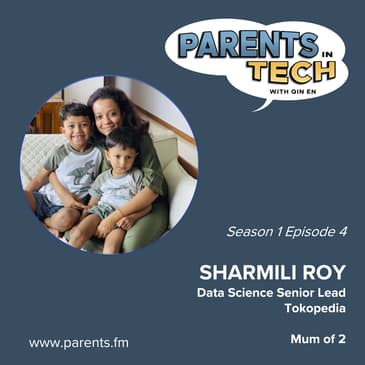
Debugging, Breadth vs Depth and Learning to be Bored, with Sharmili Roy.
Engineering experiences to instill self-sufficiency, self-awareness and survivability in our children who grow up in a tech-enabled world. Sharmili Roy shares how adaptability and debugging from her data science career is applied to parenting.
Sharmili Roy, mother of two sons aged seven and three, is a leader in AI and data science with a background in electrical engineering and biomedical imaging. She’s currently Data Science Senior Lead at Tokopedia and a Bangkit Mentor, building the next generation of data scientists and data enthusiasts for Indonesia.
Sharmili takes us through the process of becoming conscious about skills gaps, and the active steps she took to address them by embarking on an EMBA. She talks about balancing between breadth and depth in learning, and shares her favourite toys and tools for fostering passion and curiosity in her sons, as well as her hopes for their futures.
To get in touch with Sharmili, find her on LinkedIn: linkedin.com/in/sharmili-roy-b488265
Or shoot her an email at roy.sharmili [at] gmail [dot] com
Don’t forget to head over to www.parents.fm to stay up to date with new and previous episodes, join our community of parents in tech or drop me a line.
Thanks for listening to the Parents in Tech podcast with me, your host, Qin En. We hope you were inspired on how to raise kids and build companies. To catch up on earlier episodes or stay updated with upcoming ones, head over to www.Parents.FM to join our community of parents in tech. There, you can also drop me a question, idea, feedback or suggestion. See you next time!
Transcript
Qin En 00:06
Hi. I am Qin En, and this is the Parents in Tech podcast. Welcome to Season One of the Parents in Tech podcast where we interview moms who are technology company leaders based in Southeast Asia. We want to hear stories, hopes, challenges and tips from moms who are raising kids while pursuing their career aspirations. In this episode, we speak to Sharmili, data science senior leader at Tokopedia. Sharmili started her career as an electronic engineer, before pursuing a PhD in biomedical image analysis and visualization. More recently, she has established herself as a leader in AI and data science in tech companies. Sharmili is also a Bangkit Mentor, an academy to nurture high caliber tech talent in Indonesia. She is a mom of two sons, age seven, and three. Hi, Sharmili, welcome to the Parents in Tech show. To begin with, could you tell us a bit more about your family?
Sharmili 01:10
Hi, Qin En. So family wise, I have two kids and my husband, and four of us have been living in Singapore since 2009.
Qin En 01:19
How old are both your kids?
Sharmili 01:20
I have two sons. The older one is seven. The younger one is three. So they really are a naughty bunch. It's always a circus at home.
Qin En 01:31
Yeah, but I think - I'm sure it's a very lively one. So, Sharmili, can you humor me? How do you explain your job to your children? I guess in this case, your eldest son.
Sharmili 01:40
Yes, correct. So my oldest son is a little bit geeky. He's the one who's really interested in science, and he'll bring books, all kinds of books, and, you know, maths, science and everything. And he come and ask me questions. It's very hard for me to explain to him, you know, a data scientist is not really a scientist who goes to a lab and discovers something. He keeps asking me, you know, you are a scientist, you should try and discover new stuff. I try to explain to him that I actually discover stuff using data. So he's a big fan of Beyblade. I tell him, okay, you know, when you're trying to find a new Beyblade, and you're looking online and searching for it, you know, Mama's algorithms gives you the best recommendations, you know. You should try and find it on Mama's platform. She knows what your like, and she'll give you the right advice. So that is what I do with data. I try to explain to him we use a lot of data to model people, try and understand what kind of personality they have, how we can help them find the right things and, you know, make their lives easier. That's how I try and explain him about my job. But it's tough.
Qin En 02:41
I think it's already tough to explain sometimes to the uninitiated adult what data science is.
Sharmili 02:48
Exactly.
Qin En 02:48
And I'm surprised. Beyblades, I remember when I was a kid, more than a decade back, that was the in thing. Glad to know that it's still the in thing these days.
Sharmili 02:56
Yeah. People say technology changes everything where some things never change, right? Like Beyblades.
Qin En 03:03
Exactly. Now, Sharmili, you mentioned something that's really fascinating. You've mentioned that your eldest son, he's geeky. He loves all the science tech stuff. How did you discover it? And when did you discover it?
Sharmili 03:13
Yeah, yeah, it's really interesting. So older one is geeky, the younger one is absolutely not. So um, sometimes I try to understand, you know, what are the differences? I'll tell you how I understood, right, very early, like, he is the geeky kind. You know, children have these play cards, right, where they have the letters A, B, C, D. And then they will have some pictures, right, A for apple, and then for B, there'll be a ball. So we got him some of those cards very early. Let's say he was like two years old or something. He was only interested in the letter T because it had a truck on it. And then he will start asking questions about, you know, how does the truck work, you know, what kind of parts it has. And this is at three. So, you know, then we realize, okay, maybe he's really into science and all of that.
Qin En 03:59
That's so, so fascinating. And since you discovered a passion, how did you help him to further grow his passion, his curiosity?
Sharmili 04:07
Books I found is something which was really what my elder one was interested in. We would buy all kinds of like cute little stories around engines and tractors. And you would be surprised how much content is out there. He started with those. And then of course, you know, these kids, you cannot keep them away from screens, right? How much ever you try, right? So we try to make sure that whatever he was reading, we are trying to find media related to that. If he's reading a truck-based story, then we try to find, you know, truck based stories for him to look at when he's looking. And then LEGO, I would say, is one of the most versatile toys, so we knew that he likes engines and trucks and science, so we tried to give him some theme-based LEGO. Once he was five, five plus, he really came to us and said, "Okay, I want to do the LEGO Technic. I want to go to center where they actually teach us to make things with LEGO." So he started doing his coding camps at seven. I mean, kids are different. My younger one, I show him all these things. He's really not interested. I mean, I showed him the same set of cards, and my younger one actually picked up only the ones with animals. He's clearly way different. He's really into animals. And he reads books which are animals, he has Legos which are animals. So it's really two different characteristics.
Qin En 05:24
I think that's so beautiful. It's about understanding and discovering what each child's affinity is. Yeah. And I love the fact that, you know, your son, you gave him all these platforms and these opportunities, so much so that, you know, he went out to discover, and he - - -
Sharmili 05:38
Yeah.
Qin En 05:38
He's asking you, right, to send him to coding camps. I do know that there's almost like an increasing pressure these days to like, oh, everyone must learn how to code. But it's so nice to see that that comes from the children themselves, and really a born out of a place of authenticity and genuine curiosity. So we mentioned about books, I presume you're talking about hardcopy books, not e-books?
Sharmili 06:00
Yeah, no, not at all. Yeah. To be honest, I'm very old school in that way.
Qin En 06:05
We also did mention a bit about screen time. So tell us, Sharmili, how do you think about screen time? How do you set up the guardrails around that? And how do you manage that?
Sharmili 06:15
I guess it's like everybody's problem, right, nowadays with work from home. And, you know, having kids around all the time, we tend to give the screen for some time. And I personally feel that we need to be careful about not overexposing children to screens. But at the same time, I do not have a specific time bound thing. It's not like you get this half an hour, do whatever you want. Because in the beginning, when I was new, like, you know, new parent, I wanted to be very strict that okay, you know, you have this half an hour in the day when you can watch it. But then that is also sometimes restrictive in the sense that - you know, he also likes origami. He will come and say, "Okay, I want to make this new thing." He has a lot of origami books, he's run out of ideas, so he'll come and say, "Okay, I found this interesting project, origami project, I'm going to do it". Now you're thinking do you want to count it as a screen time? If you do that, then you're kind of restricting him and you're indirectly telling him, "Okay, you're not allowed to explore these." So there is a trade-off. But we try and keep a schedule. Like, we won't overdo it in the sense, like, we get this half an hour unrestricted that your watch what you want, but at the same time, there are times when, you know, you want to do something constructive, go and do it. But generally, we feel that there shouldn't be a lot of structure in the day, like we shouldn't keep a fixed structure for the children, they should also have some time where they can do whatever they feel like, and sometimes we force them to be bored, without anything, you know. Like, we did a 10 day quarantine with the children because we went overseas, and we came back. We had to do it in a hotel. It was difficult, but because the children were used to, you know, atmosphere where you have only a few toys, you just use what you have, make up games, and, you know, try to keep yourself busy, it was really a breezer - the 10 days. We didn't have to increase their screen time. We didn't have to give them - you know, pamper them with lots of toys and all of that. I guess we all need to sometimes sit and relax and just, you know, do nothing like at least for some time, like maybe 10 minutes, 15 minutes, how much ever you can afford.
Qin En 08:19
Yeah, doing nothing. Wow. That's, that's, that's new to me. But, again, it's also, I think, so important, right? I just get the sense that we live in a culture where you've always got to be doing something always got to be killing it. You've got to be productive. I mean, there's a whole industry around hacking your schedule, hacking your body, hacking everything, but sometimes to just sit down and live with the boredom or not busy yourself. Right. I think that it's such a valuable skill. Because, you know, how do you stop doing sometimes and start thinking, Yeah, it's really heartening to see how that's something that you're encouraging. And also the idea of not having, you know, strict rigid schedules, which we all know kids hate, and then there's a very almost antagonistic relationship with sometimes. That's, that's really encouraging to hear. So, Sharmili, you know, this is quite inspiring. Where did you learn this parenting from? Are there particular mentors, or even from your family that you learned some of these things?
Sharmili 09:17
No, I don't - there's no mentor or anything. I just - sometimes we do this comparison between when we were, you know, children versus the children of this generation. I know it's very cliched. Most parents age, right, when we were young, life was difficult. You know, we didn't have all the luxury. We didn't have, you know, TV and all that. But we cannot change that, right? Neither do we want our children to be devoid of all the luxury when we can afford it, right? That's not even fair. We feel that we can simulate that in the sense that they should be able to realize that there can be situations when you do not have the luxury of everything and you still need to survive and it's very difficult to simulate that in a very developed country like Singapore, right? How do you do it? Pre-COVID, we used to travel a lot. And whenever we would travel, we will not go into luxury hotels. We try to find, you know, a room in the middle of the jungle. The children learn to cook. They learn to serve their own food. They learn to clean up and all of that. It's very hard. On a day to day basis, we can't let them do it, right? Because, you know, at home, how do you force them? Right? They have the luxuries of, you know, helpers here and all the facilities. They don't even want to cook and all of that. But when the COVID struck, it was really hard, right? Because they are at home, and how do you simulate such things. So that - which is where we started doing these kind of things, we will sit down and we just play, we will just use cards or, you know, make cards with our own. Or sometimes my son actually makes his own games. He will write down 1, 2, 3, 4 until 100. And then, you know, like a snake and ladder, but he'll have his own version of snakes and ladders. He will have obstacles and he will have - okay, if you come to this number, you have to go back three or, you know, things like that. I think all of this comes when you really sit down and you want to do something with limited means, right? I guess, basically, we try and see like what we did when we were children. Sometimes it will happen that there is no electricity, right? But I can't simulate that, right. But we - when we didn't have electricity, we just sat down, we played some games, right? We just created games. So that's what we try and do that, okay, we don't have any toys. You sitting in this room, we're just having a family time. We can do whatever you feel like
Qin En 11:32
That is so inspiring. It's almost like in this tech-enabled world, where everything is so always about pushing the frontiers, it's almost how do you take a step back, and how you develop, almost, what I would say, survival skills. That - the survival skills itself, per se, is not that important. But I think it's the character building, right? You know, you don't get everything handed to you, so it's great. Especially for holidays, I think that's always the temptation that you want to have a good time, you want to stay in a nice hotel, but the kind of experiences that you engineer are so unique. And with all of this, Sharmili, what are some of the hopes and dreams you have for your children? Because it sounds like, you know, they are just this curious, this resilient, and it's things that you want to inculcate in them. What are some hopes and dreams you have for them?
Sharmili 12:18
It's difficult. Like, we have dreams, but we do not want to also impose them on children, right. Idealistically, I would want them to be able to survive themselves, right? Like, you know, be somebody who can buy whatever they want, and be a self-made person who can really take care of himself and his family going forward. Right, he really wants to be a scientist. o I would rather have that as my dream, because, you know, I don't want to really be a contradiction to what he wants to be. But, basically, the idea is, we want them to be self-sufficient. And also, we want to build a person who can survive outside in the wild world also. Like, when I say wild world, I do not mean Singapore, right. Because in Singapore, we are very protected if you think about it, right? Everything is so safe. And you know, I will not be worried if they are out and about at 2am, 4am because I know, you know, they're safe in Singapore, but of course when they step out of the country, that the world changes, right? So I really want them to be self aware and, you know, be adaptable to situations which are not under their control. That is what I dream of and which is why we try and, you know, simulate all these things when they're young. But I know as they grow older is going to be harder, right?
Qin En 13:33
Agreed. It's really about the adaptability helps them to thrive, and it's sometimes quite a challenge when, like, exactly like you said, Singapore can be such a safe environment. But I think being intentional about it is the way to go.
Sharmili 13:46
Yeah
Qin En 13:46
And I think, Sharmili, when I look at your career, adaptability also stands out. So maybe can you quickly take us through your career journey so far, and what led you to your current role as a data science leader?
Sharmili 13:58
I got married in 2009, and my husband moved to Singapore because his first job after his MBA was in Citibank. Back then I was working in a government institution in India, so there was no way I could get an internal transfer out. I resigned. Anyway, I wanted to do a PhD, and it was in my list for a very long time. I took this opportunity to apply to NUS, and, luckily, I got an admission. So that's how I moved to Singapore. And then I did a PhD which is mostly on computer vision and machine learning so, basically, train machine to understand pictures. Like, started with medical images, which is more like radiological images, like, you know, CT scans, MRIs, PET scans, things like that. I also went to Japan and worked with A*STAR for - doing things like mouse images. Like, if you take a 3D scan of a mouse, how do you read that? How do you understand what are the problems that the mouse is having? Is there any genetic problems? You know, basically gene coding of mouse, things like that. It was mostly biomedical and medicine related. Singapore is small, right? So we don't have a big volume of patients and a big volume of data. It was getting harder to do real data science in medicine. So I moved on to more like general purpose images, like instead of focusing on medicinal images, I started looking at normal photographs. Still, in the beginning, it was health related. You know, Singapore has diabetes problem, right. We started building an app where you could take a picture of your food and then start doing your photo journaling. It was still related to health. But then again, the mode was different. And then from there onwards, I started exploring what else can be done using images. I joined a very early startup coming out of Entrepreneur First where we were trying to generate ads using AI. So that is where I really entered the industry. And from there onwards, I moved to this company called Tokopedia, where it's an e-commerce company. We are using machine learning for E-commerce.
Qin En 15:56
Right. And when you made the jump from research to industry, were there any challenges that you faced?
Sharmili 16:02
So it's not really easy to jump directly from research to industry because, you know, when you are doing research, our focus is very different. During my PhD as well as during the postdocs, I've always been working in real world problems in the sense that there was always a target audience, be it a radiologist, be it a scientist, or be it a government agency for which we were doing the food journaling, and the whole research process was geared towards making a product which can be used, instead of it being more, like, theoretical or - you know? The research was more practical. Basically, the challenge was when I wanted to move from medicinal, you know, radiological research to mainstream industry. To do that transition, basically, I moved from A*STAR to NTU. And NTU had a lab which was doing a lot of projects in collaboration with industry. I guess that was the bridge between core research versus industry. And then that gave me exposure to, you know, industry projects, industry collaboration, and from then onwards, I moved to industry. That jump I really had to plan carefully because you're not doing one postdoc, and then another one, you would tend to not do it, right? You will feel that okay, what's the point? But basically, the point was the bridge.
Qin En 17:16
Yeah, exactly. And even as you think about career transitions, because that's something that takes up a lot of time, a lot of headspace, how did, essentially, your family come into the picture, right? Because at that point - or even at this point, you have two young children. At that point, they were probably even younger. So love to hear in terms of what were some of the considerations? Because something that especially young parents might face or parents of young children might face, there's so many things happening. How do I deal with it? I'd love to hear how you overcame that.
Sharmili 17:46
Yeah. I guess, when you think about it, it's basically the support. I would say ask for help. We tend to think that we will manage everything by ourselves. It's really building a support system around you. Otherwise, it's not possible. Definitely your family, your partner plays a big role, right? And then my parents really helped a lot. They came in and out from India to help with the children. And I have a great helper who's always taking care of the children. My key is that, especially during transitions, you know, you really need that support system. So prepare for the support system more than prepare for the transition, I would say, most of us are tend to overdo ourselves. And that is when the problem starts.
Qin En 18:31
So true. It's about being thoughtful and not trying to load on too many things and being - almost like recognizing what are you good at? And what are things that you can get someone to help? Definitely do that. I'm curious as to how do you think about dividing some of these responsibilities and workload with your husband? Right? What were some of the conversations like? How does that look like today?
Sharmili 18:52
COVID was very difficult, right, because most of us were working from home. It was like two of us with the two kids. There was a point when even the kids were not going to school, right? We basically sat down, and as much as I say that I don't like structure in my whole day, that was the time when we really sat down and made a structure because it was not going to happen otherwise. My husband really said, "Okay, I am an early riser," so he would start his work really early. Like, he started at 5, and by 9, he would be, like, halfway done, right? And then I will try and wake the kids up by nine, like you know, or slightly later. Then I hand over to him. In this whole conversation it's not only about as the family but also the support, right? We did have to have this conversation with the helper also, like, you know, we are trying to do this so that all of us can really survive through this time.
Qin En 19:40
I love how inclusive you are even bringing your helper into the conversation and making sure that it's something that that's sustainable, works out for everyone. I think that it's really commendable, and it clearly worked out well for you. And also, Sharmili, I heard that you are also going to take on a new challenge, or, rather, you're already halfway through the challenge of an EMBA, so tell us more about that. Because you probably started thinking about this program during COVID. What was going through your mind? Was there concerns that, hey, you know, there's a lot that's going on, right? I'm building up my career, I'm taking care of my family, and now that's one more thing to look at. I would love to hear that decision-making journey.
Sharmili 20:18
Actually, in Tokopedia, I have a big team, right. I have to do a lot of team building, leadership related responsibilities. I realized that I'm learning on the job trying to do all of that, but there is something missing, right? I do not have that business acumen, right, why something works and why something doesn't work. I don't have that, you know, the foundations of being a good manager, right, which is when I started thinking that it's probably not fair to the team or to the company, because you're trying to do a role where you're adapting, you're learning. But, you know, you could do much more if you had the good foundations. The role was also changing a little bit. I wanted to make sure that I'm giving 100% of the role, which is when the seed was planted. And, to be honest, I was not rushing to this, but my husband actually started this conversation that, you know, this is actually the best time because you're - there's COVID, you're working from home, I know that a lot of things are being managed, but you get more time, right, which is how the whole conversation started.
Qin En 21:21
I really liked that idea that you never stop learning and, you know, being very conscious of where the gaps in your skills were, and taking active steps to approach it. I'm curious why, particularly, like, a formal program that has extended commitment versus something that's, let's say, a bit more short-form? Because I'm sure there are also some parents on our podcast who are thinking about different ways and paths, like yourself, where they can grow. I would love to hear your thought process around weighing those different options.
Sharmili 21:49
It also sometimes depends on what situation are you in. Of course, there are these short-term courses also, right, which basically, really, really focus on certain aspects of it, be it communication, be it leadership, be it, you know, digital transformation. So there are these small courses which are very focused, but for me, I felt like I was doing okay in my job, but I guess I wanted the breadth, not the depth. I guess basically, you have to balance between the depth and the breadth. If you're doing an executive MBA, which is very long in terms of the duration, and you have a lot of courses to cover, you can't go very, very deep into it. I do not expect myself to understand fully about finance, for example, right? Or strategy, for example. But if you're doing a course which is core on finance, you will know much more right? I guess that's the balance, depth versus breadth. And at this point, for me, breath was more important than the depth.
Qin En 22:41
That makes a lot of sense. And over the past nine months since you pursued the EMBA, were there any lessons or things that surprised you in your journey so far?
Sharmili 22:52
The most unexpected part of this whole MBA is basically the cohort. MBA is not only about the course. I guess, it's also about all the people that you meet, and you know, you hang out with and you learn. I guess the professors and the course is really great in a world class infrastructure, content and everything, but at the same time, the cohort is world class. So you derive as much learning from the professors as much from your cohort as well. The company and the colleagues that I have met during the MBA program are still an asset and, I would say, an equally important asset when you compare it with what you're learning during the course.
Qin En 23:32
Yeah, I think truly they say it's - I mean, the course and the content is one, but sometimes the network and the people, not just in terms of the utility value, but even just how they inspire you, right, the different backgrounds they come from. Like for you, I'm sure you bring a very unique set of stories and experiences. And each of your different classmates have the same. So, Sharmili, on top of all of the things that you're building and doing so successfully, I noticed you are also a mentor at this program called Bangkit. Tell us a bit more about what Bangkit is.
Sharmili 24:03
Yeah. So Bangkit is basically a collaboration between multiple companies. It is a course to nurture the next generation digital talent in Indonesia. So these companies come together. And they have built a course where students go through formal training of data science as well as, you know, building real applications using machine learning. There are two parts to it: there is the coursework as well as then there is a capstone project in the end. The capstone project basically brings together all the things that they have learned during the course, and then they develop an app which can be used by all, you know, users there, which they can really put it into App Store. It is basically developing talent in Indonesia, telling them how data science work, how they can basically use data to really solve real-world problems. The hope is that some of them will really end up being, you know, a company which is solving a problem and, you know, adding value to people's lives. So that's the whole concept. But basically, we are trying to build the next generation of data scientists, data enthusiasts for Indonesia.
Qin En 25:10
I think that's one of the things that's definitely needed, you know, with the explosion of data. And there's clearly a scarcity of talent over here. So for people who are potentially considering, say, a career pivot into data science, where should they get started? What advice would you have for them?
Sharmili 25:27
That's a tricky one. Because you know, there are so many online courses now. And I've seen so many data scientists who are self-taught. So it depends upon really the background of the person. If you are into engineering, then you have certain perspective. But for me, I feel like if you really are serious about doing data science and - it is always good to do a formal course. If we are talking about Singapore, there are a few data science courses from our universities locally in Singapore. My general feeling is if you go to online platforms and, you know, do some of these online courses, you go as far as just using what is available on the web and then reusing that to solve some problems. But if you really want to be a data scientist who really understands and is able to build solutions, you need to know the technology, you know, in depth. A formal course, which is like a year and a half or something like that, would be the ultimate way to go about it if you can afford it, right. Some people might not have the time or - you know, there are a lot of constraints. But if you don't have those constraints that's the best way, yeah.
Qin En 26:32
That makes a lot of sense. Nothing like the intensive, rigorous curriculum plus also the support that you get from your peers and your instructors that sometimes it's hard to create in those shorter forms. And even as you perhaps interview and meet quite a few of these people, what is the one or two things that you look out for when you think about hiring data scientists into your team?
Sharmili 26:53
When we do courses, everything is very structured, right? If I go and enroll into a data science course, I will be given a data, and I will be told, like, you know, these are the steps you have to follow, and you just follow them. And then everything works, and it feels like magic. But in real world, data science is not magic. At least 90% of the times, whatever we do doesn't work. And at those times is when you have to understand why it is not working because most of the time things don't work, right? And to be able to debug on why things aren't working, you need to know why things work. Right? It can't be that, you know, you have a pre-built stuff, and you're just reusing it and, you know, building on top of it. You can only make something work when you know how things can go wrong, and this is something that you learn when you are doing, right, data science yourself using raw data. When we are interviewing people as data scientists, I try to give them situations where, you know, it's more situational. Like, we do a lot of case studies, and we say, "Okay, this is the situation. How are you going to handle it? This is the data you have. What are you going to do?" It's not easy to answer such questions. But what we are looking at is the thought process, you know, at least the thought process of how you're going to debug it. You are not expected to debug, but, you know, how you think through this. So it's basically the acumen not anything else.
Qin En 28:16
Yeah, it's about how they would approach it in a structured, thoughtful kind of logical way. And yeah, things like, you know, the tech stack, are things that you can learn, right? And you can - you can find the right people. So I think that that's really useful advice. I'm curious, Sharmili, have you ever had to use the same mindset of figuring out what works, what doesn't work back at home in your parenting life?
Sharmili 28:36
Yeah, always. With kids, there's always these situations where sometimes you have to try and debug. There was a situation where - my older one, he's usually very curious type, as I mentioned, right? He one day came with a book which was on drugs, and he came and said, "Okay, Mama, you know, I have this book, and I want to read it." Then you start thinking about it, okay, so what worked, what didn't work?
Qin En 29:06
Whoa, how did he even get the book? Do you know how he got the book?
Sharmili 29:10
Yeah. So this is where the debugging started. So it was like, "Okay, let's read it." You know, when you come, and you suddenly say, "Okay, you know, you're not supposed to read this book," then you actually are making him even more curious, and you're telling him, "Okay, you know, this is something that I should know about, but my parents are not letting me know," right? Then I started that debugging process there like, "Okay, so let's start and read about it." He said he got it from the library, and I was - I was like, "Okay, you can get it from the library, but you would have heard something or seen something that must have been the real reason behind you going to the library and finding for these kinds of books," right. Then in the end, it seems like there were some children in the school bus who just said, "Okay, you're walking as if you're on drugs." That's about it. That's what was the real issue. This is where it started. So getting into the depth of the situation without frowning on the outcome is something that we can all apply in every situation. It could have easily gone very wrong, right? If I said, "No, you can't read it" or - you know, he could have gone to the internet and looked at YouTube videos which is not something very pleasant, right. And we do not want to get into a situation where we have to monitor a person. We want that person to be responsible by answering. You know, if he's asking logical questions, I'll answer him logically and try to understand his thought process.
Qin En 30:30
That's good, right? Because there's almost like a knee-jerk reaction, especially to something that's almost so black and white, in terms of, like, right or wrong.
Sharmili 30:37
Yeah.
Qin En 30:37
But for you to be able to apply the thoughtful process and, and kind of working through the issues instead of just reacting to it, I think that's valuable. And like you said, it is better for people to - especially for children to understand why they shouldn't do it, then for us to just say, "Oh, you shouldn't," and then it kind of instigates their curiosity. So, Sharmili, if there's one lesson you learned as a parent in tech, what would that be?
Sharmili 31:02
The one lesson I would say is prioritize. Usually, as parents, we tend to overdo. We tend to think everything is possible, right? Especially as moms, we always try and, you know, take care of the family, take care of the house, take care of work and everything we want to do. I think over the last few years, I've realized I really need to prioritize what is important for me and what is not for everybody. I would say we should all sit down ourselves and out of 10 things we need to do, we should prioritize what is the most important thing. There are always urgent things, and there are always important things, and we tend to keep, you know, ourselves engaged with non-ending urgent stuff. The key is try to spend some time to prioritize, and then have that prioritization as your basis for doing everything.
Qin En 31:52
That's beautiful. I love it. Well, Sharmili, it's been such a joy to have you on the show. If some of the parents would love to connect with you, how can they best do that?
Sharmili 32:01
I'm pretty much quite responsive in LinkedIn most of the time, and I can also share my email address, so feel free to contact me.
Qin En 32:09
Alright, thank you so much for joining us today, Sharmili, it's been such a joy to talk to you.
Sharmili 32:13
Thank you so much for having me.
Qin En 32:16
Thanks for listening to the Parents in Tech podcast with me, your host, Qin En. We hope you were inspired on how to raise kids and build companies. To catch up on earlier episodes or stay updated with upcoming ones, head over to www.parents.fm to join our community of parents in tech. There you can also drop me a question, idea, feedback or suggestion. Once again, the website is www.parents.fm. That's all for this episode, folks. See you next time.