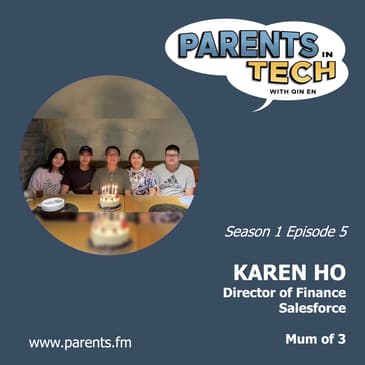
Adopting a growth mindset, self-promoting effectively, and mentoring kids as they make the leap from adolescence to adulthood. Karen shares her experience juggling career ambitions with parenthood and learning to let go.
Karen Ho is Director of Finance at Salesforce and a certified facilitator of Google’s #iamRemarkable program, an initiative to empower women and underrepresented groups to celebrate professional achievements and develop an awareness of self-promotion.
While building her career of 20+ years in tech companies like Accenture, IDA and Dell, she raised three children. We discuss nurturing children with unique abilities and interests as they navigate academic and social pressures within the local education system. Karen also shares with us tips on using allyship as a tool to promote oneself by giving credit to the team.
To get in touch with Karen, find her on LinkedIn https://www.linkedin.com/in/karen-ho-ca-a514357
#IamRemarkable Program
https://iamremarkable.withgoogle.com/
Don’t forget to head over to www.parents.fm to stay up to date with new and previous episodes, join our community of parents in tech or drop me a line. I’d love to hear from you!
Thanks for listening to the Parents in Tech podcast with me, your host, Qin En. We hope you were inspired on how to raise kids and build companies. To catch up on earlier episodes or stay updated with upcoming ones, head over to www.Parents.FM to join our community of parents in tech. There, you can also drop me a question, idea, feedback or suggestion. See you next time!
Transcript
Qin En
Hi, I am Qin En, and this is the Parents in Tech podcast. Welcome to Season 1, where we interview moms who are technology company leaders based in Southeast Asia. We want to hear stories, hopes, challenges and tips from moms who are raising kids while pursuing their career aspirations. In this episode, we speak to Karen, Director of Finance at Salesforce. Karen spent the past two decades of a career in tech companies, including Accenture, IDA and Dell. Earlier this year, she also took on the challenge to train as a #IamRemarkable facilitator, a program organized by Google to encourage women and underrepresented groups to speak openly about their accomplishments in the workplace and beyond. Karen is a mom of three teenage children aged 20, 18 and 15. Hi, Karen, welcome to The Parents in Tech show. Thanks for joining us today.
Karen
Hi, Qin En.
Qin En
To begin with, could you tell us a bit more about your family?
Karen
I'm married with three children, and they are all already currently in their teens, so the eldest one is about 20 years old, the second is 18, and my youngest is 15 years old.
Qin En
I would love to hear, how do you explain your job to your children?
Karen
During the time when they started preschool they asked me, "So, mommy, what do you actually do at work?" And I said, "Oh, okay, I deal with numbers, and I basically count the money for the company." At that time, because I do have helper, then my daughter said, "Oh, my mommy is an instructor. She instructs the workers on what to do." And then it was like, oh, okay. Now as they grow older they are able to understand what exactly is accounting, what exactly is finance, even though they do not know in detail the exact job nature that I'm performing, but they are able to appreciate the differences between that versus a job as a sales or IT or consulting or whatsoever.
Qin En
And I see that you have built your finance career both in tech companies and, I would say, those non-tech companies. What's the difference, and what led you to build your career currently in tech companies?
Karen
For the past 24 years or so, the majority of my career journey was actually spent in the tech industry, and I personally prefer this industry more than the other industries that I ever worked, especially for the areas that I'm working on in finance, right. I find that technology business - it's easier for us to grasp. It's easier for us to self-account, and it's not so messy like the other industry. That's my personal opinion. It's not as messy as, say, manufacturing or companies with consumer goods that you have to account for the physical goods. So over here, human capital is usually the assets of the company or things like the IT assets. The kind of intangible kind of assets that we account for is complex to people outside of the industry, but it is very interesting for us for industry long enough. It is a very fast-paced, fast-moving industry with a lot of changes both in front as the technology moves, and also for us in the finance side that's supporting the business, we also have to move very fast to catch up with the business. It's a very exciting space that we are actually in.
Qin En
I can imagine that that's such a - such a challenge and - but it's also so exciting. In the past 24 years, so many things have happened in the industry, and even when I think of, like, the function like finance and with all that's happening, let's say, in the blockchain and crypto and learning how are we going to deal with those, those are some of the challenges that I'm sure you have to face. So maybe if you could share what is the one biggest change that you've seen over the past 24 years? What was something that you used to do, and now you have to do it entirely differently?
Karen
I will say finance digital transformation. In the past, a lot of things are done manually. We can account it in Excel or on paper, you know. All the debits and credits are all accounted there, but then now a lot of times it is done through the system. With a matter of a click, it just generates within seconds, and something can be done. We said our skill set would kind of have to shift, and we have to have a change mindset where we would want to move more towards strategic thinking in terms of how we analyze and add value to the company on predictive analysis rather than just accounting for whatever happened historically and say, "Oh, because this happened, then perhaps things will just go on like that," or extrapolate. But then now with the kind of data and the kind of tools that we have, we can even predict up to a few years time what will actually happen based on the existing data that we have.
I love that Karen the part about how finance, at least in the past, used to be something that was about historical data - what was it over the past three months, what was it over the past 12 months - but these days, right, the role of finance, especially in the tech industry, it's really forward looking, shaping the strategic decision making, and that's something that you are also very actively part of.
Qin En
I also noticed earlier this year that you got involved with the #IamRemarkable initiative. Tell us more about this. What's the program about?
Karen
This is actually a program that was initiated by Google, and it is being rolled out across the world and being volunteered by volunteers like myself to facilitate the workshop. And it is a 90 minute workshop that anyone can join as long as you sign up for it or reach out to the certified facilitators like myself. This basically addresses the awareness of self-promotion, particularly targeting on the underrepresented groups like women and minorities in the society. And I find this program is very helpful because, especially for women and especially for people like us who are in Asia, right, we probably are being brought up in a way to say, "Oh, let's be humble. Let's not broadcast so much about your own success," and etc. But actually, this is a very normal thing to do to actually help you to progress in your career or to market yourself to be able to be sharing what you have actually achieved. I find this program very helpful when I first attended it last year. That's why I got certified to be a facilitator to help more women and more underrepresented people to actually get to be more aware of what they can be, how remarkable they are and, therefore, to help them progress in their career.
Qin En
I love that. It's so true. Many times when think of self promotion, there's almost like a negative connotation to it. Sometimes people say, "Oh I'm too shy. I'm too embarrassed," and a lot of Asian cultures and values are steeped in humbleness and modesty, but I think sometimes that can serve as quite a disadvantage, right?
Karen
Yeah.
Qin En
I would love to hear it, have you had the opportunity to take what you've learned from this is #IamRemarkable and even apply it back home to share with your partner or even your children?
Karen
I did share with my family, but not through a formal workshop. However, I have conducted it for a couple of my friends through the workshop. Initially, they were asking me, "Oh, so what is actually self-promotion? Why is it so important?" But after they attended the workshop, the feedback from them is that it's very helpful, and they have started to use the methods and the suggestions of the workshop to help them to be able to be more intentional in promoting themselves in terms of their achievements, and it kind of helped them in terms of their career progression.
Qin En
And for our listeners who are listening, could you maybe share why is self-promotion important?
Karen
Achievements don't speak for themselves. Nobody will know what exactly you have done well if you don't promote yourself in terms of that. If it is about facts and not about boasting or something that is coming out from air, there's nothing wrong with self-promoting whatever that you have achieved.
Qin En
I think it's so true. It's not about telling fiction or fairy tales, but it's about understanding what we have done to date and crafting stories around that. What's maybe one or two methods from this workshop, this program, that you really like, you really subscribe to, and you have even seen it impact the people whom you have coached?
Karen
Right. For example, when we want to be intentional in promoting ourselves, probably we can do it through allyship. It doesn't mean that you have to say, "Oh, I completed this. I did this," right. You can say, "Oh, so and so actually is part of the team and have done a good job on this, and then, as a team, we have actually achieved this, this and this." It's kind of like you are promoting the team. You are showing your leadership, and at the same time helping someone to promote them. But then it also gives the people the idea that you are also promoting yourself as part of the group. This method is helpful, especially for those of us who are very shy and very conscious of promoting yourself.
Qin En
What are your hopes with this platform that you have? Right, given that you have been certified this year, you're just at the start of the journey, what are your hopes?
Karen
This year I have already conducted about six workshops both internally and externally. With the next year and going forward, I hope to conduct more and more such sessions within my company and for outside organizations to help more people to be aware of what is good for them and to understand as well how allyship can help them as well. I think it is also very useful, because I'm also a mentor for the undergrads who are coming out to workforce, to also share this with them so that, right from the start, they have this conception that it is okay for them to be self-promoting themselves. But it is also useful for them to know what are the good and useful methods that they can do, so rather than appearing like you know, as if you're talking something that is out of nothing.
Qin En
And I love that you're coaching undergrads while, at the same time, your children are also going to enter college soon, going to enter university soon or probably there already, right?
Karen
Right.
Qin En
So maybe just tell us about where are they at their stage, and how have you been coaching and facilitating them through this journey of transitioning from teenager to adulthood?
Karen
Right. For my two boys, the elder one is in the final year of Poly, and the second one is taking his A level exams this year. Both of them will be serving their NS next year, yeah.
Qin En
Wow. So together, okay.
Karen
Yeah. And then my daughter is in year three this year. So, I mean, in terms of what I can do to help them is to, from time to time, share my experiences and tell them it is good to consider certain aspects of it, and to give them my insights on certain issues or topics. But I think, personally, I do feel that it is a little bit more challenging to mentor or guide your own family members or your kids because they won't really listen to you as much as they would listen to a teacher or an external mentor, so I just do what I can.
Qin En
Wow. I completely identify with that. You know, so many times I've heard advice from my own parents and sort of brushed them off or discounted it, but then when someone else says the exact same thing, I'm like, "Yep. Okay, I think that's good advice." So, as a parent of a one year old daughter myself, I think that's what life will be like one to two decades from now. I'm curious. Your eldest is currently in the final year of Poly. After that he is going to serve NS. What are your views of his next steps after he completes his national service? Do you hope for him to continue his studies in university or to go and get some work experience first? What are your thoughts around that?
Karen
My initial thoughts - of course, I would prefer him to be able to get into a uni and get a degree, but considering that [grades] might not be able to get into the course that he wants, then maybe the next best option would be for him to perhaps go out to the workforce to work a few years, get the experience and then apply as an experienced person to get into the course that he'll be interested in. If I just sort of, like, force him to go into any course, right, it may not be something that he has passion or enjoy in. And then if it turns out that he has to be in that career for long-term, it might not be so interesting and enjoyable for him.
Qin En
I can understand that almost like tension that you have to juggle, right. On one hand, I believe we are still in a society and a day and age where, unfortunately, that paper degree still matters to some extent. While that is changing, I think it's not completely gone yet. But at the same time, I really like how open you are and just how you place his interests first, right. And it's not just about getting the degree itself, but making sure that he finds a course, a major that he's passionate about and not just get any paper degree, right. I think that's really unique, and that's special, and your son must appreciate that. Now, I would love to hear a bit about the whole grades thing, right? You brought three children up through the Singapore education system. It's stressful. It's not easy, and especially for you who have built such a successful career, I'm sure there were challenges along the way. What has your perspectives on grades, academies and studies been over these past 20 years?
Karen
I think as a parent, especially in Singapore, right, most of us are very conscious of how well our child perform in terms of academic because we all know that, without that paper qualification, it is very hard to progress. I mean, that's the conception that all of us would probably have, and we want the best for our kids. I also used to think that it is very important for my kids to do well. However, all my three kids have very different learning abilities. Over the time, I sort of realize and come to terms that I cannot use the same standard to judge all three of them the same because I have to cater according to their ability individually and then plan and expect the best for them. As a parent, of course, I do whatever that I can, whatever that it takes that can help them as much as possible, and the rest will be really up to them, whether they would have the motivation to work hard for it or to try to get something better in a sense.
Qin En
Makes sense.
Karen
Even though all three have different abilities, I think, in my opinion, all three have at least achieved the best at their abilities.
Qin En
That's so important, right? I think there's always the confusion of efforts versus outcome, and a lot of times it's easy to just focus on the outcome and judge purely based on that. I think the challenge of exams and schools, it's - it gives literally a number to it, and everyone is kind of assessed just on that number or their letter grade. But a lot of times, it's important, especially as parents, to go below the surface and recognize the effort that has gone there. You mentioned that they are very different learning abilities for different strengths tell us a bit more.
Karen
For my eldest son, he is slightly dyslexic, so from young, it is slightly more challenging for him to learn in terms of language, in terms of mathematics. He actually has to personally spend more effort than other people to catch up. Fortunately, he was able to clear PSLE all level and got into Poly, and now because he's older, already he's more mature, and he's able to think slightly better, in a sense, to consider his own potential as well as his desire to do well. Although results-wise, academic, it may not be the best, comparing to his own self it is quite good enough in a sense. For my second son, he is a fast learner, so from a young age, he never really gives me a lot of problem because he's very independent, he's very quick, able to do things well, and he usually does well in the exams. I'm just hoping that he again does well in his A level and to be able to get into the course that he would like in the uni. My youngest daughter - I will say she is more of like the dark horse because I thought that she is always the one that is slightly more relaxed, doesn't know what she wants. But she's always the one that, in the end, she does the best out of the three of my kids. Yes, we may have certain expectations, we may think they are doing this well and not so well, but it may surprise you somehow, you know. Sometimes I think it's good to, like, as if you're playing a kite where sometimes you pull tight, sometimes you let go. But in the end, I think so long there's a framework and there's a certain agreed expectation, things will somehow turn out well.
Qin En
This idea of tailoring your parenting expectations, really, to each individual child that you have, I think that is such a big theme. When did you come to realize this, and what was the - what happened? What made you realize that, hey, I need to be different in terms of the way I coach, I nurture my child?
Karen
Initially, when they were younger, in primary school, I felt that we can always do something so long we put in effort, maybe give them more tuition, maybe score them more, maybe - you know, things like that. But then, later on, I realized that actually things doesn't work out that way. There are certain things that are very much beyond our control that we have to learn to accept and come to terms and try to work around it to see how best we can help them. Like, for example, it was only very late in primary school, like P5, then I discovered that my eldest son has some slight dyslexia. And therefore, that was a time where I sent him to an enrichment program that tackles on his dyslexia to help him to guide him on certain ways that he can improve on how he understand when he reads comprehension or things like that. So that kind of helped him a little. I also realized then that, oh, there's a lot of things that my other kids are able to do better than my first one, so I cannot really expect the same from the first one then the second or the third. And I thought that then I need to take them all separately and view them as an individual with that kind of level of expectation, then apply a customized coaching - or also called parenting - with each of the different kids.
Qin En
If I can just take you back to when your eldest son was in P5 and when you realized that he had mild dyslexia, how did you feel at that point? What were the thoughts that went through your mind?
Karen
It was like, thankful and a bit lost because I was like, luckily, it's only a mild case, and luckily, it's only dyslexia. It's not something more serious. So I think it's not really a very major problem. So that was a good thing that I thought, oh, it's a blessing in disguise. It's something that I should be thankful for, but the other part was - it was also like, oh, dear, then what happens? I mean, if he can't do well, and the society expects everyone to have good academics to be able to progress, then what will happen to him in the future? As a parent, you will worry about it. Yeah.
Qin En
Yeah. And how do you go about finding out the resources, like, for example, the enrichment program, right? I think in this situations, I'm sure a support network or even putting in the effort, it's critical. I would love to hear what was the network, or what was some of the resources that you found most helpful.
Karen
So initially, of course, I started with researching online for alternatives or help that I'm able to get. Then I also started to talk to friends and colleagues, and I realized that this is a very common thing. There's actually a lot of kids these days that have ADD, ADHD, dyslexia, etc. So it is quite common, and some of the parents who are, sort of, a few years ahead of me have already experienced it, so they have some good advice for me and good resources for me to read and reach out to. It was from there that I sort of explored a few options and finally decided on one particular enrichment that we thought that might help.
Qin En
Got it. And I think truly finding your own community of friends who are parents and being able to open up, it's so important. It creates a safe space for conversation and, like you said, makes you realize that, hey, at the end of the day, it's not that uncommon, right, and there are really ways to go about how to manage it. So if, let's say, you could turn back time and talk to your 20 year younger self, when you first started becoming a parent, what would you tell her?
Karen
I would probably say, you are good enough. You have done your best, and keep up the good work.
Qin En
I like that. That's the whole part about "good enough," right? I think sometimes parents do hold themselves to such a high standard, plus the whole comparison with others of whether I'm being the best parent and provided the best education, the best support the best everything, that it creates so much stress and pressure. I was wondering whether there were seasons or times when you felt that pressure, and how have you overcome it?
Karen
Definitely, yeah. I mean, being so competitive in in the society now, right, even amongst siblings or friends, sometimes there may be comparison, so you will feel a little bit of pressure and competition. They're like, oops, somebody else's kid does so well, and why is my kid not doing as well, that kind of thing. Sometimes you just have to take it in your stride and then tell yourself that, actually, that's not the end of the world because if you look at ourselves, right, actually, people who have done well academically may not be doing well when they go out to work, vice versa. So there are always a chance that they may not perform as well at school, but when they come out, they can still excel. I started to tell myself, okay, relax, don't get so caught up or don't be so competitive, and with that, then you feel much better because you're not comparing with others, and you're just comparing with yourself at least.
Qin En
Yeah, for sure. I think just being able to accept that you have done your best and, once again, separating the effort from the outcome. I think that that's so valuable.
Karen
Yeah.
Qin En
So now that you are also a leader at the workplace, and I'm sure you come across fresh graduates or people who are new in the workplace, what are the one or two qualities that you look out for that makes you say, hey, I want this person to be on my team, and this person is a stellar performer?
Karen
Being able to carry through their tasks independently because if you are not able to take through a task, and the manager has to keep probing you and say, "How is it? Is it done? Can you update me the status?" - It's not very effective, and as the manager, I also feel very bad I have to keep chasing. Plus, each of us will have our own priorities and our own deliverables. So that's one quality that I would definitely look for. The other one would be being resourceful, so by that, what I mean is that the person is able to find their own way within the network or within the team to find the answers for themselves in whatever deliverables that they are in tasked with and be able to be searching online or find some materials or whatsoever, and then deliver the final result to you.
Qin En
The resourcefulness bit it's so important. I think that's something that the education system, at least in Singapore, is starting to recognize is important. In the past, it used to be we give you this syllabus, you learn it, you master it, and we'll test you on the exams, yeah. And that was it, right? I think it really challenged students, and even for myself going through the system, on how can one be resourceful. When I was building my company and working with some of the Polytechnic students, I noticed that they had this resourcefulness that was in them, right?
Karen
Right.
Qin En
Because, for example, they had to find industry partners. They had to find projects to work for. It's almost like this fire that has to be ignited, and we have to show and equip the students with the right skills. I'm curious because basically both of your sons are going through slightly different education pathways, one through the polytechnic route, one through the junior college route.
Karen
Yeah.
Qin En
Do you see any differences in the system and how it trains them?
Karen
Yes. For example, my eldest son in the Poly system, right, I think it is a little bit more hands-on in the approach, so they do a lot of experiments, a lot of design, innovation that needs them to think and, at the same time, apply what they learn in theory to what they can do practical, and then they have like attachments that can help them to apply what they learned in school. And then for my second son, who is in the A level, I think it's still very academic and very theory based, but the good thing now is that our Singapore approach in the A levels system, right, is gearing more towards application. So whatever they learn in the theory is not something that you will regurgitate during the exams. You will still have to apply what you know to the practical questions that they ask in the exams. So in that sense, it is also very good training.
Qin En
Definitely. And I would say, the curriculum and even the education system is recognizing that, that learning, it's not just something that you do once, but it's something that even many, many years out of school, we have to continue to do. I'd love to hear from you, Karen, at this stage, whether in parenting or work, what is one area that you are learning or that you're curious about?
Karen
I'm trying to find ways of being a better mentor or coach, both at work and at home parenting, such that I'm able to help to be able to share my experience or to coach, you know, my kids and the people that I'm coaching to help them in their development.
Qin En
And for the parents who are listening, what was maybe one thing that you have found to be helpful in your journey of transitioning from the person who takes care of every single detail to be that mentor or that coach as your as your children grow up?
Karen
When we switch from someone that handles everything to someone that is more advisor, mentor, coach, right, we will need to learn to let go. We need to be able to give them the opportunity to show that they are able to do it and then along the way probe them, ask them questions, or share some of our experience to give them an idea of how they can actually approach that. Sometimes I have to pull in things like asking what do their teacher think and maybe asking their aunt or someone else to share their experience, as well as a core mentor, that kind of thing, so that they will be more open to listen to the guidance and advice.
Qin En
I really like that advice, right, of finding not just yourself and really not just taking the whole load on yourself but even looking and thinking out of the box in creative ways on what are interesting ways that you can engage and connect with your children on that front.
Karen
Right.
Qin En
What is the best compliment that you have ever received from your kids? With all that you have done for them from young to now, what's one of the most memorable compliments, I might ask, that you might have received from your kids?
Karen
I guess it will be, "Mommy knows best."
Qin En
Was that said in a positive way or in a frustrated way?
Karen
My second boy wanted to go on a trip with his friends right after his A level exams next month. Initially, I left it to them to the kids to actually plan their own trip, book their own tickets and etc, but because, as you know, the current COVID situation and there's this VTL travel, and there's a lot of different rules and regulations, right, and somehow they booked themselves on the wrong flight which was the non-VTL flight, and then I sort of asked them, "Okay, did you make sure that the flight that you booked has this code VTL?" And then they went to check and realized that oh, no, it doesn't have. I said, "You better go and change your flight because otherwise you will have to end up to be quarantined when you come back to Singapore." I gave them the opportunity to be independent to do whatever they need, but then at the back, I know that oh, there must be something that I need to watch out for, and I will prompt them when I realize that it is really happening.
Qin En
Wow. I mean, it's such a nice story because I think it encapsulates the whole part about being a coach, right? You'd let them have the freedom. You let them figure out how to do things. Maybe sometimes that's about, like, fall down, but I think, because you're also on the sidelines actively watching, you're able to watch out for these small things. So maybe coming back to also your career, right, you build your career navigating complexity, so, perhaps, could you share what was a complex situation back home that you had to navigate?
Karen
When I had my third child, I was a full-time working mother, and it was very challenging at the time to be able to cope with three kids and work, and especially you know that in the finance industry, finance, world, we do have to work very long hours every month because of the closing and etc, so it's a little bit hard to juggle at the time to be fighting for my own career development and yet to be able to be a good mother and take care of my family. Of course, I had very good home support. My in-laws were always there to help us, but ,again, the challenge is that, in terms of the development, it's still something that requires a lot of my attention.
Qin En
I can imagine. Well, I only have one daughter now. She's starting to walk around. I find myself chasing her around the house. I can imagine at that point with two young sons and a baby girl, that would have been a lot more complex. I can imagine that it must have been quite stressful and tiring. How did you take care of yourself during that period?
Karen
Probably because I was still considered very young, I had a lot more energy, so I was still able to cope with the demands of work as well as family, but I took the decision to focus more on the family and take a back step on my career. I was just happy where I was doing what I did on a day-to-day basis, and not, like, being ambitious to push for any progression, or what, until my kids were slightly older. Then it was the time where I started to shift my focus back to my career again. That was a very important decision because I will never be able to turn back time to be able to put the kind of effort on my family and my kids if I don't do that.
Qin En
That's so valuable advice, right. When I think about it, so many times, we need to see life in terms of seasons, right, and it's not necessarily that if you have to, for example, take a back step in your career now, it doesn't have to be the model going forward for the next 20 years of your life. I would love to hear that transition that you made when it was time for you to get back in and help to grow your career and realize your ambitions.
Karen
I needed to think about where my passion lies, which are the areas I excel in and am able to give more value to the company or to myself. I found that the area of compliance on streamlining of business processes and finance transformation is an area that I have passion in, so I started to focus on helping the team in terms of providing the support and advisory on accounting and compliance issues, and with that, I kind of grow. It also helps that the company is willing to invest in our development, so while I accumulate more expertise and experience, I was also learning and taking more courses to upgrade myself to be able to ensure that when I progress in my career, I have the necessary skills to be able to move up.
Qin En
Karen, thanks for sharing because it's really that growth mindset, and in spite of all the busyness that happens - you know, you as a wife, you as a mom, you as a professional - you still take time to be a student, right, and take those opportunities, whether provided by the company or outside, to learn and grow, and I think that's just so incredibly valuable to always have that mindset and to look for opportunities.
Karen
Yep.
Qin En
Thank you so much for joining us on the show, Karen, and if, let's say, our listeners would like to connect with you, how can they do so?
Karen
They can reach out to me on LinkedIn or through yourself.
Qin En
Thank you so much, Karen, for joining us on Parents in Tech.
Karen
Thank you.
Qin En
Thanks for listening to the Parents and Tech podcast with me, your host, Qin En. We hope you were inspired on how to raise kids and build companies. To catch up on earlier episodes or stay updated with upcoming ones, head over to www.parents.fm to join our community of parents in tech. There you can also drop me a question, idea, feedback or suggestion. Once again, the website is www.parents.fm. That's all for this episode, folks. See you next time.