
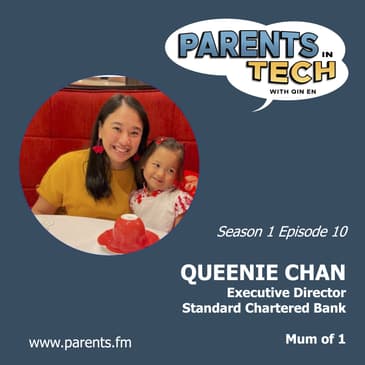
A special Parents in Tech episode celebrating International Womens' Day.
Against all odds, Queenie had a miracle daughter after many years of waiting, defying a medical diagnosis that meant she wouldn't have been able to have a child. Queenie narrates how she was blessed with Angela but then she faced a number of post-natal challenges along with the start of the pandemic.
This challenging ordeal inspired her to share her story to help and uplift others who may be facing a similar situation, motivating her to create the platform "Untold Stories", a series of inclusion stories from employees of different facets of life.
She also describes the mental well-being aspect of her ordeal. She explains the relevance and importance of mental health in the work place and her efforts as a Mental Health First Aider to improve how people perceive mental health and to remove stigma.
Born in Hong Kong, raised in Australia, and now based in Singapore, Queenie is the Executive Director at Standard Chartered Bank, heading strategy and transformation. She has almost 2 decades of experience working with different banks as head of technology and digital transformation leader. She created a platform at Standard Chartered for inclusion stories to be told. She is a Diversity & Inclusion and mental health champion and has a 2-year-old daughter, Angela.
Queenie explains in detail how she associates emotions with objects as a tool to help her child regulate her emotions in the "Terrible Twos" period. She also notes that while the pandemic has been quite a tough time, it afforded the opportunity to spend more time with her family and experience those pivotal moments in her baby's development. Her earlier challenge was adapting to the mindset of motherhood and "mom guilt" of combining work with raising her kid. To accomplish this, she set boundaries using the "Golden Time" concept to allow herself times of flexibility and family during the day. In raising her child Queenie has learned empathy, how to focus on what is important, and ability to let things go; all tools required that made her a better leader today. She encourages leaders to be intentional about the wellbeing of the employees planning to return to work by keeping them updated on new changes in the workplace and roles available. She discusses the role of a Mental First Aider and the effort and resources the organization has invested to support employees towards early identification and tackling of mental health challenges.
She is grateful for her husband for role modeling shared responsibilities within the household and supported her career aspirations. As the best role modeling for children starts from home, for the next generation to understand what equality truly means.
Queenie encourages mothers; “Be kind to yourself, it takes a village to raise a kid. You are amazing because it is one of the hardest jobs. Pat yourself and appreciate those who have helped you”
To get in touch with Queenie, find her on LinkedIn https://www.linkedin.com/in/queeniechan1?originalSubdomain=sg
Don’t forget to head over to www.parents.fm to stay up to date with new and previous episodes.
Join our community of parents in tech or drop me a line
Thanks for listening to the Parents in Tech podcast with me, your host, Qin En. We hope you were inspired on how to raise kids and build companies. To catch up on earlier episodes or stay updated with upcoming ones, head over to www.Parents.FM to join our community of parents in tech. There, you can also drop me a question, idea, feedback or suggestion. See you next time!
Transcript
Qin En 00:06
Hi, I am Qin En. And this is the Parent in Tech podcast. In this episode, we speak to Queenie, Executive Director at Standard Chartered Bank, born in Hong Kong, raised in Australia and now in Singapore. Queenie has almost two decades of experience with Accenture, ANZ and DBS Bank in technology and digital roles. She also found a movement, Untold Stories at Standard Chartered to create a platform for inclusion stories to be shared. Queenie is a Mental Health First Aider and has a daughter, Angela, age two and a half years old. Hi Queenie, welcome to the Parents in Tech show. To begin with, can you tell us a bit more about your family?
Queenie Chan 00:54
Sure. I'm Queenie and I was born in Hong Kong. But I moved to Australia and grew up there since I was 10 years old. And five years back, I was headhunted to move to Singapore for banking opportunity. So as for my family, I'm a proud mother of my miracle child, Angela. And after facing many years of fertility challenge, Angela was born when I was almost 14. And since then, she has been my pride, my joy. And she's now two and a half years old. And it's also the first generation of COVID baby. In my family, my husband is my key pillar of strength. He is so supportive, calm, patient, and without him, I wouldn't be where I am today. A little bit about him. He's Australian with German and Filipino blood. So it makes our family quite multicultural.
Qin En 01:42
That’s wonderful. Well, Angela's two and a half year old age, she's starting to learn how to speak and basic words. How did you explain what you do at work to her?
Queenie Chan 01:53
Well, Angela, haven't yet asked me about that. But since she's the first generation of COVID baby, I've been working at home majority of time. So work for her is where mommy's in a room having video call with aunties and uncles, and sometimes she joined me as a special guest also. But as a serious note, for my role as Head of Strategy and Transformation for a bank. I will explain to her, it's like playing with building blocks that I play with her when we build a city and train track together, we need to think about what's important, where is the big item? How do we want to place them? For example, where do you want to place the hospital block? How about the school? How about the police station, or even the playground? And then we lay our train tracks and bridges around it. And the key question is, where is that train track going to lead us? Is that going to lead us to a bigger and a better city? So, I'll explain strategy and transformations just like building LEGO blocks. And we've kids, they like to knock things down and rebuild it again. So every time we do it differently, it's almost like transforming the city again, with our key building blocks.
Qin En 03:00
That's wonderful. It's so nice, this analogy that you're come up about building train tracks, making sure that you know where the direction is headed. Now, Queenie, you mentioned something interesting, essentially you became a mum when COVID struck. So I have to ask you, it's COVID, good or bad for you as new mum?
Queenie Chan 03:19
Everything there's positive and there’s negative perspective on it, and I'm someone that's always half glass full. So even though there are challenges with COVID, we just had to change the way we work and so forth. And home based learning, everything kicks in. But in hindsight, if you look at it without COVID, we won't be able to spend so much time with our family, both my job and my husband job is quite demanding. In the past, we had to travel overseas quite a lot for business trip. Again, it's that quality time that we can actually spend together and seeing her grow, seeing her say the first word and make the first step. And these are precious moments that traditionally, as a working mother, you might have missed some of those opportunity, where working at home and having that bonding time have make a big difference. So I definitely see a positive aspect on that.
Qin En 04:10
Absolutely. It's the same for me, in the normal world, we will be flying in and out. But because of this whole COVID situation, I'm able to see my daughter's first step, first crawl, first everything and that's wonderful. I like to call this the once in a generation opportunity when you're able to have your job while not missing out on these life events. So that's nice, but maybe let's travel even a little back which is around the whole journey of the pregnancy. And like you mentioned, it was a miracle child. Maybe tell us a bit more about that?
Queenie Chan 04:43
For us it's been challenging a few years. The reason I actually moved to Singapore was when I was told that I was diagnosed with an immune disease that I couldn't have child. So for me, one door closes another door open. So I thought let's take on a job opportunity and move to Singapore. As I’ve work longer in Singapore, my desire of having a kid, it's still there, somewhere I can grow and nurtures. So then we thought we'd give it another chance and that's when my miracle kids happen. So, but it hasn't been as easy as mentioned. We went through a few postnatal challenges. And first, I would like to explain, what's the major challenge, mean because it's such a term that maybe people don't are familiar with? Postnatal challenge is something that can be both physical and mental. And one common physical aspect of it's fatigue, and being sleep deprived. Because as a new mother, with the constant clock work, and just waking up two, three times a night, and also the lack of me time, and referring back to a few of the earlier podcasts, I recall one of the mother sharing, just even having alone time to shower or go for bathroom, it's a luxury. So this is some of the postnatal challenge that maybe people don't really openly talk about. The other aspect, it's a mental one. And it can be hormone related. And it does impact your mood, your anxiety level, and you can start to worry about everything. And your perspective, sometimes it gets blur on how you sort of react to different situation. And one key myth I want to explain about postnatal challenges, it can also lend for a long time, or it can even be retriggered. It's not necessarily something that immediately after you give birth, but it can be something that triggered even as a mum returning back to work. So these are some of the personal example of challenge that you face after giving birth.
Qin En 06:32
Got it, Queenie. And for you, what was most challenging? If I had to ask you to dial back to two and a half, three years back when you first welcome, Angela, to the world, what was perhaps one of the toughest moments that you had to face?
Queenie Chan 06:45
When I first returned back to work, it's dealing with a new team. We've COVID being here, everything is sort of up in the air and we've just so much changes. And personally, I haven't yet embraced my new identity as a mother, was I straightaway dive back into work. And with COVID, the line between work and home definitely start to blur when you just work from home instead of going through the office. So that's where the notion of doing double shift really happens. Once you finish work, then you continue with looking after your kids and stuff. So that is where one of the key challenge I face. The other more common one, it's the mum guilt. It's a common feeling when mothers return to work - first you want to feel like you fit in, because it's been a while since you've gone back to work. But at the same time, you also want to be a mother. And it's a constant battle in your head trying to play the two roles in just one single capacity. And for me, the famous quote that really stuck to me, you can have everything, but you can't have it all at the same time. And for me, that's the biggest lesson learn about this balancing act. It's like a muscle that you constantly have to train and everyone have their own different circumstances. So you just have to find out what works for you, and how do you do this balancing?
Qin En 08:02
I'm curious for you, when you think about balancing, let's say in the first three months returning back to work, how did that look like? What was the balance? What was the priority list?
Queenie Chan 08:13
For me, it's about setting boundaries. And this is one thing that as a leader, I also get to introduce when I have my team is what we call a social contract, which is what is the boundary and the way of working we want? And that's when I sort of go through what I mean by the golden time, what is the golden time in a day, that's very important to you that you want your flexibility and you don't want to be disrupted. And for me that golden time is 6:30 to 8:30. That's my time, spend time with my kids to barfing, to read her story and put her to bed. And that's very important when you first go back to work to communicate and share, this is a golden time. And this is not just apply to mothers. In my team, I have millennial, I have single people that have elderly care responsibility. Everyone have that golden window that they want that flexibility. And for me that what's really helped is sharing, what that means? And by sharing you actually create this accountability, we can your team. And we do send each other nudges, hey, it's seven, how can you still online? You need to go cook for your mother and stuff like that. So that's a very fundamental building block you need, when you go back to work is setting that boundary and working out these new flexibility that you can have with your team.
Qin En 09:30
Indeed, that's wonderful. And I like this concept of golden time. So when is golden time for you Queenie, and what do you do during that period?
Queenie Chan 09:38
So my golden time, it's the 6:30 to 8:30. As I mentioned, it's the time that I spend bathing my kids, reading story and playing with her and putting her to bed. And recently I've also been interviewed and someone's asked me, “What is your magic moment?” And a lot of people talk about I've won this award. This is this achievement, and I think she was really shocked when I told her everyday my magic moment is, before I go to bed, I just pick into my daughter's room and seeing her fast asleep and just sleeping peacefully. That is the magic moment for me.
Qin En 10:09
Did you expect that before you became a mom that such a simple, small thing, like looking at your daughter's sleep could bring so much joy?
Queenie Chan 10:18
Definitely, NO. And being a mother you've learned and you discover lots of surprising thing and you can't prep enough. I'm a pretty organized person, but you just can't prep enough to becoming a mother.
Qin En 10:30
I fully agree. Well, Queenie, what did some of the preparations look like as you were preparing to welcome Angela, and even after she came into the world?
Queenie Chan 10:38
The key thing is, as a family, it's not just the preparation for myself, but with my husband. What does our household look like? What is the value that's important for us? And that is a very core thing. And the rest of the logistics, we can sort it as we go. But the core value in your family is very important. And, how we also set out share responsibility within the household, because we know both of us going to return back to work. But yet, we also want to provide the best for our kids and be present for them. So that communication, that discussion is actually quite key in preparing myself. And to be honest, no matter how much you prepare, you will just be hit with very unexpected thing, and you just need to learn to deal with it and go with the flow.
Qin En 11:25
I fully agree. There's so many books, videos, even people you could talk to, but like you said, there's never 100% preparation. So maybe what was one of the things that caught you by surprise, or was unexpected, and you and your husband had to deal with it?
Queenie Chan 11:40
The most surprising thing for me is actually the lesson and new skill I learned as a mum, it's so invaluable and I cannot learn in any job. Usually, I'm quite a not a very patient person, I will say I'm quite fast paced, and like thing, bang, bang, bang type of thing. But once you have a baby, my patience level definitely have increased tremendously, and you just learn to listen. And as I mentioned, I'm pretty organized, like to plan everything on a spreadsheet and so forth. But with kids, it's just so spontaneous. You just really have to expect the unexpected. So ability to learn to juggle, be brutal on your priority, it's one of the biggest lesson. And quite surprisingly, after being a mother, I'm actually become a better and more rounded leader. Because I understand more about nurturing, about empathy. And I focus on what's really important with prior to having kids I plan to do everything. And I'm a bureau perfectionist before, but now I just grew to be a better leader.
Qin En 12:40
I can totally see that, and how being a parent helps you to be a better leader and vice versa. The part about, how you can plan it's so true. One thing when I had my newborn, they don't care what you're doing. If they're hungry, they're uncomfortable, they just cry, and you got to put down whatever you're doing. It's so different from before being a parent, what comes up, it's easy to tell our spouse, hey, I'm busy. I need time, and it's generally respected, but kids don't understand that. But that's also one of the things that, like you said, helps to nurture that patience. Now, Queenie, you also mentioned about sleep deprivation, something that I'm sure all moms especially those who are breastfeeding go through. How did that look like for you, and how did you manage it?
Queenie Chan 13:29
It's something that I'm still battling with, my daughter's two and a half. And she slept in her own room for every night, she politely knock on my room and try to climb into outfit. So every night I still do get wake up at least once or twice. And this is just going to continue because sooner or later, they're going to learn about toilet train, you have to wake them up anyway. So it's a continuous journey. And you just need to learn to work around it and what gets your energy out, and that's why it's quite important in the morning. Now I start to have my own morning routine because sometimes when you don't have enough sleep, what gets you right? It's not just about drinking coffee and so forth. But for me is having my walk, my little alone time that will really pick me up to start my day. So in corporate, those little routine that works for you to get you through, because it's not something that you can control your own time. Because some parents, I'm sure they slept deprivation that journey has gone on for quite a few years.
Qin En 14:27
Absolutely. But it's about carving out a routine, that space for you to be able to focus and do what you need to stay sane, no matter what happens. And of course, a big part of this that comes in is the support that your husband gives. Earlier you mentioned about, aligning on core values and sharing responsibilities. Can you shed some light into how those conversations when maybe starting with the core values bit, because both of you come from very diverse and different backgrounds. How did those conversations look like?
Queenie Chan 14:57
To start off we opposite attract, we have very completely opposite and upbringings very different. Traditionally, coming from an Asian family, I was brought up by a helper, my mom was also working. And when we moved to Australia, my mum gave up her job to look after me. And very typical Asian, I only left home when I was 33 when I got married, so my whole life bringing up I would look after by either a helper or my mother with housework. So little do I know, where's my husband upbringing is completely different. Both of his parents actually work in the hospital. So they actually had to rotate to do shift, day shift and night shift. So they had that foundation of shared responsibility worked it out from the start, how the dad look after the daytime, and the mum look after at nighttime? And he grew up in a family that's pretty independent, that he learned to do his housework to clean to wash. So it's very different. And that's one thing that inspired us that we want to demonstrate that share responsibility in our everyday life. Because how your kids being brought up, they learn from us, we are the role model. So if you want this world to be more equal, you start with your home, because they will definitely instill those values in them when they grew up, and when they actually start their own family or even in the workplace. So that's one thing that's very important to understand your upbringing, and how you compromise and work through with your partner, and instilling those values at home. And maybe I'll just share a very recent example that we had a few weeks back, I was actually quite unwell. So what happened is, my husband decided why doesn't he took on the responsibility to sending Angela to school every morning? At the end of the week, my husband came back and just share with me how much he has bonded with Angela, just during that 15 minute ride every day to school. He mentioned how she shared about who lives here, about what her friend does, where the friend stays? And they have so much more rich conversation in that 15 minute every day that he sent her to school, to a point that my husband say, Hey, how about we change things out moving forward, I'll drop Angela to school every Tuesday and Thursday. And sometimes a little bit of rotation or switch thing around. You'll be surprised the impact on the relationship between you and your spouse and also with your kids. And Angela is someone that take a while to get her to school, she would like to drag things on. But now every Tuesday, Thursday, she's like, Daddy, I'm ready to. So that's definitely benefit for both party. So my suggestion for people, it's not all I'm going to take on everything, but just even a minor switch or switching things around, it does changes the dynamic at home.
Qin En 17:40
Indeed, it's about carving out those small moments where both parents can bond with the child. So other than of course, ferrying Angela to and from school, how did you think also about the other responsibilities given the both of you are in very time consuming, very intensive, fast paced careers, how did that look like?
Queenie Chan 18:00
For us, there are certain activity where we want to do it together, versus certain activity that it's like a mommy's activity, mommy's time versus daddy time, because it's important you cough up time that how the relationship bond between you and the kids versus together. So barfing is a key time that we actually want to do together. Because it's end of the day when they're really relaxed, and we are playing and winding down. So it's important to carve out different element. You don't have to do everything together. But it's a balance and making sure both of the parent have their own special time with the kids because that is what they can remember when they grow up. It's every Saturday, my daddy bring me to the wet market, and we eat Hawker center. These are some of the moments that it will be lasting for the kids when they growing up.
Qin En 18:49
That's spot on. It's doesn't necessarily have to be big things like going on a holiday or doing something big. It's actually these small moments that actually stick with us for life. So I really appreciate you sharing that Queenie. Thanks for that. Now, Angela is now is probably considered a toddler. She's two and a half years old. She's probably learning how to speak and increasing her vocabulary, and there's this thing called terrible twos. Tell me more about this, from her be a baby crawling, just googoo gaga and to now someone who can talk to communicate, what has the transition look like? And what are some of the challenges?
Queenie Chan 19:29
Transition has been huge from definitely speaking a few words to now stringing together as a sentence. And being a first generation COVID baby, she is quite shy when she see other people, but when she's with us, she's a chatterbox just like the mother. And she can constantly talk and she's a very happy and joyous baby, but in between saying a few words to talking a sentence, a key element why people sort of always relate to the terrible two is, “How do they regulate their emotion?” And this is something that we came in sort of preparing and reading a lot of books to her because the reason why two years or three years old chuck tantrum is they cannot express themselves fully or they cannot regulate their emotion. So we start with doing storybooks about what emotion means, not just happy and sad, but what object does that relate to. For her, happy is a balloon, sad, it's there's an elephant in your heart. For her when she's crying, I go be calm because the image she relate to is a balloon. And I will pretend to blow an image of blowing a balloon. Let me take the elephant from your heart and put a balloon in you. Those other conversation that I found quite helpful, and she understand that I am listening to her and she can express her emotion. So by reading a book correlating to different image or stuff that she understand, definitely helped with that transition, and I really enjoy my moment being with her every day.
Qin En 21:01
Okay, Queenie. This is actually advice for myself, because my daughter now she's 15 months where I'm getting to that stage. Tell me a bit more about that association technique that you use, the balloon and the elephant, where did you learn that from? And could you elaborate a bit more on, how you can train that association or how that came about?
Queenie Chan 21:20
So we purchase different books on emotion and not every books will correlate for your kids. So it's good, you buy different books, and it's important to read to them and see which one that resonate with them, and then stick with that type of book. I have mother's friends that use color as association for feelings. But for me, as I mentioned, what works is, there's this book that associated with different objects, saying, your heart is like a house, you have many feelings. One day, you can be like this and one day you can be calm like a balloon. Angry, it's like a fire and bendy. So for me just reading it to her and at the end of the story he will ask you always, how do you feel today? So for her to actually express it, whether it's word or you do image like I literally blow a balloon, I actually are blowing a balloon. They say, I'm going to put this in your heart. I'm going to take the elephant away from you, I'm going to take the fire from your heart and put it in there. A combination of image action really helpful her to resonate, even though when she can't really express himself. The other thing I use when she's chuck tantrum is, the first thing we need to say to her is, “mommy is here to listen”. I'm listening to you, tell me I'm listening. Once you extrapolate that you are listening, they do tend to count that. It is a magic word, I was quite surprised. But just comment on mommy's listening, and that is where I think she regularly a lot better is because she's being heard.
Qin En 22:45
That's packed for good advice, and that's been, so such a different shift from perhaps at least how I remember I was being parented. The idea of listening and telling your children you're listening to them can sometimes sound a little foreign I feel, to my parents and today generation where they feel like stop acting and it's usually followed by a threat or “if you do this, this will happen”. But truly rare to be able to empathize and develop that sense in her, that's wonderful. So thanks so much for sharing data. And also, as Angela continues to grow as she calls it’s discover the world, what's perhaps one or two of the most memorable moments you've shared with her over the past year?
Queenie Chan 23:28
That's a tough one, because we have so many. Recently I thought, sharing cooking experience with her because cooking is one of my passion. That's a way I express love, and that's the way my mom expressed love to me is by cooking for me. So she have her fake toys. We have a chopping board with her plastic fruit and stuff like that. So when I do prep for meal, I get her on one of those standing still in our kitchen. And I give her something soft that she can cut like tofu or whatsoever. So it's a bonding experience even though it's not real, but to her it's like we're doing something together. And this is the Asian side of us all traditional Asian we inherit the secret recipe from your mom cooking and food is very important, even though we born in a very multicultural family. I do want to make sure she has that sort of in Chinese element of her about cooking and providing for people and sharing love. And when I mentioned about managing emotion that is one trait I'm definitely learning from my husband. When I met them in law, it's like they hug you, they say I love you. It's very different. And being in a multicultural family, you take the best from both and you teach it to your children.
Qin En 24:43
I got to dive a bit deeper into that. There's a lot of wonderful things that come with multicultural environment, a lot of new perspectives, but what was perhaps one area where initially you and your husband disagreed on or perhaps had very different views?
Queenie Chan 24:59
That's a tough one to find a view.
Qin En 25:02
Let's say in the view of discipline, was there differences or were you're pretty aligned in that?
Queenie Chan 25:08
We are pretty aligned in that, and we have a pack and say. Sometimes we do loses our patience, but it's almost about tech team isn't like a wrestler thing. When I'm so angry, I go, okay, Daddy, you come in, you take turn, because you don't want to lose your cool so much in front of your kids. They pick on everything you do and it's very important, because that's how they pick up and that's how they're going to treat other kids in the playground when they're angry if they start yelling and screaming. So for us, is that constant role modeling, it's actually quite important. But let me think, whether there's anything we are quite different without bringing. No, we're actually quite pretty aligned.
Qin En 25:57
That's wonderful. Got it. So Queenie, now, I'm gonna shift gears a little, because you mentioned earlier, how being a parent has shaped you, and helped you become a better leader at the workplace. Maybe tell us a bit more about that lessons that you have applied as a parent in the workplace, earlier mentioning about a nurturing bit? What were some of the changes? So let's say, I ask your team members, how is Queenie changed since she became a mum? What would they say?
Queenie Chan 26:30
For me, the big change as a leader is be clear of, what you stand for? And what do you advocate for? And for me, being a mother, I have a better appreciation and understanding what are the postnatal challenges, what are returning to mum and definitely with the COVID, what is mental health? So for me, that's a major change. And a year ago, when I went back to work, I've decided to actually start this serious call untold story, it was just simply sharing my personal story as a working mother. We postnatal challenge and the impact of pandemic and how I manage it. And to be honest, originally, my intention is just to share my story encourage other, so then people don't felt like they are alone. And when a leader actually speak about it, then people at different level realize it's actually open to discuss about it. And through sharing the story, I was hoping we can really transform our environment to be more empathetic and understanding, especially when COVID hit. The human interaction, it's lesser, because we don't go to the office. We are all just behind a screen, and we got so much feedback from sharing such a vulnerable story that really people connect to. So riding on that I realized that is something I really want to stand for is, creating the culture that people feel safe to talk about what they're going through. So within the last year, we have continued a series of untold story. But we did different inclusive story covering different persona, both from a female and male perspective and also targeting at different stage of life dealing with challenges and struggle, that they might have masked themselves away from work. And these stories sort of give you tips and guidelines, how you can navigate through those challenge? And I guess a few of them particular relating to parents apart from my motherhood story, we did one about fatherhood, for our father, who almost lost his wife after she gave birth. And he had to look after the elderly and a newborn. How he shared that story? We did a few interview with parents with special needs kids, that they have kids with autism, down syndrome and how do they actually manage and care for them? So there are so many different persona, even just within the parenting itself that people need to be aware of. And through the untold story, we definitely create a platform that we connect to people during this COVID time, and it was such a timely time to launch it. And the three key thing about this whole untold story, we call it the ‘Three H’ is, how do we be more human? And the ‘Three H’ we talk about is honesty, hope, and humanity. And more than ever, every organization need today is how do we be more human to really retain out talent? And through this, that's definitely create a lot of awareness for people and leader to learn about different dimensions of inclusion. And it's me going through these challenges as a mother, it gave me the courage to speak up to be bold on what I stand for, and be an advocate for our cost that it created a movement in our organization.
Qin En 29:45
That's so inspiring Queenie, and what really excites me, it's how you are able to do this in a large organization. One of the challenges that sometimes parents or even generally we might view it, or as part of a large organization, a large company, how do I even go about starting such a thing? So for our audience who are listening to this, who might be inspired and thinking of ways to start this in their workplace, what advice would you give to them?
Queenie Chan 30:13
Drawing back my original intention writing the story is not to make it's like a ballbuster thing. But it was just a simple way to just share my story that you are not alone. And I was really surprised when I just wrote up this story, it's word of mouth and it's just ripple effect. I started with a group of 300 people. And then I actually spoke to the CIO, this is what I went through, and I want to share that story. And he gave me a platform to go to 3000 people in there. Then later on, the chief of staff had heard it, then across all technology. Then again, a few months later, I've got a call from our group CEO and CFO that say, can we do a podcast for 33 countries on the importance of mental health? To be honest, when I started, I never thought we are here to create a movement. It was just a simple, humble cause of I just want to share my story. So people know they are not alone. But when you are true to your stand, people see and doors just open itself organically. So just start with a simple step, every step you make can make a difference. So that will be my simple advice, “just start small”, and it will create ripple effect. For other more practical tips in general, for leaders dealing with parents or return to work mum, which is a quite a passionate topic for me is, during maternity leave, it's important for the leader to check in with them, perhaps one month before they come back to having the conversation how they are, it means a lot. And the other key thing is, it happens to a lot of people when you're in maternity leave, organization have gone through changes. Your role might not be there when you come back. So by having that honest conversation, and be proactive in helping them to find the right role when they come back, that really aligned with the priority and their ambitions. Because the worst thing you want is you come back and you realize my role is not there, they already trying to build a backup, they're confident but let alone this. So all those polls check that a leader can do just prior to that coming back will make a big difference to the team.
Qin En 32:22
Got it. Well, thanks for that. Like you said, starting small and also being a gauge, being productive if you're a leader of a team with a mom who is on maternity leave, or even dads who are at paternity leave to take that first step towards engaging them. So thanks a lot for sharing equity. Now, I gotta ask you this, because I noticed you are a Mental Health First Aider. First of all, tell us a bit more about what that is, and how you got into it also?
Queenie Chan 32:50
So Mental Health First Aid is a qualified course that teaches in UK and it's a course that our company are very supportive in getting more people certify and have better understanding of what mental health mean. And personally going through the postnatal challenge, it's an area that I'm really passionate about. But in order to help someone, you do need to have some knowledge about it. And so it is a course that talks about different level of mental health. It can range from just having blue day to depression to it gets so serious in a disorder that you might want to take your life. So Mental Health First Aid, that is to equip people in the organization that people can reach out to us almost like the first level of triage, and we are not counselor or anything to help them but at the first level of triage that if we know that your risk of harming yourself or anything serious, we will help you to navigate and find the right venue. Because it's very daunting to tell someone go speak to a counselor, go seeing a psychologist whereas even I'm reach of your organization, people are probably more open to it to support that. So in our organization, we care so much about the well-being of our employees and our target, we do want to make sure we have at least one certified Mental Health First Aid for every 1000 employees and also want in and spread it across all the markets that we have. So for me, it's just learning more about this topic, so I can actually help people on that.
Qin En 34:18
Got it. And that's a wonderful initiative because like you said, there is such a real stereotype against mental health. No one questions it when you are sick and you go to a doctor, but it seems like there's still a stigma that is there. But thankfully, it's changing. So other topics of stick past is stereotypes, what is one status quo, or a stereotype that you reject, whether as a mum or as a parent working in tech?
Queenie Chan 34:44
It's definitely the stigma of mental health that, it's a taboo topic that you don't talk about at work. It's now more than ever, it's more important we talk about mental health with COVID and the impact to both female and men or even as children’s. And a lot of our employees are going through this challenge, behind closed door or even behind the screen they are at. And I love the quote that, “Everyone has mental health, you are either thriving, or you're just surviving”. It's like having good or bad days. But when you're bad, they just keep continuing and it just impacting you so much, then it's important that you acknowledge those signs and do something about it or talk to someone. So that is one of the causes that we want to normalize talking about not mental health and make people feel like it's not something that they need to hide it. And in my untold story, this is one of the key vision that I have, I wonder one day whether we can really create an environment that people can talk about mental health having a migraine or cold and flu. And that's very powerful for our organization to have such culture, and that's what really makes people stay.
Qin En 35:53
I 100% agree. And while we are not there yet, we're certainly working towards it. I'm excited at what you're doing and you're championing within your organization. So Queenie, we are going to be releasing this episode on International Women's Day, what message would you like to share with all the moms out there?
Queenie Chan 36:10
My key message to them is, “Be kind to yourself”. There is a saying that, “It takes a village to raise your kids”, and you are raising these kids, you are already amazing as it is, and it is one of the hardest jobs. So pat yourself on the back and celebrate with all those who have helped you in this journey.
Qin En 36:28
That's wonderful. Well, thanks so much for this time, Queenie, and if some of our listeners, especially moms who would like to connect with you, how can they best do so?
Queenie Chan 36:36
Please connect through LinkedIn. You can find me Queenie Chan in Standard Chartered Bank.
Qin En 36:41
Sure, we will do so. Well, thank you so much Queenie for taking time off to join us in Parents in Tech, this was a wonderful conversation.
Queenie Chan 36:47
Thank you very much for having me.
Qin En 36:53
Thanks for listening to the Parents in Tech podcast with me, your host Qin En. We hope you were inspired on how to raise kids and build companies. To catch up on earlier episodes or stay updated with upcoming ones, head over to www.parents.fm to join our community of Parents in Tech. There you can also drop me a question, idea, feedback or suggestion. Once again, the website it's www.parents.fm. That's all for this episode, folks. See you next time.