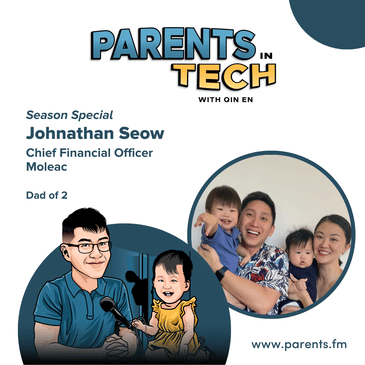
The journey of raising a child with special needs, overcoming the anxieties of being a first-time dad in a difficult situation, and learning how to show more support for one’s spouse. In this special episode, I speak with Jonathan Seow about the challenges and lessons he learned as a father of two.
Jonathan is the Chief Financial Officer at Moleac and a board member at Down Syndrome Association of Singapore. Jonathan has an illustrious career starting as CIMB before rising the ranks in the biopharmaceutical space. He's also an active advocate and supporter for families with children diagnosed with Down Syndrome.
Jonathan’s eldest son Nathan was diagnosed when he was still in his mother’s womb. Despite the medical advice and snide remarks by the gynecologist, who said that their kid would turn out to be “gross”, Jonathan and his wife decided to keep Nathan. Now, he's in a loving home environment with the help of a better gynecologist and a community that helps them learn how to become better at parenting children with down syndrome.
My conversation with Jonathan was inspiring and I hope it is for you too.
The Down Syndrome Association of Singapore (DSA) is also hosting the Mystique Charity Gala Dinner on Saturday, 24 September 2022. This event will mark DSA’s first in-person event since 2019, which aims to raise $300,000 to continue the association’s mission to serve persons with Down syndrome and their families with quality programs and services.
Support this cause with a donation of any amount, or purchasing a seat / table for Mystique here: https://give.asia/campaign/dsa-mystique-xvi-charity-dinner Donations will be eligible for a tax deduction of 250%
To get in touch with Jonathan Seow, find him on LinkedIn: https://www.linkedin.com/in/jonathan-seow/
Don’t forget to head over to www.parents.fm to stay up to date with new and previous episodes, join our community of parents in tech, or drop me a line.
Thanks for listening to the Parents in Tech podcast with me, your host, Qin En. We hope you were inspired on how to raise kids and build companies. To catch up on earlier episodes or stay updated with upcoming ones, head over to www.Parents.FM to join our community of parents in tech. There, you can also drop me a question, idea, feedback or suggestion. See you next time!
[0:39] Introducing today’s guest, Jonathan Seow
[1:59] How Jonathan and his wife found out they were pregnant
[4:42] Finding out about Nathan’s condition
[9:58] Working and parenting a child with down syndrome
[14:02] Doctor said the baby will be “gross”
[15:32] Looking for role models
[16:56] Importance of early interventions
[18:45] Managing highly demanding jobs
[20:53] Parenting work schedules
[22:20] What is the Down Syndrome Association?
[24:25] From a parent to a board member of Down Syndrome Association
[25:38] How to get involved with the association
[26:44] The golden advice for dads
TRANSCRIPT
[Qin En 0:00]
Hi, I am Qin En. And this is the Parents in Tech podcast.
Welcome to season two, where we interview dads, who are technology company leaders based in Southeast Asia. After hearing from moms in season one. Now it's time to speak to dads, who are raising kids while striving in their careers. Let's find out the stories, challenges, and advice they have for us.
In this episode, I speak to Jonathan, Chief Financial Officer at Moleac and board member at a Down Syndrome Association of Singapore. Jonathan has an illustrious career starting as CIMB before rising the ranks in the biopharmaceutical space. He's also an active advocate and supporter for families with down syndrome.
Jonathan is father to two children, including a son, Nathan, who turns two in September. My conversation with Jonathan was inspiring and I hope it is for you too.
Hey, Jonathan, welcome to the Parents in Tech show. To begin with, could you tell us a bit more about your family?
[Jonathan 1:19]
Hi, Qin En. Thanks for having me. Sure. So I'm a proud father. My wife and I have two under two, so the oldest is turning two in September. Youngest is five to six months old now. So as you can imagine, it's quite a handful, back home.
[Qin En 1:38]
Wow. Congratulations. But I also imagine you're not getting much sleep.
[Jonathan 1:42]
No, I, we just about got to the stage where we can sleep through the night with number one, and then number two decided to make an appearance.
[Qin En 1:50]
That's wonderful. That's wonderful. Now let's dial back a little Jonathan, right? Well, we love to hear a bit more about how you got to know your wife. And also when did children come into the picture?
[Jonathan 1:59]
Sure. So let's see, we got engaged [in] 2017. Married in 2018. So essentially I guess we two to three years of just each other before our baby was born and we found out we were pregnant. So it's an interesting story because in December 2019, you know, that's when we went for our sort [of] annual end of the year trip. So we were in Jordan, my wife and I with her sister, three of us. At that point in time, we did not actually realize that we were already pregnant.
So we went climbing, this climbing that, still drinking, the whole works, came back to Singapore. Couple of weeks later we realized, oh, okay. What a pleasant surprise.
[Qin En 2:53]
Oh, that's wonderful. Now I know, you shared this or so, but I would love to hear a bit more about how that pregnancy journey went. When was it that you discovered, and made the discovery and yeah, maybe just talk to me through that whole process?
[Jonathan 3:09]
So even before, at that time, we wanted to sort of find out how fertile we were, like, you know, we always thought we wanted a bigger family, so maybe three kids. So the idea is okay, we can't wait too long. First one, you know, has come quite soon before, you know, we start planning for the next. So on that basis, we're, okay, let's just go get ourselves checked now.
Turns out, you know, by and large, we, okay, she did have some issues. So the fact that the first pregnancy came so quickly was a very, very pleasant surprise. As with any pregnancy, I think, you know, once you find out you're pregnant, you pee on your first pregnancy thing, then you pee on the second one immediately after. Cause you just don't quite believe your eyes.
In our case, we did probably five or six before. Like, the next day, we wake up early in the morning. Okay. Let's just double check. We, you know, we went to see a GYNE that was recommended by a friend. In a private setting, we found out we were pregnant.
We sort of did everything. At that stage, it was three weeks so you have to do your own scan. Again, you know, as a parent, I think, you know, that first trimester getting past [is] sort of the biggest hurdle, if you like.
[Qin En 4:40]
Correct.
[Jonathan 4:42]
So we went [to] the clinic, super excited, we're like, okay, all you're hoping for is to see a heartbeat. So we went to the clinic, you know, saw the heartbeat, but the GYNE took especially long, kept scanning, going over. As [a] first-timer, you don't really know what that's like.
You, perhaps, think, okay. I guess that's normal. But then she kept going over, kept going over, you know, different angles, tried to shift her tummy a little bit. And then, she said something that guy said, well, you know, generally looks good, happy is good. But that's one thing that I'm not quite happy about.
And she said that there was a thick nuchal fold. So again, just for the benefit of, you know, all the listeners. So for meaning the thickness behind the neck. It's something that they'll look at, right. Typically should not be too thick, anything that's out of their normal range. I think it's 2mm, they consider that, you know, potentially a genetic condition.
So that was our first indication as to, okay, maybe it's not an entirely smooth pregnancy. That came as a bit of a shock. We were like, OK, what's all of this about? She referred us to get a second opinion.
[Qin En 6:02]
Yep.
[Jonathan 6:04]
She then also, obviously went for the natural parent, finger and NIPT. Those prenatal testing. Our results came back as high risk. So at that point, when she, and you know, if you know my wife and I, even while waiting for that two weeks to pass, we were calling her every single day and trying to chase, not just her, but trying get the number of the laboratory, you know, trying all our means to expedite the process.
So we got our result fairly quickly, [and] came back as high risk. We, it was a huge shock. I think that that whole two weeks of waiting was not pleasant to say the least. We went to the doctors. Our first words were, we decided that we do want to keep the child.
And her first words were, at that point, just about when COVID hits, where everyone's wearing masks and all that. And she's like, oh, you guys [are] Christian. And that also took us, you know a bit like, oh, why does that matter? Or what, you know, what's the relevance? And then, you know, she did further checks. So that was sort of the journey as to how we first found [out] about Nathan's diagnosis.
[Qin En 7:24]
Wow. Wow. Okay. And then I may, maybe before we get to that, I would love to hear a bit more about the certainty that you and your wife had of not terminating the pregnancy. Where did that come from? Was there ever a discussion or was it just something that both of you were absolutely clear on that's not an option?
[Jonathan 7:44]
Okay. So the first inkling we had on, as I mentioned it. The scan and we're like, oh, what does that mean?
They did a few other checks. So for example, [the] nasal horn is another indicator. Apart from the nuchal fold, everything checked out at least for any new. So we, and we hope maybe it's nothing, but then obviously when the NIPT came back and it's high risk, the very first thing we did, called my parents, they came down, you know, view it, just in tears mostly that whole night.
My parents were super worried, you know, is this gonna change their marriage? Is this gonna change them fundamentally? Are they gonna cope financially? Between my wife and I, you know. Typically, maybe not typically, but before you do your sort of this 12 week scan and the NIPT, typically, I think most parents would have a brief conversation if what would you do if your child has down syndrome, you know?
So we did have that brief conversation. We went in knowing, okay, you would still keep the child, but I can assure you that at a point in time when you realized that you're actually, you know, in that position, It changes everything.
So we were just lost and wanting to find out more, right? It's, I think for most part, people probably don't even know anybody else with down syndrome, at least maybe not in their immediate circle. And so for us, it was a very foreign concept. We literally did not know any, really too much about it.
So that was a difficult period.I guess I work in the healthcare / life science area. So the first thing we did was dive deep into research. Understand what all of this meant, what are the implications? What are people with down syndrome, what are they doing? How are they living their lives? How are their families supporting them? That's how.
[Qin En 9:58]
Wow. Got it. And I know one of the things that also you mentioned was just the element of cost and finances, right? And also, I guess, balancing what you and perhaps your wife wanted to achieve in your careers and what that meant. Talk to me a bit more about the considerations and the struggles that both of you went through.
[Jonathan 10:18]
I think my wife was just infinitely stronger than I was. She was a lot more assured, but what was also so fundamental was that we agreed, we both needed to be on the same page, you know. It was gonna be very difficult if you know, one partner was, you know, wanted to keep the child, the other one did not. And then, it's always, you know, [a] struggle. So we support each other, make sure we are both really on the same page.
There's no pressure in that sense. For me again, when I wear my finance head, it's like, cost is gonna be a huge factor, you know? When we read more about the research again, after birth typically most children of down, they need to go for NICUs or neonatal ICU. Some sort of special care nursery. Nathan himself, I found, he did spend two weeks in NICU / SCN or special care nursery. All of this just meant shit, cost is going to add up, you know?
It's gonna escalate it. And then that's just the initial stage, you know, thereafter the whole life. And the biggest worry, and again, when you speak to other parents with down syndrome, especially in adulthood, what happens, when the parents are gone, what happens to the child?
So these are real issues. What was really happening is that, so I talked about doing the research. So apart from desktop research, the next thing we do is speak to other parents, right?
Once you found a community, community is amazing. Absolutely amazing. They'll tell you the story. So we reached out to this couple, [we] didn't know them, but you know, a local couple with a young child at that point in time, probably about four years old with down syndrome.
We reached out, because we saw an article that they wrote and we would love to hear more about how we, as parents, can better prepare ourselves for the journey. We met them one time, [and] spoke for 20 - 30 minutes. The next day, they texted us saying, we went through something similar and there were financial hurdles. We wanted to give you some money to help you get by.
So immediately they just offered 3000 dollars. We did not take the money in the end, but that just goes to show how strong the community is. You know, meeting someone for the first time, the next day, they immediately tried to help you out.
And so a lot of touching stories along the way. We happen to meet another contact who also has a child with down syndrome. And for me personally, that was the biggest soft turning point. So, and that was the day after we heard about the high risk news, right?
We went to see them. We met the child. The first person in my life I've ever met with a down syndrome was this one-year-old guy. It really showed that I'm not that inexperienced. They are still a loving family. They love their child to bits. They are to go and do anything that you can imagine, typical parenting with his or her child. And so I think that showed us, like, it's not that bad. Sure, sure. It's [gonna] be a lot of work, but I think any child, it's always gonna be a lot of work anyways.
[Qin En 13:46]
Definitely. Definitely. Now I'm curious, right? In those conversations you had with parents in your research or discovery journey, what were some of the differences that you, people told you or you read about and did those actually play out?
[Jonathan 14:02]
For us, what was particularly disheartening was when we first found out and we first thought that we wanted to keep the child, she did for the scans and then unfortunately, for Nathan, he had this, sort of like a bubble or halo over his entire head. That's something called cystic hygroma. But based on that, she taught us a bunch of inaccurate things, for example, she said, your child is going to turn out gross. Like, why are you saying that to me?
[Jonathan 14:34]
Wow. Wow, wait, actually, she actually said that like the word, gross?
[Jonathan 14:38] I quote verbatim, “Your child is gonna come up gross. Do you know what spastic is? The child's gonna be spastic. Spasticity. Yeah. “I understand why you're saying that?
So that was not easy to hear. Suffice to say that was also [the] last time we saw her and we changed our GYNE right after. So her last words, as we we're soft exiting her clinic, the literal words were, take it for me. Just a minute.
[Qin En 15:10]
Wow. I'm sorry you had to go through that. That just sounds so terrible.
[Jonathan 15:32]
It’s crazy. So I think we started off the ground immediately fearing the cost. This is something tiny. He's telling you, [as a] first-time parent, you're immediately scared. Yeah, right? Yeah. But, like I said, you, thankfully my wife's a lot stronger. So we went to do the work and we found that it’s not that probably unlucky that the tiny who, medically inaccurate in a lot of the things she must say. But let's say that with any child with down syndrome, you reach out the few different resources And so when we started looking for sort of your role models, you like, we saw examples, especially in the west and in the US, and in Australia, where people go, down syndrome going on to achieve amazing things. Some, you know, one became an Ironman, some went on to university. So they can go on to achieve a lot more, as long as we give them that exposure, you know, we don't go around setting limitations on what they can achieve and just treat them like any other child.
[Qin En 16:35]
Absolutely. Absolutely. So I also know that early intervention started very early, probably when Nathan just entered the role. Maybe talk to me a bit more about that process because some of the parents that are listening to this, perhaps a handful, might be going through this journey at some point. We would love to hear a bit more about what the experience is like.
[Jonathan 16:56]
So why early intervention is highly critical is because with down syndrome, that means your development is typically the way to catch up within your typical child, in terms of developmental milestones. So they'll hit their milestones. It's just adelay. So to narrow that get narrow ,delay, it's really through intervention. So for a typical child who you'll probably learn how to crawl, or how to walk, that comes very naturally. For a child with down syndrome, you need to be a lot more conscious and intentional. So when Nathan was five weeks old, he started early intervention.
This was about once a week and again because if not for COVID, it would be a lot [more] regular but because of COVID, it was only once a week. That’s all the association could take on and so that’s the number of kids they are able to see. So once a week, we were going in for sessions. Even simple things, I guess most people think about flipping from back to front, front to back. These are things that we needed to be a lot more intentional about. Learning how to drink milk, because with down syndrome, you are typically lower muscle tone. Learning how to drink milk, swallow, these are things then needed to be encouraged, needed to be taught. And again, big shout out to KK Hospital. You know, our best decision was really gonna [go to] KK Hospital. The suite of sort of add-on services that they provide. Speech therapy, physiotherapy, immensely helpful.
[Qin En 18:31]
Got it. Yeah. I'm curious, Jonathan, as you went about going through these early interventions, I'm sure one big part of it is also how I manage my career. My work. Talk to me a bit more about that. And the stress that went behind that.
[Jonathan 18:45]
Both my wife and I have highly demanding jobs. I mean, she's a startup founder. I currently [work as] CFO [for] my company. Highly demanding jobs, but I think one again. So Nathan was born September 20. For most part of the pregnancy, we were locked down, which worked up great. Quite honest, even as, you know, as things slowly opened up, for most part, you're working from home. So that really allowed us to spend additional time at home with the family. Just support each other as best as we can. Gradually trying to bring in that village where it's parental support. Yeah. And really trying to fit everything on the schedule. A lot of parents that we spoke to who were raising children with special needs, quite often one and I'm maybe generalizing it a little bit, but quite often one parent will potentially decide to take a step back in terms of career.
Maybe be a stay-at-home dad or mom, the other parent goes off work. For us, we realized that we both do enjoy our work. We both enjoyed our careers cause it doesn't help that we also have a mortgage to pay. We both genuinely enjoy our work. So it wasn't something we wanted to necessarily leave time, but [at] the same time we were nice. We can do both.
You know, I think it's a fallacy to think that you have to choose one or the other. You can do both. I [was] able to do both really well as well. You know, it's not like you're gonna not be able to achieve at work if you, you know. For us, it's a lot of work, but it's doable. And I would encourage other parents to be open to that idea that yes, you need, you probably need an understanding boss will allow you to take some hours off in the day to send your child for therapy, but you know, you know, I'm fortunate enough. My boss is also understanding. And so I, you just make up the hours at other times of the day. And the biggest benefit about having a young kid is you're not gonna be sleeping in the middle of the night. So that's all the time you get, you know, to make up the hours. So there you go.
[Qin En 20:53]
Wow. And it sounds like both you and your wife are very engaged. And so tell me a bit more about how parenting workload schedules, how is that managed between you and your wife?
[Jonathan 21:04]
We are both very involved. We have children with down syndrome, so that just means a lot more hospital visits, but it's something more mundane, just making sure everything is off the chain in terms of the health but that’s something that requires interventions. There's a bit more to do. You really need both parties to take a hands on approach. So we support [each] other, if I'm unavailable in that couple of hours, she steps in, if vice versa. So i think we probably kind of fought a lot with a physician when a child is less active in the clinic both to step in. During the times where both of us are not able to shift our schedules around, you know, grandparents come into the picture. So that's always helpful.
[Qin En 21:51]
Definitely. I think it truly takes a village to raise a child. And one of the support networks you earlier mentioned was the Down Syndrome Association of Singapore. Tell me a bit more about how, how you got involved with it. Well, I guess you mentioned earlier about reaching out during the pregnancy, but, yeah. Would love to hear a bit more about what this association is, and now you are a board member at it. So what was the journey like to get involved and yeah, help educate us on what the mandate of [the] Down Syndrome Association of Singapore is.
[Jonathan 22:20]
Again, in that journey. When you find out your child's down syndrome, the first thing you do nowadays is you Google, right? So down syndrome Singapore, all the first few searches you come across is Down Syndrome Association Singapore. That's how we sort [of] came across and we realized, oh, there's an association, there's a community around us.
That's one of our main resources in terms of finding out more about what down syndrome is, you know, they provided us that support and the sort of during the pregnancy stage where they were able to say the first few words that you, when you tell someone else you have a child who probably has down syndrome when you're pregnant, the first few words someone would typically say is sorry.
Whereas as a parent, what you really want is congratulations. Like something like congrats on being pregnant. So even little things like this. What to say, what not to say to parents with a child who have children of down syndrome. Then they came onboard, they were like, hey congrats guys. We love to keep in touch here. Here's a slew of different programs that they offer. So essentially, they do sort of, you know, from both, all the way on to adults. So the earliest there was something called, infant toddler program. In the later years, something, what they call IFSP. So essentially they have different programs catering to different life stages of someone all the way to adults who [are] trying to put them in the workforce.
They work with different agencies in terms of placements. And then the end goal is really independent living. And so that's what the association tries to help you with the various enrichment classes and programs. First contact point was during that pregnancy where we're like, okay, what does all of this mean? Can you shed some light?
And then the second point of contact was this infant toddler program that I talked about. So when I say Nathan started therapy at five weeks, and that's where he started off his first early intervention classes.
[Qin En 24:19]
Right. And then now you are a board member. So talk to me a bit more about that.
[Jonathan 24:25]
Sure. And because of my child, you know, this became a topic that I'm highly passionate about. Raising that awareness was something that I'm particularly passionate about.
You know, when I went through my own journey, I realized there's just not enough awareness. There are probably, you know, millions more like me, parents, where their first point of contact is with a doctor, [who] tells them something. Potentially in their career, it scares them into, you know, terminating. And I think at the end of the day you have your decision.
That's fine. But at least you're presented with facts and you’re able to make the sound decision based on those facts instead of being scared. And so this whole topic about when it became something I was passionate about tried to reach out to the hospital. Like, is there anything you can do? So, and then I started speaking more to [the] Down Syndrome Association and, you know, through that I became more and more involved. For elections, I raised my hand and that's how I got involved as [a] board member.
[Qin En 25:24]
Wow. Okay. So tell me a bit more about that involvement, what plans you guys have for the association and how parents who want to support even those who are, you know, perhaps their children do not have down syndrome, how can they get involved?
[Jonathan 25:38]
Yeah, so I think that association is great because they're really trying to go after the whole community of people with down syndrome, whether you're at the early stage, just finding out. Little infant toddler supporting you through primary school, helping you with independent living. That's where the association really tries to come in and help. And so all of this is sort of self-funded. And among the many charity sort of fundraising efforts that the association does, one is really a charity gala.
So this charity gala. An annual dinner, September this year. So September 24th. We have ministers gracing the event. And it's really an opportunity for, again, back to that awareness for people who may not necessarily have that contact with someone with down syndrome to go and see, Hey, we can achieve a lot more.
There's a lot more that people down syndrome can achieve. So I would encourage, you know, your listeners to check it out, you know, whether it's an donation, whether it's buying a table or seat to the event and really seeing for yourself that these beneficiaries can go on to achieve.
[Qin En 26:44]
Definitely. Well, we'll definitely include that link and share that with our audience too, so that they can support that. So, Jonathan, looking back right at the whole parenting journey, is there anything that you would've done differently?
[Jonathan 26:55]
Let's see the biggest lesson for us was that at least for me personally, was [to] help supporting my wife. I think it's easy to think, “Oh, you're just going through some body changes,” but in reality, it's a lot more than that. They're growing your child. They might be experiencing body changes that you never ever [would] be able to imagine. They go through the birth, immense respect for what my wife went through. And now not just once but twice and through it all yet we're remaining strong for the family. So with Nathan, it was [a] more challenging pregnancy than you would expect. We had a lot of health concerns along the way. But you know, she remained the pillar of support. If there's one learning point, it's really how best as a father, as a husband, we can, you know, best support.
[Qin En 27:49]
Indeed indeed. That's golden advice, right? Truly. It's such a physically and mentally challenging journey for our wives when they go through that journey and to be able to be there, to support them. I think that's critical. Jonathan, this has been a really enjoyable conversation to wrap up our time today. What advice would you give to parents out there, having been a parent over the past two years, yourself?
[Jonathan 28:14]
I think, trust yourself. Quite often, you are trying to ask this friend, that friend, read up on the internet. What should I do? Do I do this? Do I do that? I think at the end of the day, trust that you're a parent and your own instinct and you know [the] child best and try that you are doing the right thing and the child will grow up perfectly fine.
[Qin En 28:34]
I love that. Trust yourself. Don't worry so much and just stick with your principles. So, which is exactly what you and your wife did. Well, Jonathan is such a joy to speak with you today. Thank you so much for taking time off and yeah, we look forward to seeing you around as, at the dinner too.
[Jonathan 28:50]
I love that. Trust yourself. Don't worry so much and just stick with your principles. So, which is exactly what you and your wife did. Well, Jonathan is such a joy to speak with you today. Thank you so much for taking time off and yeah, we look forward to seeing you around as, at the dinner too.
[Qin En 28:56]
Thanks for listening to the parents intact podcast with me, your host Qin En. We hope you were inspired on how to raise kids and build companies. To catch up on earlier episodes or stay updated with upcoming ones, head over to www.parents.fm to join our community of parents in tech. There, you can also drop me a question, idea, feedback or suggestion once again, the website it's www.parents.fm.
That's all for this episode, folks. See you next time.