
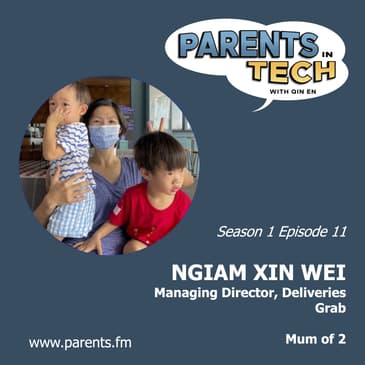
Managing expectations placed by society on mothers, pursuing passions despite a busy work and family schedule, and carving out time for yourself. Xin Wei shares with us her experience mothering two young children, and how she learnt to be physically and mentally present no matter how busy work gets.
Ngiam Xin Wei is Managing Director of Deliveries at Grab, the iconic Southeast Asia technology company that recently went public. Xin Wei is a veteran Grabber who joined in 2015. Prior to her current role in deliveries, she held key leadership positions including head of GrabHitch, the social ridesharing service, and the Head of Economics and Marketplace. Recently, Xin Wei was recognized as Prestige 40 under 40 and Singapore 100 Women in Tech.
We discuss the stresses new mothers suffer from, such as expectations on breastfeeding and making excessive sacrifices for the sake of caregiving. Xin Wei believes that breastfeeding, as with parenting decisions, is about choosing what fits you and your child. She also shares how, in the long run, keeping your passion aflame has a valuable influence on children. That’s why she sets aside time for other activities, like exercise, learning something new through podcasts, or building her wine collection.
To get in touch with Xin Wei, find her on LinkedIn https://www.linkedin.com/in/xwngiam
Don’t forget to head over to www.parents.fm to stay up to date with new and previous episodes, join our community of parents in tech or drop me a line. I’d love to hear from you!
Thanks for listening to the Parents in Tech podcast with me, your host, Qin En. We hope you were inspired on how to raise kids and build companies. To catch up on earlier episodes or stay updated with upcoming ones, head over to www.Parents.FM to join our community of parents in tech. There, you can also drop me a question, idea, feedback or suggestion. See you next time!
Transcript
00:06
Qin En
Hi, I am Qin En. And this is the Parents in Tech podcast. Welcome to season one, where we interview mums who are technology company leaders based in Southeast Asia. We want to hear stories, hopes, challenges, and tips from moms who are raising kids while pursuing their career aspirations. In this episode, we speak to Xin Wei, Managing Director of Deliveries at Grab. Xin Wei joined Grab in 2015 and was pivotal in the rollout or Grab’s social ride sharing service GrabHitch. Prior, she worked at the Boston Consulting Group and the Singapore government. Recently Xin Wei was recognized as Prestige 40 Under 40. She currently has two sons, aged 3 ½ and 2. Hi, Xin Wei. Welcome to the Parents in Tech podcast. We are really glad to have you here today. To start off with, can you tell us a bit more about your family?
01:06
Xin Wei
Hey, thanks for having me. Yeah, I have two boys. The older one's about three and a half. And the younger one is coming up to about two years old. I have a husband. So, the four of us live together. It's a pretty crazy household given how small they are and how much time they're spending at home these days.
01:24
Qin En
Nice. You said your younger boy is two years old. So, you had him just before COVID struck. Tell us how did you feel. Clearly, none of us expected this to blow up the way it was, but what was it like to have a new born at that stage almost two years ago?
01:39
Xin Wei
Well, to be honest, he was born just before all the COVID restrictions kicked in, especially at the hospitals. We didn't really sense anything at the point at which he was born. In fact, I think we had no idea what was about to hit us. And as the situation developed, I think we felt very thankful that we will all be able to work at home and stay safe. Of course, when it came time for me to go back to the office, which was some time in, I think, April or May, actually all I did was logged in to my laptop and went upstairs to my bedroom and did some zoom calls. The work from home regime actually really helped my transition. It allowed me to be a little bit more flexible. I spent a little bit more time with the baby, not have to spend lots of time commuting and of course, I didn't have to travel. In many ways, that was a blessing in disguise somewhere there.
02:33
Qin En
That's very nice to be fully present, to be with them. I like to see it as a once in a generation opportunity that very few have. How about the elder son at that point? Because was he at school? And what was the impact on him? I think at a point, schools were closed. What was the impact of having two very young children at home? Like you mentioned, a bit on the higher maintenance, did that create a fair bit of stress for you and your husband?
02:57
Xin Wei
At a point at which the younger boy born, the older one was not yet in school. So, he was just about 19 months at that time. It was definitely an adjustment for him. He spent the first six months or so, I think, being quite clingy and maybe a little bit insecure is the word to use. Kind of demanding attention and feeling maybe a little bit maybe neglected, if we spend so much time with the baby. But that soon passed. I think something that we saw and what's really nice to see was how he also grew really attached to his younger brother. So of course, it's always a love-hate relationship between siblings. But he grew to really enjoy his brother's presence. Especially when the younger one got a little bit more mobile, so he’ll trying to chase him around, teaching him how to crawl and so on. When he did finally go to school, he started going to school maybe second half of that year. So, he started going to kindergarten. Then things kind of settled down a bit because he now had a new experience to learn about. And he was three to four hours in school in the morning. So, that gave us more stability at home as well.
04:05
Qin En
Got it. Now, you touched on something very interesting. And it's new to me, but I guess probably because I only have a daughter, but about the insecurity, especially when you just welcome your second son. How did that look like and how did you respond?
04:19
Xin Wei
How does that look like? I think it was largely expressing just a desire for us to spend more time with him. So, he will ask if he was eating or he was doing things that he would normally be happy to do by himself. He would not ask for mommy to be around. He would sometimes get upset if mommy picked baby up and was carrying baby for extended periods of time. He might cry a bit more. He would just demand your presence more. I would say that's the main way in which it manifested. And I guess how did it resolve, how did it change is that, we spent quite a bit of time before the baby arrived, talking to him about what it meant to have a sibling. But being 19 months, I think understandably he didn't really understand much of it. We did all the stuff like read story books, all these great story books, kids’ books about what it's like to have a sibling, what to expect when you come at the hospital.
05:13
Xin Wei
We did all of that, but we didn't expect him to absorb most of it. And indeed, he didn’t. But I think over time, we made sure to shower him with enough love. We always made sure that we were spending largely equal times with both of them. We try very hard not to disrupt existing routines. So things like bed time routine, we would try and stick to that and do the baby duties around that to make him feel that, not that much had changed. I think over time he was keen to accept that and he came to really enjoy having his little brother around.
05:47
Qin En
That's really nice. It's like this journey of growth that is compressed. You see that evolution. It sounds crazy, right? Because you are with one of the iconic technology companies in the region. You have such a senior leadership. I'm sure there's so much busy-ness and stress that's going on. And then you have two really young, really cute, but also probably, like you said, high maintenance once again, how did you go about dealing with that stress of being a mom and a tech leader?
06:16
Xin Wei
That's a pretty great question. I think I would say that a big part of parenting and being a mom at work is, there are two very important factors. One is just an external support structure. I think that in Singapore, we are fortunate that we actually have fairly extensive support structures. We've got a really good and we have a subsidized childcare system. And many of us have live in helpers. And we are lucky to be able to also rely on, in some cases, grandparents and so on. So, having that external support structure and setting that up in the right way is I think a critical component of surviving and thriving as a mom who works full-time or more than full-time. I would say that's almost like the first thing that I would do. As a new parent, just think about your support structure and don't be afraid to emphasize on your support structure, as and when you need.
07:18
Xin Wei
I know a lot of parents, especially moms feel guilt. Like they say, “I don't want my kid to be in school all day”, or “I don't want this and that.” I've gone through many versions of those sorts of questioning. Especially in the past when we had to travel and I was away from home for like 3-4 days a week, but I think at some point you have to realize that doing what makes you happy and fulfilling it is important. For many of us, work plays the important role in our lives. So, setting up the right external support structure that you can trust is a big part of that.
07:47
Qin En
Yeah. You mentioned a spot-on topic which is guilt. And I think dads face it, but I think moms especially, because of probably how we're constructed biologically, feel that quite a lot. Can you share with us a time, a situation where you felt that and also how you overcame that? Because I think that would be really helpful to some of our moms who are listening.
08:08
Xin Wei
I think there is a lot of guilt that comes, especially for mummies, it comes from two sources. One is breastfeeding. Breastfeeding is one of these culturally, I don't know, controversial is the right word, but yeah certainly a lot of varied and strong opinion on breastfeeding among different cultures and communities. And I have realized in myself as well as the friends around me, that breastfeeding turned out to be a big source of stress. I mean, apart from the fact that it's exhausting, there are a lot expectations around what the experience should be like. And when the experience falls short off the expectation, then there are a lot of questions as to why is this happening to me? Am I doing it right? Am I short-changing my baby by not committing to a full breastfeeding regime? So, I think that's one component. The other component of guilt is just the spending of time and for working moms, getting home. I always remember trying to rush home before my helper had to put the baby to sleep with the older one there is. And many times, I just didn't make it. I would be in the Grab being like, okay, I really hope I can get home. If there's a traffic jam, I start to feel really stressed out. And how do I resolve that? I'm not sure if there was any one thing that I did. But I think over time, something that I came to realize was that the important thing when the child has to be surrounded by a loving, supportive, and a trusted environment, and that can be provided by many different people and many different structures. It doesn't just have to all come from you. So even if you're not there, if your husband's there, the grandparents are there. In our case, we had a really good helper and she played a lot of that role for us in the early days. And we are very fortunate to find her. Your child will be as happy, as well adjusted, as stimulated as he or she will otherwise be if you were there. I think understanding that conceptually definitely helped me to come to terms with what I felt were some of the moments that I was maybe missing out on.
10:28
Qin En
Well, I think you just unpacked two very interesting topics. Let's start with the first. I completely agree with you on how breastfeeding, while I think it's a very positive thing, clearly there's a lot of science to it. It's such a stressful event. I vividly recall every time I go into the hospital, OB GYN section, there'll be posters. Like, ‘WHO recommends breastfeeding for the first six months exclusively.’ There's just so much marketing and promotion saying that how you got to breastfeed. It's like, there's so much around that. What was your take on this and what worked for you? Because sometimes these pressures can be so overwhelming. What was it like for you?
11:08
Xin Wei
I'm one of those people who didn't have a very strong view of breastfeeding going into pregnancy. And many people do have a view. I just happened to not have encountered very much literature. It's always something that I read about as I was preparing to deliver the child. So, I kind of had a view. I knew it was a good thing, but I also had read enough to know that it wasn't a game-changing thing, especially in developed countries where children have good nutrition and clean water and so on. I think I went into it with a very philosophical view on breastfeeding. I will say that once you’re in it though, your experience does change. And it kind of starts from being at the hospital where the first thing that you're asked to do after you deliver your child is generally to feed your baby.
11:59
Xin Wei
And that's when you’re like, “Oh, okay. So, this is kind of the first act that is expected of me as a mom.” For many hospitals, they will assume that your default preferred method is breastfeeding. And there'll be questions or quizzical looks if you ask the nurse to maybe not disturb you tonight and feed your baby formula. I think there's some of that very subtle perception shaping that takes place in these settings. I don't think it's at a negative thing. But I do think that depending on how you come into it, you could read more into it than it's intended. And so, I think that's where some of the stress on breastfeeding started to build.
And of course, you know as a father that the milk intake of a baby changes really quickly. And it escalates kind of in a way that you would never imagine that a very small child could drink so much milk on demand.
Qin En
And so regularly.
Xin Wei
Yeah. So regularly. And in at least the first two weeks, most moms find themselves constantly feeding. It's an exhausting thing you feel and you actually don't know if you’ve got milk or not. And of course, as driven, ambitious people who have spent their lives trying to do great things and got jobs and so on, you want us to be good at this thing too. This was supposed to be something that defines in some sense, how well you can nurture your baby. I think all of these things mix into this cauldron of postpartum, sentiments, and insecurities and questions that you have. I think that's why for many women breastfeeding just becomes kind of emblematic of that state of mind of not really knowing what's expected of you as a parent. Like wanting to be really good at it. I mean, parents trying to do as much as they can to be that for your child.
13:55
Xin Wei
So, it is really very hard. I think for me, I just came to a point where I told myself and I spoke to many women about this including many experienced moms. And actually, many of them told me in the end like, “You know what? It doesn't really matter.” Some of them say, “I breastfed all the way.” Some of them say, “I couldn’t do it for more than six months.” Some of them said, “I just started at 50%.” And overtime I realized that different people treated this topic differently and there was just no right answer. I should just go easy on myself. So when the second child came around, it was much easier to be more relaxed. Ironically, I ended up breastfeeding for longer to the second child, because I guess the stars were little bit more aligned. But in both cases, we transitioned them to full formula milk by probably 8 or 9 months or so.
14:46
Xin Wei
I guess it made me a lot happier. I self-beat myself up a lot more to actually spend quality time with them. So, I would say to any mom who's going through this difficult decision, optimize for yourself and for what's going to make you the most present and fulfilled mother. And all the other stuff can be solved in other ways.
15:07
Qin En
Yeah. That's spot on. To prioritize yourself. Of course, the self-sacrificial love that a mom has for the kids, it's always so valuable. But I think especially in that period of transition, often it's hard to take care of yourself. I'm so glad that you mentioned that. And definitely that's a good call. So Xin Wei, after that whole breastfeeding transition, what was something that was more challenging than you expected when you first became a mom? Or maybe even when you had your second child?
15:35
Xin Wei
Well, there are many changes to the lifestyle when you have kids. I think the biggest adjustment that we had to make was the ability to compartmentalize and be present with our child whenever we were there. It's something that, I guess, we're still in many ways struggling with. But before you have a child, you afford to be with you all the time. And you multitask constantly throughout the day. So, you might be working then you might take a break for lunch as you're eating. And you might be eating and chatting to a friend. But you might still be having an eye on notifications. You might check the messages. We live in a very stimulated environment in that sense. Most of the science would tell you that screens are not good for very young kids. I think that's a long debate about how good or how bad screens are. For slightly older kids, maybe one and a half to two years old onwards. And they’re a little bit more able to learn in that way. But for babies and so on, most of the research is fairly clear on the fact that they're not really preferred. And there's really no reason why you should make a baby watch your phone.
16:50
Xin Wei
There are so many other things that they should be looking at, the world around them that they’ve just encountered. I think a big part of it was just being mentally present. Even while we’re physically present, sometimes we are not always mentally present. Things like just putting away our phones or even just trying to not think about work for that one hour during dinner and just trying to engage in your child, coming down to their level, like sit physically on the floor and looking at what they're interested in, trying to talk to them, notice their expressions. It kind of brought us to a level of deep, personal engagement that I feel maybe we don't really do very much anymore as adults. But it's pretty fascinating to do it with a child. I think maybe that was the biggest adjustment that we had made.
17:37
Qin En
That's so relatable. Once I had my daughter and it became a situation where I really had to put my phone away and be present with her. And it really trains the discipline. I think it's different even, let's say, you’re married without children. Sometimes personal conversations get interrupted with work and your partner would understand because they go through something similar. But for children, they don't understand. They demand your full 100% attention. You also mentioned about learning and seeing what's of interest to them. If I can flip the question back to you Xin Wei, what's something that you're curious about now as a parent or in general?
18:14
Xin Wei
In general, I mean that's a really big question. Like everyone, I'm trying to wrap my head around Web 3.0 and all that stuff, trying to understand crypto and its applications, trying to understand all these new-fangled applications and FTEs and how they might apply to maybe both of our work and our personal lives. So, that's something I'm personally very curious about right now, I think, along with half of the globe. Other things that I'm personally quite interested in collecting wine. That's another hobby that I picked out over the past few years.
18:55
Qin En
Nice. Are you into red or white? Or Moscato sweet?
19:00
Xin Wei
I would say I'm fairly agnostic on the color of the wine. Yeah, I think apart from that, I suppose something to share here is that my younger child has a bit of a speech delay. He's coming to about two years old. He says very few words. It's something that we've been researching a fair bit and reading about. That's something that I also have spent of time just trying to learn about how speech develops. That's all-neuro connections that need to be made before a child can start to verbalize and some techniques for getting children to speak. I suppose on the parenting front, that's one of the explorations that I've been going through myself.
19:43
Qin En
Got it. Now, this is really fascinating. And thanks for sharing this. Could you share how that notice or how that realization happened and when was it like? Because I think for especially many new parents, this might be new for them. It might be sometimes scary. I think your sharing here would be very helpful.
20:00
Xin Wei
My youngest son in most respects, I would say, he hit his developmental milestones much more on time than his older brother. The older boy was premature. He was a very small baby and he took his own time to crawl, to eat solid foods, all of those things. But the younger one has been generally very much on track and very high energy, like a very curious baby. This was the one thing that we expected not to have an issue with. But as time went by, as he hit his 18 months birthday which is when children are supposed to form 5 to 10 words, we saw and we were like, well, he doesn't speak any but maybe that's okay because he's pretty good at communicating. He can point. He's very expressive in the sounds that he makes and he makes his intentions known, but he can't form words.
20:59
Xin Wei
And so, we thought maybe that's fine. We waited another month or two. We talked to some people around us. And someone suggested that, “Hey, why don't you guys just go and get it assessed? Just go to a speech therapist. It’ll cost you a hundred dollars, but just know how serious this could be.” Because in some of these cases, it's purely just late talking. In some of these cases, it's symptomatic of something that's potentially larger. Like maybe a child is having issues like speech processing. It's not just that he can't express himself, but yet he doesn't understand what's going on. It could be a larger thing like autism or some other developmental issue. So, that's what we did. We saw two different therapists. One in the clinic and one in the home setting. Both of them came to a similar conclusion, which is that they felt that he was fairly strong on what they call a receptive communication, which is that he can still understand things that are being told to him. But that he didn't seem to have grasped the concept of expressive communication, which is actually using words to describe what he wants.
22:08
Xin Wei
So, he might use gestures, pointing. He might walk or run towards the object, but he didn't seem to grasp it, talking or something that he should do. And they recommended a few different things. They recommended some techniques like ways to talk withhold, and voice things out to him and talk withhold. Giving them to him unless he tried to make a certain sound. They also observed for instance, that the care setting for the younger child was actually quite quiet. Because when me and my husband work and the older one is in school, he's basically with our helper. And he's a very independent baby. He would just play by himself. The helper would be watching him, but also washing the dishes, preparing for lunch. So, he wasn't being engaged in a very deliberate way for a long time. They kind of hypothesize that that might be one reason why he hadn't quite grasped the language.
23:08
Xin Wei
I think this was little bit of a wake-up call for us. We were like, yeah. We've always just thought like, he is so independent. He's so good, he can play by himself. At times you forget he's even there in the garden playing with a ball or flipping through a book. So, I think we used the opportunity to adjust the way we interacted with him and try to be just a lot more deliberate about the way we do it. So, he has improved a lot. He still hasn't quite caught up, I think. But it definitely gave us an understanding into how the brain develops and maybe the things that we need to do to push all the thorns along the way. So, that was very valuable.
23:46
Qin En
Yeah. Wow, thanks for sharing that journey. I think just showing how you guys went about it and also do it in a very thoughtful way and now being intentional about it, I think that's helpful. It focuses on how do we address and how do we improve and change the situation. So Xin Wei, how do you explain your job to your sons? I guess mostly your older son at this stage.
24:10
Xin Wei
To be honest, I don't. But the one thing that we constantly say is that, “Mommy's got to go upstairs to tap tap tap and hello hello hello.” Those are the main words that he associates with us working, which is that we are tapping on a computer or on a phone. Then he also understands it sometimes when I call a car to go to the office, when I’m on my jeans and not just wearing t-shirt and shorts that I do at home. And a car comes up to the house and I step into the car and then I'm going to the office. He understands that uncle brings mommy to the office. So, he understands the actions of it. I haven't actually tried explaining the business to him, but I hope to do so in the next six months or so when he's a little bit older.
24:57
Qin En
That's awesome. Yeah, I think it will be so fascinating. Maybe if I could almost put you on the spot, how would you do it, let's say, 6 months from now? How would you explain what you do, to your son? I guess a Unicorn to him means something very different from what it means to us.
25:14
Xin Wei
I guess I’ll say, “Mommy has to make sure that when you want to eat McDonald's, the McDonald's can come to our house within 30 minutes.”
25:22
Qin En
I like that. That's great. It's something that's relatable. But maybe when next time McDonald's is delayed, he might be like, “Why is it not here?” But okay. Thanks for indulging me on that. Xin Wei in your role, learning and growing is such a critical part of it. With all that you are doing as a mom, as a leader, how do you continue to learn in order to stay on top of things?
25:44
Xin Wei
I think for me, it's about setting aside some mind space to ensure that I'm kind of keeping myself open to learning new things and new possibilities. Part of that is setting aside part of my schedule, say on a weekly or monthly basis, we try to do one-on-ones or coffee chats with people who I don't always interact with. So part on my team, maybe I do skip levels or for the more junior folks that have come in, trying to understand their mindsets and stuff that they're interested in. I sound like such an old person with all this, but it's all a little bit of that. Also colleagues who maybe don't work with me, work in other parts of the company or people who work in other parts of tech. So, setting aside a little bit of time for these networking type engagements. It’s not networking but in a superficial sense, I think finding people that can broaden my horizons and I can learn from, I think that's one part. The second is finding moments to ingest information.
26:50
Xin Wei
It depends on also how you learn and everyone learns in very different ways. For me, I'm not a very visual person. So, I'm quite receptive to text and words. I do try and read a lot, even if it's not like a full book. Be it articles, I save them. When people send me stuff, I make sure I set aside 20-30 minutes at the end of the day to flip through some new material I have to read. I like podcasts. So, I have a running routine. Every time I go running, I put on a podcast and I just kind of half listen to it and half run. That's often a good way for me to just take in new information. Those are some of the top techniques that I have. But they will differ for everyone depending on where you can find that time, depending on the best way that you learn.
27:42
Qin En
Well, you mentioned podcasts. What are some podcasts that you listen to?
27:46
Xin Wei
Most recently, I'm listening to a podcast called business breakdowns. It's on the apple podcast app. And basically, in every episode they talk about a particular business. There was one on Uber, for instance. It's all breaking down how is that business, where the monetization and profitability comes from and so on. I was just listening to one this morning about the Wyndham hotel group. So, they were talking through franchising hotels and how that's different from the hotel management model. It's just interesting to fill your brain with some other things that are a little bit different from work. So, I like podcasts of this nature where they just take a topic and dive into it and you can learn something, take away something from it.
28:32
Qin En
That's nice. And you listen to podcasts while you run. So the next question has to be, tell us a bit more about how you stay active, how you stay fit.
28:40
Xin Wei
Running for me is a fairly recent thing. I haven't run for many years. I busted my knee about six years ago. Since then, I've been very careful about doing high impact exercise. Apart from running, I also do a lot of weights. Before COVID and through the different parts of COVID when gyms were open and so on, I would go down to a gym. Now I have some equipment at home. I'm trying to, I guess, equip myself for the full work from home experience. So, I try to do that. I would say one change that I've made is that in the past, I used to set aside maybe one or two hours a week. During lunch time, you can go down to the gym if you end up in the office. Now because of our new work environment, also I think the pace of work has changed, y'all on Zoom all day. So, people don't go for lunch. You know, you go from Zoom call to Zoom call. It’s like 30 minutes-30 minutes-30 minutes. I switched to a more like micro workout type mindset. So what I said is my runs are usually in the morning. I wake up, the kids are getting showered or the younger one might still be asleep. So, I just go out and I do a run from 07:30 AM to 08:00 AM. I come back, the kids are usually ready to go to school or they’re ready for breakfast. In the middle of the day, if I've got 30 minutes between calls, I’ll go and do 5 sets of squats. And in other 30 minutes, I go in and do a bunch of other things. So, it’s like breaking it up, not being too tied into a full routine. I think that's something I’m iterating on, especially in the past year or so.
30:27
Qin En
I want to double-click a bit into that. Where do you design, plan or do your workouts from? Is it something that you go in, you just think of what to do? Or do you follow some programs, some channels? Tell us a bit more about that.
30:41
Xin Wei
I had a trainer for a number of years, someone who I'm still in touch with and I still train with now and then. So I think because I had that, it gave me a proper foundation on how to think about training. Depending on what your objective is, you have different exercises or different combinations you can do of reps and rest times and stuff and weights. At this point, I am just trying to stay active, stay flexible, and generally to just preserve muscle mass, I guess. I'm not trying to build a big strength or lose anything. I'm trying to maybe reduce my fat percentage and increase on muscle percentage, but I'm not trying to make drastic changes in my appearance or anything. I tend to go for compound exercises. I do hold weights. I do 5x5. I do 4x8. I don't do any programs that are particularly intense. Although there are those and they're not difficult to find online. But I think that if you do something very consistently and if you're not trying to make big changes, that kind of works out for me.
31:52
Qin En
Yeah. It's almost like a habit that you're building. So, do you have a preference of working out at home versus say, at the gym or outside?
32:01
Xin Wei
The nice thing about working out outside is that there’s just generally more space. I would say that’s the main benefit. You get to maybe try out new equipment now and then. So, I do miss it. I think when things open up a bit, I'll definitely try to fit in one or two gym type workouts. But for 90% of the time, I think working out at home is good enough.
32:24
Qin En
Yeah. And it gives you those slots. Because for example, you have 30 minutes between calls. You can't really head it out to the gym, but you can just head to your room and get a quick workout done. Wow. That sounds like a really balanced life, Xin Wei, that you’re leading. Something that I think many parents would aspire to. Let's say new or younger parents, especially those that are more junior level who are trying to navigate and manage all of this, what's your advice for them?
32:50
Xin Wei
I think the first piece of advice is just don't be too hard on yourself. It takes time to work out something that fits both you and your child. And every child is different. Every child has different needs. You don't have to rush into finding a formula that works. In fact, you should be prepared for that formula to constantly change. As your child grows, they go through phases, so on and so forth that you can’t expect them to stay the same as well. I think the second thing I would say is don't come into this thinking that you need to make big sacrifice. I mean, don't get me wrong. You do have to make sacrifices. It’s all a part. But you can’t come into this with a mindset that you willingly give up things that matter a lot to you. You have to come into it thinking that you need to maintain your passion and your drive because your child is going to benefit the most from observing a role model who lives life to the fullest, treats people around them with respect and has passion in what they do and all those things. If all you are is a sacrificial caregiver, I think at some point earlier or later, they will stop getting enough benefit from the caregiving and they will start to look to role modeling, emotional modeling and so on. So, don’t come into this thinking that you have to give up a whole lot of stuff. You need to be willing to make adjustments, willing to make changes to your lifestyle, but you also just need to be really focused on retaining what's important to you and what keeps you motivated and happy as an adult. So, don't give up too easily.
34:35
Qin En
Yeah, that's golden. I think one thing that stands out Xin Wei as I speak to you, is that you know what you want. You know what drives you. You know what gives you energy, what gets you out of bed. And I think because you are clear on that, therefore you are able to have that clarity and almost work your life around that so that there's that balance, that integration between your responsibilities as a wife, as a mom, and of course, as a tech leader. That's advice that we should definitely take. Now, maybe let's talk a bit about parenting responsibilities between you and your husband. How does that look like? Because stereotype says that moms are the primary caregivers, which in many cases it still is, but I'm just curious about how that conversation looked like.
35:19
Xin Wei
So in my household, I would say that I am probably closer to the kids from a caregiving perspective. Not sure exactly how that happened, to be honest. It's not something that we deliberately intended, but it did turn out that way. I think partly it was also because my schedule, firstly it's a Southeast Asia company. So, I don't generally have a lot of late night or very early morning calls. Whereas my husband is in a global role. So, his schedule is more unpredictable in that way. It's more likely that I'll be around for breakfast and bed time and be able to take them to school. My schedule is also a little bit more flexible, I will say. Probably the magnitude or the amount of work is the same, but after a little bit work, I’m free to say like, okay, I will try and clear out 30 minutes here or clear out 30 minutes there. So I think for that reason, I have a lot more face time with the kids. Especially when they were a little bit younger, of course there was a maternity leave which also helped. My husband is the one who plays funny games with them. He does things like cut their hair. It's funny. Like if they want certain things, they'll ask daddy for it and certain things, they’ll ask mommy. I'll say I can’t very clearly delineate the roles. We both try very hard for dinners and breakfast and weekends to be very much as a family, but I think from a physical presence and caregiving perspective, it has turned out that I ended up doing more of that.
36:57
Qin En
Yeah. And you mentioned weekends. So, what do weekends look like for your family?
37:01
Xin Wei
On weekends, we have two family engagements. We have my family on Saturday evening and my husband's family on Sunday afternoon. Everything else kind of fits around that. What normally happens is that either myself or my husband might have a social engagement on one of those days. So, we plan it out. So on Sunday afternoon, he’s seeing his friends. Then I'll make sure that I'm around. Or on Saturday, I'm having brunch with some friends. I’ll make sure he’s around. We might take some personal time, but otherwise we do try and plan out stuff for the kids. Now especially, for a long time we couldn't go as a family because there are four of us. But we used to have this routine where we would take the train because my older boy really loves trains. So, we would walk to the MRT station. We would take the train down to some place. From where we live, you can take the straight train to Marina One, which is where the Grab office used to be. But there’s also a really great restaurant there that’s very kid friendly. So we’ll go there, have lunch and we would take a taxi home. So, we’ll do some outings like that. The thing is that kids go in there with lots of excitement. You don't have to plan a whole itinerary. All they want is like a place to run around and for the parents to be there with them. Like maybe some interesting things to see and they should be quite easily satisfied. So, we try to keep these outings around the two family meals and the weekend goes by in a flash, I would say.
38:28
Qin En
It does. 48 hours don’t seem like enough. And I like it. Because what you mentioned about even the journey to that place to have a meal, it's an adventure to our kids. I think what to us sometimes is just a means to an end, for them it's encouraging. It just nice to hear how your elder son loves the trains and perhaps that it's an experience for him in itself. Xin Wei, this has been a really enjoyable conversation. To close off, if there's one lesson you have learned as a parent in tech, what would it be?
38:57
Xin Wei
I think the one lesson I've learned from my kids is on one hand, patience. On the other hand, openness to embrace change. Patience because the way our child develops and the way they think and the way they are able to communicate to you, that's not something that you can control. I think that in our daily lives, we are very used to being able to controlling things around us. In many ways, for those of us who are in technology, technology is about shaping the world, though what you think it should be. And the truth is that it doesn't happen with children. The ability to love your child for who he or she is and be with him or her on every step of that journey, that takes certain patience and acceptance of who they are. In many ways, I think that's helped me navigate work situations and people's situations at work. Having the mindset that, hey, people are the way they are for a reason. Things are the way they are for a reason. Don’t come in and think that everything should happen the way that we envision it to be. At the same time, every time you think our child has to reach some new level of stability, they will change. You'll be like, “Oh wait, now they don’t like this and they like that.” Often when you think about the journey of parenting, let's say you're waking up four times a night in the first three months or six months thinking, oh my God. I can't do this or for how long can I do this? The truth is you don't actually have to do it for much longer. You just don't know how long it will be. It might be three or four months, or it might be six more months, but it will end. It's just that you don't know when. I think having that long view to say that ultimately everything is going to change and all the pain or the suffering or the frustration, all that will be changed and soaked up for some other pain and frustration. So being open to that and accepting of that, I think that's the mindset that gets drummed into you as a parent. I think it's important to enjoy being a parent and to relish being a parent.
41:22
Qin En
Yeah. That's wonderful. It's about relishing. The moment you're in and knowing that whatever challenges you face, it's temporal. Nothing is ever permanent. To wrap up today's session, if our listeners especially moms who would love to connect with you Xin Wei, how can they best do so?
41:38
Xin Wei
Look me up on LinkedIn, send me a message. I'm always happy to connect with other parents, especially moms in the sector and exchange tips with them on how we can control the monsters.
41:50
Qin En
Certainly. Well, it’s been such a joy to have you on the show today, Xin Wei. Thank you so much for sharing of us.
Xin Wei
Thank you.
Qin En
Thanks for listening to the Parents in Tech podcast with me, your host, Qin En. We hope you were inspired on how to raise kids and build companies. To catch up on earlier episodes or stay updated with upcoming ones, head over to https://www.parents.fm to join our community of parents in tech. There, you can also drop me a question, idea, feedback or suggestion. Once again, the website is https://www.parents.fm. That's all for this episode, folks. See you next time.