
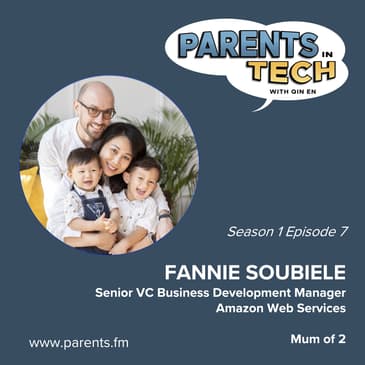
Stimulating children’s minds, parenting in a cross-cultural environment, and setting clear work-life priorities. I talk to Fannie on raising two boys who are curious about the world around them while keeping up with career aspirations.
Fannie Soubiele runs Venture Capital Business Development at Amazon Web Services in ASEAN where she helps businesses scale and realize their potential. With a wealth of experience in startups, Fannie was COO of JFDI.Asia, one of the first startup accelerators in Southeast Asia. In 2020, she was recognized in Prestige’s 40 Under 40 List.
Fannie and her husband learn to manage cross-cultural differences in parenting through experts’ advice, research, and open conversation. We discuss ways to encourage children’s curiosity by exposing them to diverse experiences: learning different languages, visiting the zoo (and the benefits of an annual membership), reading bedtime stories, and traveling abroad. Fannie explains how planning ahead and setting priorities help her balance motherhood with career ambitions.
To get in touch with Fannie, find her on LinkedIn https://www.linkedin.com/in/fannie/
Mandai Wildlife Reserve
https://www.mandai.com/en/memberships.html
Don’t forget to head over to www.parents.fm to stay up to date with new and previous episodes, join our community of parents in tech or drop me a line. I’d love to hear from you!
Thanks for listening to the Parents in Tech podcast with me, your host, Qin En. We hope you were inspired on how to raise kids and build companies. To catch up on earlier episodes or stay updated with upcoming ones, head over to www.Parents.FM to join our community of parents in tech. There, you can also drop me a question, idea, feedback or suggestion. See you next time!
Transcript
00:06
Qin En
Hi, I am Qin En. And this is the Parents in Tech podcast. Welcome to season one, where we interview mums who are technology company leaders based in Southeast Asia. We want to hear stories, hopes, challenges, and tips from moms who are raising kids while pursuing their career aspirations. In this episode, we speak to Fannie who runs the start-up business development function for Amazon Web Services in ASEAN. I first met Fannie when she was COO of JFDI.Asia and one of the region’s leading start-up accelerators. She was one of the few who took a chance on my co-founders and I. Since then, she has been recognized as a rising leader in tech, including the recent Prestige 40 under 40. She has two sons. One is three years old and the other is 16 months. Hi, Fannie. Welcome to the Parents in Tech show. To begin with, can you tell us a bit more about your family?
01:10
Fannie
Hello, Qin En. Sure. I have two kids together with my partner, of course, my husband. The two little boys, with one being three and a half years old at the moment, attending a preschool now. And the other one just turned 16 months. So, two little boys at home with one big boy, which is my husband. I’m like the minority in the family at the moment.
01:35
Qin En
Very nice. Your eldest son who is probably starting to expand his mastery of English language, how do you explain your job to him?
01:45
Fannie
Wow. I’m not there yet, but if he were to ask me, “What is mommy doing today?” I will probably say, “I helped a lot of different uncles, aunties, gor gor and jie jie to help them dream big and make the dream happen. That is probably how I would describe it to him. I’m not sure if he will fully understand that, but I think he’ll definitely understand how I am helping the other people who are, having a big dream. This is what he always talks about at night as well before bedtime.
02:16
Qin En
Oh, that’s so beautiful. I love how it’s centered around dream. What does he talk about at night about dreams? Does he talk about what dreams he wants to have for that night?
02:25
Fannie
Not literally in the future, but it was basically a lot about nightmares. That’s number one, because he’s still a little afraid of darkness. I don’t know where he learned that from, but he thinks about monsters. And when there is some background sound like the neighbors walking past, he’ll be like, “That must be a monster outside, mama.” It changes every day from monsters to dinosaurs, sometimes good stuff. Like, it could be, “The stars are pretty bright today”, and “I love the moon because today it’s round.” Dreams in that sense, but not so much about, ‘What do I want to do when I grew up?’ yet. Although we’re trying to instill that through our bed time storybooks, just to get him exposed that he could do anything he wants, basically. He just got the dream beat. That’s something that we’re still working on. Hopefully someday he will be able to articulate what he wants to do when he grows up.
03:21
Qin En
I’m sure he’ll get there. I love the routine that you guys set for bedtime stories. Maybe tell us a bit about these kinds of routines right. For example, telling bedtime stories. How did you develop this? When did this begin?
03:33
Fannie
From day one. I think we started I guess, the day he came back home from the hospital. Day four, I think that’s critical in my husband’s culture, not so much mine, that reading started really early for him. Just exposing them with books, different stories, even though they may not understand at that particular age, the fact that they’re listening and hearing to your voice, those are just really important milestones. And actually talking about voice, I probably started that way before when I was still pregnant. I was reading Dr. Seuss book. They say those are really good books for pregnancy. And I started buying that and just reading aloud during pregnancy itself. That was quite an interesting experience for myself. I’m not sure if anything happened, but at least for my own entertainment, it was a good book to read.
04:26
Fannie
And reading out loud is something that probably most adults these days are not used to. But yeah, it was pretty good. It’s always highly recommended if you haven’t tried it. He actually loves the books now. Sometimes he would just say, “Hey mom, I want to read this particular book.” One of his favourites was ‘Green eggs and Ham’. If I remember correctly. He’s always asking me to read that particular book. But yeah, ever since every day, every night, our routine is to read one or two books. Sometimes he might negotiate for three or four, but I’m like, no, let’s stick to one or two. And we could probably speak in different languages. I may do like Chinese books today, English books, or different languages on other days. Just also getting exposed to different culture and different languages. So, he knows that stories come in different languages and cultures as well. Sometimes they may be the same or even different. It's really up to him how he wants to interpret it.
05:20
Qin En
I love that diversity of variety. And it almost is like a reminder for me. Because I do read to my kid and I do talk to her, but all in English. But like, yeah, maybe I should mix it up a bit.
05:32
Fannie
Yeah. I think having diverse language is important, at least in my family. Because my husband is non-Chinese. I want to make sure that he gets exposed to his culture as well, which is French in this case. At the same time, I'm also actually half Indonesian. So, there is a little bit of Bahasa involved, given my parents speak to him at home sometimes. So, he does understand. Surprisingly, I guess, he really understood the different languages and actually the translation. He would say, “Mama, you're not speaking French because you are Chinese”, or rather “Papa, I want Chinese book today. I want mama to read instead of you.” He understood those differences and sometimes he would even translate the sentence to me in exactly what the father was saying to him and translate it to English for me. That was really interesting when he first did that. I was like, wow, two years old can start translating between French and English. That's good to know that he can do that.
06:33
Qin En
Wow. That is such a pleasant experience. It's almost like kids at this age when they're young, they’re like a sponge. I'm sure if you ask us to learn new languages now, I think we will take a lot of effort, a lot of pain.
06:43
Fannie
Yeah. For now, they are not asking why they’re doing this or why do they have to learn. They just accept and do it, which is the best time to probably get them exposed to a lot of different, interesting things because they are just so hungry and eager to learn new stuff, basically.
07:01
Qin En
Yeah. Fannie, how do you constantly discover new ways to kind of engage and satiate that curiosity?
07:07
Fannie
Well, this is a big topic. I don't think I have a structured manner around that. Perhaps it's more around the activities that we do daily or on weekly basis. Not only through book, but I get him to learn about different things or we visit different places. Fortunately, pre COVID time, we managed to travel quite a bit. His first country was Hong Kong, two months old, and then we've been traveling quite a bit after. He gets to see, well, maybe not understand at that age, but at least he gets to experience maybe as simple as cold or snow or even people of different skin tone and languages. The people behave differently for a specific activity. Like the way they eat or even the cuisine that we eat at different places. So, those are just great experiences. But these days it depends on that. Especially my younger one who hasn't really been to anywhere, we try to do something different every week in the weekend, especially I guess in Singapore, not a lot of occasions, but we try to do, for example, visiting the farm, the zoo. Zoo is best because they get to see so many different animals, different experiences, bird park, art and science museum. I'm sure you know there are a whole long list of things that you can do in Singapore with children. Having those kinds of interactions and activities would definitely help to open up their mindset and see the world differently, hopefully with some explanations on your side that they could understand.
08:38
Qin En
Certainly. It's all about the 3D world. Not just on a screen, the 2D, but just being able to see it. Did you get a Zoo or a nice safari membership?
Fannie
Of course.
08:47
Qin En
Yeah. I recently heard about it. I also got it. I was like, yup. It's the kind of thing that I feel like you don't really think about when you don't have kids. It's like, why would anyone pay for a membership? Why would you go more than once in five years?
09:00
Fannie
Yeah. It's really nice because if you don't know what to do on Sunday morning, we’re like, maybe we should just go to the zoo because we have a membership. So, why not? It could be just one hour or a half day trip rather than spend the entire day in the zoo, because I don’t want to explore the entire place. But now we probably just do one section each time we go, just so we can do more things at a particular section rather than trying to finish everything that they have, like catching all the shows that they have or making sure that we don't miss any feeding times. That’s still not the discussion at the moment, now that we have the membership. Those out there who haven't been to the zoo or haven't gotten the membership, I would suggest you to think about that. It might be a useful investment for sure.
09:46
Qin En
Yeah. Well, I feel like the wildlife reserve should pay us for this commercial.
09:50
Fannie
Doing some marketing for them.
09:53
Qin En
I know. But I fully agree. I think all that programming and just being able to expose them to nature, which is sometimes quite hard to get over in Singapore, that truly is so valuable. Now I'm gonna circle back a bit, right? You say the first trip your son took was to Hong Kong at two months old. Why? What was the thinking behind that? Usually that's when, I guess, the confinement nanny would just leave. What happened?
10:15
Fannie
That was pure practical reason. It was a business trip for my husband. I'm like, “Hey, why don't we just try for the first time, a family trip with a kid? Because we were first time parents. He's two months old, so basically there’s nothing much he would do. Because he's not crawling, he's not running. From what we heard from our friends, our parents friends, that is probably the best time to travel because it's a lot lower maintenance compared to a toddler who may ask and demand more in terms of, “I want to check out these toys”, “I want to go to this”, “I want to buy that or the eat this.” A two-month-old baby, besides breastfeeding and drinking milk that’s just about it. We just need the take care and make sure that he gets his nap or enough sleep throughout the day.
11:03
Fannie
It was an experiment for us to really kind of see and try what's the experience like. It was just a few days, I believe it was five days. It wasn't that bad. Since then, we did quite a few different trips. We did a crazy one. We drove to Cherating Club Med instead of choosing to fly there. I'm not sure if that was a wise decision because it was a 12 hours’ drive to Cherating, Malaysia for those who don't know. When we reached there, the club med experience was definitely great. That was when he first started walking and he started to not be afraid of water. Because he started learning how to swim at four months as well. So, he was very comfortable with water. Yeah, the trip was really pleasant to these different places. We were in London as well. In Jakarta, of course, because that's where my family is.
11:50
Fannie
So, pretty interesting trips, definitely with a one kid family. A trip like that wouldn’t promise for those who have more than one, because I only tried that once recently when were for a trip to France just few weeks ago with two cakes. I wouldn't say it's a nightmare, but it's definitely not an easy one when you have two kids in the plane, especially a long-haul flight. Just want to double click on that and think twice before you decide any VTL flights that you have planned for Christmas or what not.
12:22
Qin En
I love that. Okay. Tell me what happened on a flight that made it tiring to say the least?
12:28
Fannie
It's probably my first long haul flight that I couldn't finish my movie. I mean the screen is just a screen. It doesn't help in any way. I think for the older one, at least he starts to know these cartoons or shows. He gets to entertain himself for a little bit of time. I'll leave some nice, cute shows on the screen. The younger one, he doesn't know that. All he knows is, “I just learned how to walk. So, let me walk around the plane.” He goes, walking round and round the plane, meeting different people, just touching them like he knew them and making friends in the air stewardesses. I don't know, trying to get more drinks or snacks from them. Like 12 hours nonstop walking around the plane. I'm glad it wasn't that full, but I've definitely made some friends during the flight itself, given his social skills and how he just interrupts people in the middle of their sleep, which is not so great. Yeah, it's essentially a lot of walking instead of sitting down and watching a nice movie when you were still single and alone.
13:39
Qin En
That is hilarious. I can imagine that. Now, I feel like when my daughter walks and even just in an open environment, I’ve to constantly fend her for just going to touch people. I think in a cabin that would be even more challenging. I’m curious. Especially because you travel and there’s VTR arrangements. Were there concerns over, I guess, COVID and health in general? Because of course in Singapore, it's contained. I would say it's well managed, but the considerations of travel and all of that, what were some of the thoughts?
14:10
Fannie
Definitely as a concern. Because no, they're not vaccinated. We really don't know what is a situation out there. I mean outside of Singapore, we are just not very familiar. You can hear all the news you want about what is the reported number of cases or whatever measures that the country is making. The fact is it's really up to you as a family to be disciplined enough on what you need to do or what you don't want your kids to do. For example, just making sure that you wash the hands often, especially when you come back from outdoor activities. For example, making sure you sanitise your hand before having food intake and just be more aware on your surroundings. We try to avoid crowded areas. At least that's the number one thing and just go to a more open area, to the park or to outdoor playground rather than any indoor playground.
15:01
Fannie
I mean, we don't have to be told. I mean, life still goes on. So you still need to live a life and have the kind of social interaction with some of the kids that you see in the playground. That's fine. It's really up to you as a parent on how you manage the kid’s expectation, not exposing them to too much excitement in the wrong area where it's so crowded with other kids. Maybe that's something that you probably need to plan a little bit in advance before you go to the particular place, for example.
15:29
Qin En
True. I think that's golden advice. I think being thoughtful about where the places you go, what times ago go, I think that makes a huge difference. For those parents, especially with young ones who are thinking about traveling, what's maybe one or two tips or advice that you might have for them?
15:45
Fannie
Depending on the country they are going, definitely check and do your homework. There's a lot of information online. Whether is it from the government themselves or other sources of information, definitely do your research. That's something that is really important as a parent to know what is the requirement. Because sometimes you might miss some details, for example, taking any of PCR tests or whatnot. But more importantly for the kids, I would say, be disciplined in terms of hygiene. This is just self-hygiene. You can't depend on external factors. I don't think other countries have the same mindset as Singapore, if you are very used to the restriction or the limitation that we have here. So, adapt to it. That’s totally fine. But just be aware and be mindful about that so that if you see anything weird or something that is out of the ordinary, you know what to do. So, definitely research and self-hygiene.
16:38
Qin En
That's good advice. On the topic of research also, I think as parents, perhaps Singaporean parents especially, we tend to do a lot of research on a lot of the topics. One of the things that we talked about before this was on preschool research for your elder son who started to go to preschool. So, tell me about that process. What was it like? What did you do?
16:57
Fannie
Yeah, he started the preschool at about 15 months old. We knew that a preschool typically starts around 18 months or even two years old. It really depends on each school structure. We wanted to do more research before that. We were lucky that we managed to find one that is kind of fitting the type of philosophy and the culture that we're looking for. Hence, we just send him straight because he started accepting children from 15 months or so. That's the reason why we started at 15 months old. But the whole process took a while because were the kind of parents where we believed a lot in the culture and the philosophy of the education. So, it's not just mouth feeding them, I don't know, academics like the kinds of STEM syllabus where you have to start science, mathematics from very beginning. I don't think a lot of schools do that, but some do. There are different types of pedagogy that you might be looking at, are we trying to do believe them.
17:56
Fannie
Maybe those are the things that you might want to read through and discuss with your partner. Is this the kind of philosophy or the pedagogy that you're looking after or going for? And after that really, it's all about logistics. How far is a school? Are they feeding the kids the right things? Is that what you're particular in? Is it convenient for you to pick up the kids or fetch them from school? Is it near the MRT? All these things kind of come into consideration. I think I literally did a matrix around that, with all the criteria and how important are all these parameters, compared to what we were looking for and give them like a scoring. Definitely school fees will be one of them. I mean, practically, that's really what it comes down to. We have everything that you want. That's the school fees. It's kind of the budget that you have for the kids.
18:43
Fannie
All these things came down to a few options. We did a couple of school visits, talked to the principal or the teachers, kind of observed how they teach and everything. Yeah, we came down to one finally and glad that our kid loves it. He's still at the moment in the same school. Hopefully, the younger one will be able to join him, maybe next year in the same school as well.
19:06
Qin En
That’s nice. You mentioned about that philosophy and culture that was important, trying to avoid those, it's almost like the very Singaporean competitive style. We’re like trying to prepare you for the one. What kind of philosophy or culture were you looking for?
19:19
Fannie
For us, we will be looking at more creativity and playing, allowing the kids to really imagine and do what they want rather than being asked what they need to do. Having that play element, we thought it was important. Like, just outdoor play. We thought it's super critical, especially depending on the kid's personality, ours, oh my, he is such an active kid. We probably definitely need to send him outdoor every single day to get those energy out. If not, we will struggle at home. We want to make sure that he has those opportunities in school. Which in this case, we do have. I mean, it's not a big playground, but at least there is just another playground out there for them to do crazy stuff, from water play to sand play to running around and just obstacle causes or whatnot.
20:10
Fannie
I have no idea what other things they do, but there is that outdoor session that they allow. I think for my kids, it's also a bit specific because my husband is French. We were looking for schools that may be able to kind of deliver French as a language for the kids. And not many schools in Singapore offer that, but there are some. So, we managed to find one that is not too far away from our place. And they do trilingual, which is amazing. It ticked all the boxes for us. They do a Mandarin, French and English, which is exactly what we were looking for. Although we have to compromise a bit of things. It's not exactly like a walk to the school. We still have to drive there, but it’s not that far. If we get that kind of trilingual kind of culture that were looking for, I think were willing to make the 10 minutes’ drive to the school every morning. I think that's something that we will be more than willing to compromise. Having that priority scoring again, that was critical. I think for us, the scoring for distance was less important than the pedagogy and the culture. That's why we attended and chose that school.
21:16
Qin En
Makes sense. Language is so important because it connects us to our culture, to our roots. What is it like to be a parent in a cross-culture environment?
21:25
Fannie
It's interesting. I'm learning myself a lot from the kids as well. Like I mentioned how they pick up language so easily and able to translate that not only to the parents, to the friends and even now to his younger brother, which is really interesting. For us, we compromise and understand each other's culture, the roots, the belief, and we kind of rationalize what do we want our child to be. We expose them, for me to Chinese culture and for him, the French culture, how do we do things differently, and just let him see the differences and choose what he believes or how he wants to react to that. We don't have a magic formula to kind of tell our kids what they need to do, but it's more about getting them exposed. For my side, for example, they spent quite a lot of time with my parents.
22:17
Fannie
So, I was lucky to have my parents to help take care of kids during office hours. Like for now I'm working at home quietly with my husband and happily playing with the grandparents in another location without having to interfere us or us dragging them to just hiding in one room and play. Spending some time with my parents really helped because then they get the Chinese culture exposure and a bit of a Bahasa. Like I mentioned, I’m a bit of Indonesian. Eating Chinese food or eating French food, I'm glad they don't have a preference. They love, Chinese food, rice, porridge to pasta and cheese. So, that's great. Understanding the differences in cuisine, especially for French, we have a huge focus on cuisine for the kids. I'm glad this cuisine is being covered and they're not particular about that.
23:08
Qin En
That's nice. And especially food is one of the topics that give parents the most headache. Because kids, they always want variety. I guess, in terms of parenting styles, Fannie, I would love to hear, as you went and bought on this journey of parenthood, were there any surprises or differences in terms of the way you parent versus the way your husband parents?
23:30
Fannie
That's a topic we talk about every day. Literally just this morning we were talking about how do we go about disciplining the toddler. In toddler stage, there's always a lot of different challenges. It could be a meltdown. It could be just a variety of different things. At the moment we are going through, how do we manage meltdowns. And we have different philosophy. How in Chinese culture, not all parents, but most parents at least from the friends that I know, more about say disciplining the kid in the different way. Perhaps slightly harsher than the Western culture. I grew up with my mum caning me, for example. Like canes pretty common in Chinese culture. Whereas in French culture, he'll be so shocked that my mom used cane on me. He just couldn't wrap that around his head and couldn't understand and accept that this happened.
24:21
Fannie
He doesn't want that to happen to the kid. I mean, yes, I don't agree as well. There are different reasons for that. We have a lot of research that to talk about how do we manage meltdown. And definitely having the kind of harsh discipline is not the solution. We just have an open discussion and talk about it. I think the important part is really having different opinions, advices from professionals. So we also discuss with the principals and schools, teachers, and talk about how do they usually manage this. They have the experience, they see more kids than us, some even more difficult kids than what we are facing right now. So, do you have the right tips? And that's how we resolve that. That could be one slice in terms of just managing the way you want to bring up your kid in terms of discipline.
25:09
Fannie
One important or interesting one that I want to bring up is, I think we are quite lucky in the sense that we both have an elder sibling. My brother has three kids as well. My sister-in-law, she has two kids. Both about the same age around nine and seven or six. We get to see how they bring up the children and then learn from them. Like what is the best way or best practices? We realize, one being French family and one of the Singapore and Indonesian family, although they are the same age, but they turn out to be quite different, completely opposite. I would give an example. My nephew is nine years old now. My niece in France, she's also nine years old. They’re so different. I guess maybe besides personality, I won't touch that because everyone's just has different personality, but the way they were brought up, my nephew is pretty IT savvy. He has his phone and his iPad.
26:03
Fannie
He plays roadblocks, just the usual tech stuff that we know in the tech world. The niece in France, I wouldn't say she's not tech savvy. I'm sure she is. But because she wasn't brought up in that environment where she gets an iPad or a laptop or a phone, she was very happy with playing board games during the holidays and card games. And that's what she loves doing. Now, she got a present. What was it? IQ test, where you have to solve problems with different maze. It was a 3D structure basically. And she really loved that. She reads her own books. Physical books, not Kindle. She enjoys doing that the whole day. I don't see my nephew doing that at all. I think he would just go crazy without his computer. That was interesting on how you bring up your kid.
26:53
Fannie
It really depends on the environment. I was just discussing that with my husband. What does it mean to us? How do we want our kid to grow up in the future? There's no conclusion. I think it really plays by year, on the environment or even the school interaction that they have, or the friends that he hangs out with. I guess we want to give him the options to expose him and see if he enjoys it, and that he gets to play with their cousins and understand that different cousins play different toys. For the moment, he enjoys both type of games like the offline and the online games, which is good to know. To be honest, I still don't know how this will turn out, but I just wanted to say, the upbringing of your family really has an impact in the way you grow up and play. That is important for all parents out there who are listening.
27:43
Qin En
Absolutely. It's about being aware, being open. I think also there's this sense where kids can grow up in different ways and that's still going to be fine. There's not one way that's better. I think that one of the things that even I myself sometimes fall victim to is the whole idea of comparison, or even seeing almost like a model of what things should be, and then trying to kind of work towards it. But I think, it's very different, perhaps that's a lot of what our parents' generation had in mind. But I think that clearly is quite different these days. I also noticed you're very engaged. I love the part where you say you don't just figure out things with you and your husband. You take the effort to go to school, to talk to the parents, the teachers, of course they do this as a profession. How do you do that on top of managing your career aspirations and the busy-ness of working at Amazon?
28:31
Fannie
For me, it's really prioritization. I think that's a key thing that I've learned at least in the past three to four years, having children now. You just got to prioritize. I mean, work is important. Family is important as well. I don't think you need to choose either-or. It's like they say, a work life harmony. And at a certain level at your workplace as you climb the ladder or when you hold more responsibilities, it is the fact that you might spend more time maybe talking to an important client, trying to close a deal. It is an important moment like your kid's birthday. You probably don't want to miss that or like a parent's teacher day or whatnot, that you definitely don't want to miss that either. So, really prioritize and plan in advance as you grow with more responsibilities. Planning is important, too. As basic as calendar management. I’m guilty myself. I got to admit this and it’s really bad. I forgot to pick up my kid from school.
29:26
Fannie
That's like the worst thing ever that could happen to any parent. I feel so bad and guilty ever since. But I should have known that the parents were not available to pick him up from school. I should have put that in my calendar instead of just going through my work calls. And I totally forgot about my son waiting alone in school. The teacher had to call me, “What’s happening?” That is just not great. And he wasn't crying or feeling disappointed. He was playing, but things could have been worse. Really prioritize and plan in advance with the responsibilities that you're carrying as you grow in your company. Career is important. But definitely remember that family is important as well. I try not to work in the weekends for example. Because that's really the only time where I can spend full days with my kid. Monday to Fridays, you basically only spend time in the morning and in the evening, putting them to bed with a story. That's really about it.
30:21
Fannie
I mean, that's literally less than two, three hours of the day. And you don't get to see how they develop throughout that day. That's really the majority of the week. You definitely want to spend the whole of Saturday and Sunday with them. And it doesn't have to be just them. To be with your friends, making sure that yes, you’re living a good social life with the friends that you hang out with or having some play dates if you've had. If you're lucky enough to have those friends who are of similar age, kids that hang out together, I think that's the ideal scenario. Really planning those play dates, planning going out to the zoo or other activities. Those are great fun family activities that you will remember as you grow older about the quality times that you've spent with them.
31:02
Qin En
Certainly. I think drawing those boundaries and sometimes even communicating them with your team. I think people these days are pretty understanding. I think the biggest challenge, I find it with my own self, as well. The sense that I want to get things done. Sometimes you got to really draw that. Yeah.
31:18
Fannie
And it’s totally fine. You could just take a break. Like, sometimes I really go to work late because I just got to close this deal. And maybe instead of spending two hours in the evening, I spend one hour and tell my husband, “Hey, I really got to get this done by today.” Then you put the kids to sleep, I go back to work. It's no big deal. I mean, it's really up to you how you want to manage your time as long as you get the job done. I believe most companies are like that these days. I guess, do spend some time with the family, whether it's your husband, your spouse, or just the kids. But also make sure that you finish what you have promised your people, whether is it the team or the family when you set out something to do.
31:58
Qin En
That's a golden advice. Now, one kid versus two kid. Is it double the work?
32:05
Fannie
Is it double or exponential? Well, I guess there's pros and cons. I guess having two boys, maybe it helps because there's a lot of common toys that you get to play. I don't have to buy new toys. I mean, I'm buying new toys that are different, so they get even more interesting and diverse toys that they can play together. I wouldn't say double the work load. I wouldn't say work load either. But two kids are definitely more taxing that one for sure. I'm not going to deny that. Especially when the younger one is still waking up every night for milk. That's definitely really tiring. But it really helps to see how the older one is taking care of the younger one. That is super interesting. I never really thought about it when I was pregnant with the second one. Like the older brother now is just helping to bottle feed the baby or try to help throw the diapers or try to make sure that he is taking care of the brother while the parents are busy doing other stuff.
33:05
Fannie
Those are great help because they are peers. The younger one would kind of look up to the older brother and see what he's doing and learn from each other. Obviously, there will be fights and it's starting already. Sometimes it can be really frustrating that you can just have one toy. You need two of exactly the same toys so they don't fight. I think the golden moment is really when they play with each other. That's really heart-warming. It's really nice to see how you get to play with each other rather than just playing yourself with a toy.
33:36
Qin En
Well, Fannie. Two kids vs. three kids, any thoughts on that?
33:39
Fannie
Oh, wow. I did think about that, but that might be a bit too much. I think my husband's still trying to convince me that the older one will take care of the younger ones and it's going to be amazing. He's just not there yet. I got to make him try harder on me.
33:54
Qin En
Okay. Got it. Fannie, I saw there's something very interesting. Which is when you were on maternity leave, taking care of your second child, you also embarked on AWS solutions architect certification, which is fascinating. Because as someone who built your career primarily in tech, but non-technical direction, what led you to take this on, especially at a time when I guess you could rest or you could chill? What was the thinking behind that?
34:21
Fannie
I think for me, it's all about learning and being curious. We should find a leadership principle in Amazon actually. I always like to learn something new. And I felt from experience in the first pregnancy, at least at the point of time, I was thinking I do have a lot of time during the maternity leave. The first time, I actually did not have a confinement lady. But I was lucky that my first kid was quite nice. He sleeps all the time. There's really nothing much to do besides breastfeeding and making sure that I eat properly and that’s about it. I was looking at various different things to do. During the second pregnancy, I thought I'll be more structured this time around. I saved lots of podcasts, books that I want to do. I'm like, hey, why don't I just listen and watch the videos of all these AWS services that I've been really keen to learn, but I didn't have time to learn during the work itself? Especially for mothers who are still breastfeeding or pumping, you should probably know when, during breastfeeding on pumping, this really nothing much are doing, especially at night when your husband is sleeping too.
35:21
Fannie
There's no one to chat. The lights are off. Also, it's really hard to read a book. The only time you can do is play with your phone. Sometimes you don't get dumb by just playing games or just going through social media. I started watching all this and I'm like, hey, maybe it's about time for me to do something more challenging. I run through the whole video curriculum. That I could try some of the exam questions. Hey, maybe I should just go for it. I'm really lucky that I went through these at first try and I passed it. That was surprising to me, but I'm glad I did it. Finally, after few years in the company, I managed to get these certifications I’m really proud of because it's not easy at all. It was really tough. I got a lot of support, tips and tricks from the company itself, from the friends that I have, solutions architect friends and colleagues. That was a great moment and the milestone for me. I'm pretty proud of that.
36:17
Qin En
Yeah, definitely huge. Congratulations. I think like you said, it's not just the cert itself, but really the journey that you took and being intentional about it. So, for moms and especially new moms who might potentially want to use these opportunities to grow and to take on additional courses, what kind of tips would you have for them?
36:36
Fannie
Oh, it really depends what you want to do and where your passion lies. For me it really is to upscale myself because I know I wouldn't have the time when I go back to work. In fact, I use that time to kind of catch up with my crypto knowledge, for example. I mean, it's such an interesting topic. You never finished learning about what's happening in these industries. A lot of resources out there. And I feel one more tip that I should tell parents out there, the AirPods Pro is really helpful. Now I don't have a cable that is tied to my phone and I can just do whatever I want while listening to a podcast or a video that. Those are super amazing, especially, I'm sorry, I got to say this again, especially when you're breastfeeding, it gets in the way. And the ear piece is amazing.
37:22
Fannie
That's how I managed to just really catch up with a lot of podcasts and a lot of videos that I've been wanting to learn. But be prepared, do your research. I'm sure there's a ton of things that you've been wanting to listen to. Even Ted talks, for example, are one of my favorites, to listen to. All these amazing speakers on the specific topics that you just probably wouldn't have so much time to spend on when you're in the full day or full-time work.
37:47
Qin En
So true. Fannie, we started this conversation talking about books. If you were good to write a book for your children, what would it be about?
37:57
Fannie
A good one. That would probably be the most practical one. I’ll put all the learnings that are one my children to know into the book. And so far, all the books have been pretty amazing in teaching the children about specific things. It could be as practical as like, I don't know, toilet training. Those are great books. Like it was precisely the books that I borrowed from the library, for example, on toilet training or for how to brush your teeth or for showering, or just basic things like that, to read them in the book. It's so much more interesting than us telling them what to do. If I were to write, I'll definitely write a whole series of ‘What you need to learn’, but in the children manner. They will be definitely absorbing that in the more interesting manner, from practical ones that I mentioned, but all importantly, just interesting educational materials that will help them in getting the kind of exposure that you normally wouldn't get if you were to just tell them through day-to-day conversations.
39:00
Qin En
True. Conversations, easy to forget. But a book, you memorize it. I wish that you'll find the time, hopefully at some point to start putting those thoughts.
39:09
Fannie
Lots of drawings too for having those kinds of visuals. It’s important.
39:13
Qin En
Yeah. Certainly Fannie, to wrap up our conversation for today, if there's one lesson you learned as a parent in tech, what is it?
39:20
Fannie
I'll come back to the word ‘Prioritize’. I think that's really the key, at least for me to know how to prioritize between different things. Whether is it urgent, whether it is it not, how important is this. I don't want to be saying that family comes first. Yes, it does. I know personally that sometimes there's some urgent work that you really need to attend. You're the one to be on the bottleneck and that's fine as well. But plan in advance, making sure that someone else in the family, whether is it your spouse or other family members would be able to help attend the children, for example, before you dive straight back into the work. So, prioritize and planning is definitely a critical trait for any parent in tech.
40:07
Qin En
I think just over the past conversation, you shared so much tips and advice that I'm sure would be helpful to the audience. For the mums and dads who are listening, who would be interested to connect with you, how can they best do?
40:18
Fannie
I have a lot of connections on LinkedIn. I'll really love to connect over that as well if anyone wants to just find me there. Just say that you are listening to me in Parents in Tech, I’ll love to connect with you there.
40:30
Qin En
Well, thanks so much for taking time off, Fannie. It's such a joy to have you on the show.
40:34
Fannie
Thank you for having me.
40:44
Qin En
Thanks for listening to the Parents in Tech podcast with me, your host, Qin En. We hope you were inspired on how to raise kids and built companies. To catch up on earlier episodes or stay updated with upcoming ones, head over to https://www.parents.fm to join our community of parents in tech. There, you can also drop me a question, idea, feedback or suggestion. Once again, the website is https://www.parents.fm. That's all for this episode, folks. See you next time.